
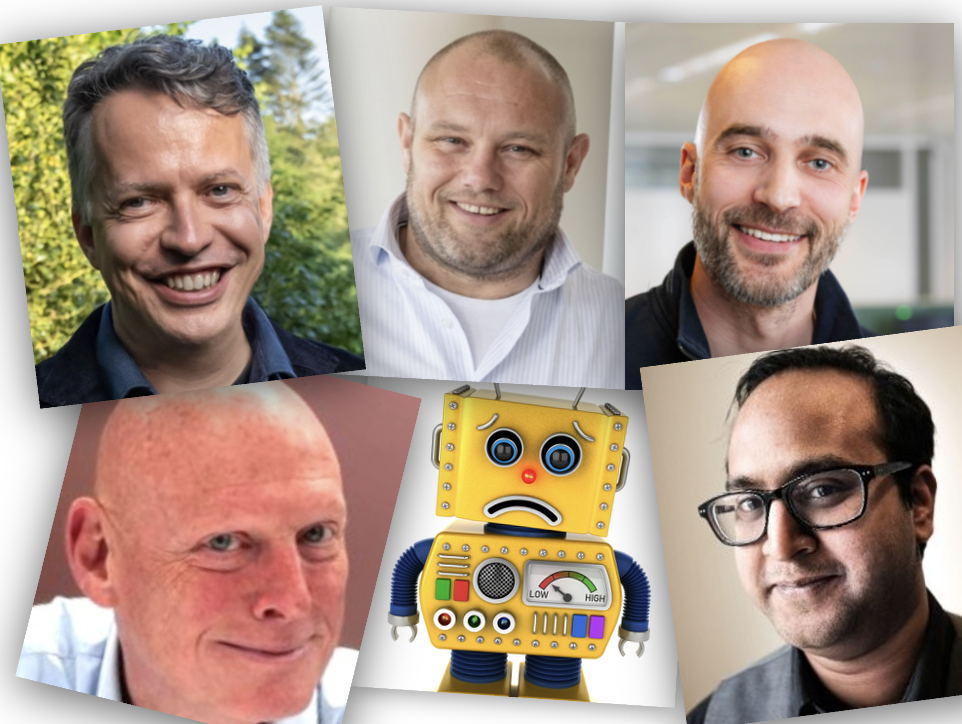
 Chatbots score poorly with consumers, and yet they are said to capture many questions. Bad bots are said to say more about the organization and implementation than about the technology. At the same time, examples of good bots are not easy to come by. So what is the deal? Ziptone listed seven myths surrounding chatbots and then asked experts to respond.
Myth 1: You have a conversation with a chatbot.
Chat stands for 'a little chat'. However, most chatbots translate the customer's question into a (looked-up) answer. That is different from a conversation. Even if a bot operates based on an LLM, there remains a difference between language proficiency and conversational skills: an LLM formulates more fluently, but under the hood still retrieves a passage from a knowledge base (with or without the help of RAG) and frames it into neat sentences. More fluent answers are not a conversation.
Moreover, a normal conversation is based on two-way communication. A bot rarely asks a clarifying follow-up question or seeks context (“do you mean this month’s invoice or last month’s correction?”). Bots are not satisfied with just half a word from the customer and can rarely change the subject within a conversation. They also have no memory for customers, rarely sense the sentiment of a conversation, and usually do not have access to customer data, context, or current events.

Jos de Jong, PWN
According to Jos de Jong (conversation designer at PWN) a well-built and well-instructed chatbot can approximate the idea of a conversation, for example by asking good follow-up questions or by incorporating conversation history when formulating answers. “But in most cases, at its core, it remains a fancy FAQ page that pretends a conversation is taking place.”
Mark Jansen (Department Manager CX at VGZ) also believes that a full-fledged conversation rarely, if ever, takes place. The fly in the ointment is often that customer-specific data cannot or may not be used. “How effective the conversation will be depends on how personalized we can make the answers.”
Robin van Dorland (Interim Manager & Program Manager): “Technology is no longer the limiting factor. Language-based bots, which have been widely available on the market since 2024, do ask follow-up questions and retain the context of a conversation. Once connected to the systems, they can access a client file or schedule an appointment.”
Tom Webbink (Customer manager Qbuzz) clarifies: “You can indeed teach an AI agent a specific behavioral pattern: how to behave in a particular situation, which signals to recognize, and how to respond to them. For example, you can have the agent recognize sentiment and then let the agent determine what is most appropriate in that situation: answering themselves, providing additional information, responding more empathetically, or escalating to an employee.”
Myth 2: Our chatbot handles 80 percent of our conversations.
Is that so? Or can they answer 80 percent of all questions customers might ask? Many of the questions that chatbots answer were already no longer asked of employees, but were looked up by customers themselves in the FAQs. The chatbot is therefore more of a replacement for the FAQ than for customer conversations with employees. The question is at which organizations call volumes have dropped by 80 percent and contact center occupancy has shrunk by 80 percent due to the introduction of chatbots.
“The current generation of chatbots certainly does not reach that percentage,” states De Jong“The most frequently asked question to a chatbot remains 'I want to speak to an employee'. Often, the bot is primarily a facilitator that directs customers to the right place on the website. Integrations with backend systems can significantly boost the percentage, but there always remains a group of customers who simply want human contact, or who still want to verify the bot's answer. 80 percent is and remains a myth.”

Mark Janssen, VGZ
According to Janssen Adding a chatbot initially leads to more touchpoints. “The increase in chats does not lead to a decrease in telephony. We are actually seeing a decrease in live chat. If there is contact with an employee after someone has interacted with a chatbot, it is often to get confirmation that the bot's answer is correct or for clarification.”
At Qbuzz An increase in the use of chat was accompanied by a decrease in the use of web forms. “The bottom line is that this means less direct contact with employees,” says Webbink. After using a chatbot, some customers still look for confirmation; but there are also customers who are less digitally skilled or who simply do not take the trouble to look for it themselves. They prefer to send a message in the chat or via WhatsApp. “So AI not only takes work away from employees; it also changes the way customers seek access to information.”
According to Nadim Zaman (Director Global Business Development at Vanad Interactions) states that FTE reduction is only one of the possible business cases for the deployment of chatbots, just like absorbing strong growth without a proportional increase in the customer service operation's personnel. Zaman refers to successful cases where chatbots handle large numbers of customer inquiries: Vodafone's SuperTOBi accounts for 60 million interactions per month with, according to Vodafone, a 70 percent end-to-end resolution rate. Or Billie from bol, which handles 9 million conversations per year.
Myth 3: Our chatbot solves 80 percent of customer questions independently.
The supplier claims are often about containment: the proportion of sessions that end without the session needing to be handed over to an employee. That proportion includes both sessions where the customer clicks away in frustration and sessions where the customer has been helped well. Containment is not the same as a solution or an answer. Containment can even rise with a bad bot, according to Decagon's benchmarks.
The containment of Flora (PWN's chatbot, ed.) is not at 80 percent either, says De Jong“Part of this is distorted: all chats outside live chat opening hours are by definition not escalated, simply because that is not possible. But even within opening hours, we see customers who receive a generated response, close the chat, and end up calling anyway.” As with myth 2, the same applies: in addition to up-to-date sources, connections with backend systems can truly contribute to higher containment.

Tom Webbink, Qbuzz
Containment can indeed distort, confirms WebbinkThat is why Qbuzz reviews a large portion of the answered calls daily. “We look at escalations, among other things. Does the answer match the question? Is the information correct? Can it be improved? And what choices does the officer make when accessing dialogues, instructions, procedures, or knowledge sources?”
Time advocates for other KPIs for the effectiveness of chatbots: for example, true end-to-end resolution and repeated contacts. One should also look at the development of assisted volume and at CSAT/NPS. According to Zaman, vendors should be more transparent about the denominator behind percentages like 70 or 80. “Containment is not resolution.”
Myth 4: Chatbots take away many questions from the contact center.
Perhaps, but the use of chatbots can also lead to follow-up questions due to false promises, hallucinations, and references to procedures that no longer exist. Anyone who drops out of the chat and subsequently calls or emails is counted as 'successfully handled' in the bot statistics and as a new contact in the contact center statistics.
What exactly shifts between channels is not always clear. One of the rules of thumb in customer contact is that a new channel leads to more interactions. A channel that is open 24/7 and provides an immediate response triggers interactions that would otherwise never have occurred. An example of this is a customer who attempts to get an answer to a question from a chatbot in multiple ways and has multiple consecutive sessions doing so. These count as separate interactions in the statistics.
A frequently heard argument is that a chatbot contributes to your 24/7 availability. A bot that answers at night but cannot complete or escalate anything because no people are available creates a form of false availability.
At PWN, there is no complete picture regarding channel shifting as a result of chatbot Flora, according to De JongChats remain anonymous until identification is required (for example, during escalation). “As a result, we cannot yet link sessions to phone calls from the same customer.” At the same time, a chatbot has an advantage that is not mentioned: Flora can respond to current events faster than a major website change. Think of proactively informing customers who are on vacation about not submitting a meter reading on time, or informing customers in specific postal code areas before they ask a question themselves. “Those are concrete (repeat) questions that are indeed taken away from the Customer Contact Center,” says De Jong.
Webbink Van Qbuzz is not in favor of constantly adding new channels for customers. “If you have the basic performance on your most important channels in order, there is also less need for extra channels such as WhatsApp, although that depends on your product and your services.”
Janssen is convinced that a chatbot can indeed handle many questions. “You can prevent many status inquiries or hygiene contacts, provided you can organize identification properly.” As a company, you can also choose to speak to the customer personally for certain target groups and intents.

Robin van Dorland
Van Dorland: “A large part is displacement and a small part is actual reduction, but often we don't know because almost no one conducts a baseline measurement before the bot goes live. Call volume also changes due to the season, outages, a process change, or a new website. A drop after going live then says little about the bot itself. If a bot only provides explanations, it replaces the FAQ, not the conversation with an employee, and some customers will still call afterward. Real reduction only occurs when the bot can perform actions within systems. Think of scheduling an appointment, setting up a payment plan, or displaying a current status. That applies to only a small portion of the inquiries. The biggest reduction does not come from a bot. It comes from removing the reason to call.”
Myth 5: Chatbots contribute to cost reduction
A single chatbot interaction generally costs a fraction of the cost of a conversation with a customer service representative. However, with LLM bots, costs scale with volume; with classic self-service or rule-based chatbots, marginal costs tend toward zero. Hidden costs are also often overlooked or not included: knowledge base maintenance, conversation design, testing, monitoring, guardrails, legal review, and the continuous monitoring of content drift.
If the bot handles the simple questions, the remaining conversations are primarily complex in nature. This means a higher Average Handling Time (AHT), higher recruitment and training requirements, and a higher workload. Furthermore, the costs of escalated conversations with frustrated customers are rarely mapped out separately.
Webbink considers cost reduction as a possible consequence. "With the space that becomes available, you can also do very different things, such as handling first-line HR questions internally. In some situations, it can ultimately also mean that you need fewer FTEs.
Van Dorland“A conversation with an LLM costs a fraction of a call with an employee. The money goes to the knowledge base, management, and the people maintaining the bot. If the bot removes simple questions, the average call duration increases. Anyone who continues to focus on the original AHT then punishes the team for the bot's success. Therefore, adjust your KPIs before the bot goes live.”
De Jong disagrees with the assertion that chatbots do not contribute to cost reduction. At Flora, at the very least, it prevents customers from calling or emailing for simple questions. The fact that the remaining conversations are more complex does not mean that complexity would not have existed otherwise; it is rather a shift towards quality. A higher AHT is not a problem if it eliminates repeat calls, according to De Jong. “At PWN, we are fortunate that knowledge base maintenance, conversation design, testing, monitoring, guardrails, and content drift monitoring are all handled by one small team. So, those 'hidden costs' are not overlooked here.”
Janssen states that cost savings are obvious but often unclear. At higher volumes, token costs do indeed increase, but management costs decrease. If you still receive phone calls for specific intents, costs rise again.
Myth 6: Customers find chatbots super handy
Customers have no objection to a bot that reports a package status within ten seconds, or if the bot provides other appropriate and targeted answers. However, the customer does not know which questions the chatbot works well for when starting the 'conversation'. The customer must therefore first figure this out through trial and error. That process strongly resembles searching a knowledge base. Chatbots primarily lead to frustration when they fail to offer a solution or block the route to a human employee, according to a series of studies. Consumer experiences with chatbots.
Janssen emphasizes that it is important to indicate what the bot can and cannot do well. That helps customers choose the right channel.
According to Webbink Agents and traditional bots have a bad image because they are poorly configured, poorly maintained, or because the foundation of the operation is not in order. “An AI implementation forces you to get your organization in order. If your processes, knowledge, escalations, and responsibilities are not right, you might as well not turn on AI.”

Nadiem Zaman, Vanad Interactions
Whether customers find chatbots useful depends on the customer's preference, according to De JongSubmitting a meter reading via Flora works very well, even when customers ask other questions in between. “For those kinds of tasks, a chatbot is really handy.”
Time believes that we should take signals from consumer surveys seriously, but “we should not draw conclusions too easily about what the technology can do and what business impact good applications can have. There are applications running on an enormous scale from which organizations report positive operational results.”
Myth 7: A bad chatbot is not due to the technology, but to the implementation.
Naturally, careful implementation and content management are essential for a successful chatbot. Without an owner and management, a chatbot loses reliability over time. But even if a chatbot is well implemented and well maintained, myths 1 through 6 apply. The conversational technique cannot (yet) be compared to that of a human employee.
Both Janssen, De Jong as Webbink They agree: the software determines the functioning. De Jong“If a bot knows just as much about the customer as an employee, customer trust in the bot can grow – and with that, the aforementioned myths can indeed become reality.” But whether a chatbot ultimately works, Webbink clarifies, depends to a large extent on the implementation: “Incorrect information, poor answers, loops, and illogical conversations are usually not just a problem of the software, but also of the person operating it.” Continuous testing, analysis, and adjustment are essential, according to Webbink.
Van Dorland“A poor bot is due to missing connections and an outdated knowledge base. That is setup and management. You can also see this in the aforementioned Decagon figures: less than 35 percent containment among the weakest bots, 70 to 80 percent among the best. You largely create that difference yourself.”
(Ziptone/Erik Bouwer)


Also interesting
-

Better preparation for chatbot implementations, better management of expectations: homework for the market.
-
The HvA and the KSF have developed Van Bot naar Beter, a practical framework to improve the quality of chat and…
-

The chatbot has an end-to-end resolution rate of 70% according to Vodafone, and has also resulted in an NPS increase of 8…