
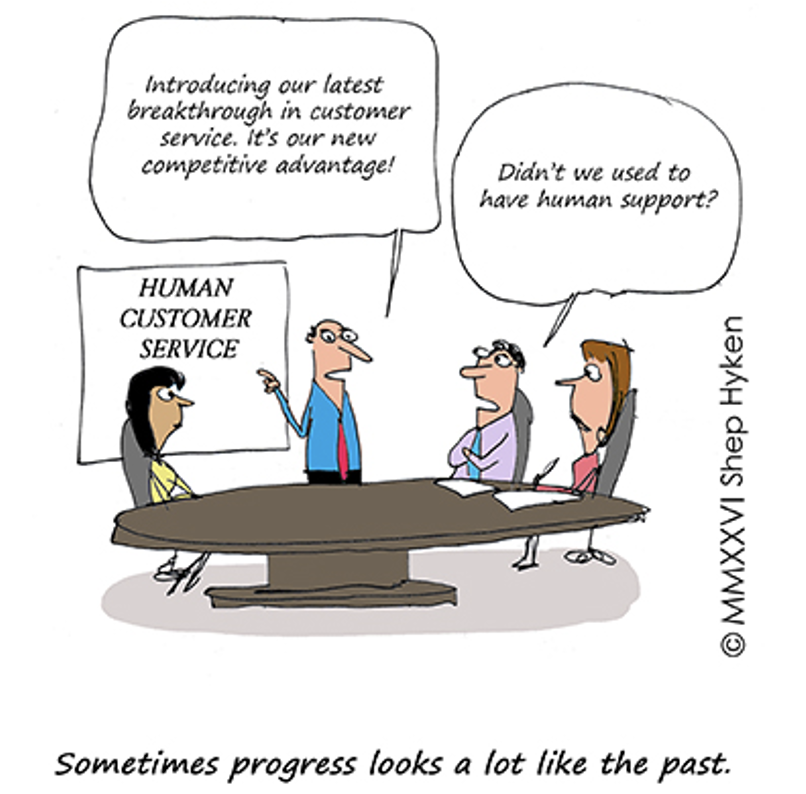
 This article answers the question: do customers want AI or human customer service? The answer: now that AI and automation are making human support harder to access, companies that give their customers easy access to knowledgeable, friendly people can turn human customer service into a competitive advantage.
Text: Shep Hyken
How often have I heard from our subscribers that the companies they call have made it impossible to get a human on the line? Of course, I don't expect you to know the answer, but there are… a great many of them!
Seriously: I receive a lot of emails and comments from people who are dissatisfied with the service they are experiencing. There are plenty of customer service horror stories, but one complaint keeps coming back: “Why is it so difficult to speak to a real person?”
Now that AI customer service and other self-service technologies are becoming increasingly common, customers are not necessarily against technology. They just don't want the technology to become an obstacle when they want to speak to a human.
I have always sent back an empathetic response, but recently I felt it was time to tackle the problem directly. Reading an excellent article by Andre Prins in his LinkedIn newsletter placed the topic at the top of my to-do list: Why the Premium Experience of the Future Is a Person Who Answers (in Dutch: why the premium experience of the future is a person recording – ed.).
His premise caught my attention. Prins argues that access to a human becomes part of a premium experience as human support becomes rarer. If companies automate an increasingly large part of the customer experience, can easy access to human customer service become a differentiating factor?
Customers love self-service, but don't want to get stuck in it.
My presence most recent research into customer service and CX possibly provides the answer. That research shows that 84% of American customers believe that the use of AI in customer service should always include a simple route to a human. And 71% of customers believe that AI makes it more difficult to reach a person.
But don't misunderstand what customers are saying. They are not rejecting technology. They love self-service, but they don't want to get stuck in it.
And this is where the idea of a premium experience becomes interesting. Prins argues that customers should not have to pay extra to speak to a human. But that does not mean that customers would not be willing to pay more for a product or service from a company that makes human support part of the experience.
Imagine two companies selling similar products. One is slightly cheaper, but if there is a problem, you have to spend time (in other words, waste time) on a series of automated options. The other costs a little more, but you know that an expert and friendly customer service representative is ready to assist you whenever you need help. For many customers, that difference is worth the money.
AI and automation should make the customer experience easier. Deploy both where it makes sense. Just remember that the most valuable technology strategy sometimes consists of knowing when to set the technology aside and let a human take over.
(Ziptone/Shep Hyken)
This article was previously published on Hyken.com


Also interesting
-

If no one answers, customers get – even if unintentionally – the impression that the company or brand…
-

There are no stupid questions, you might say, but stupid answers certainly exist. And ChatGPT is good at it, like…
-

If companies deploy AI for the right tasks, both customers and employees will get a better experience, Sheo Hyken hopes.