
Two years ago, Pegasystems introduced the T-Switch - a switch that allows you to choose the application of explainable or inexplicable algorithms in your Pega environment. This year at Pegaworld2019, Rob Walker (VP Decision Management & Analytics, Pegasystems) again discussed the increasing role of artificial intelligence (AI) in marketing, sales and service. How do we keep track of how AI determines our lives as consumers?
 Attention to the ethical side of AI is increasing: how do we know for sure that artificial intelligence makes the right decisions? A well-known dilemma is that of the self-driving car that has to make moral considerations. A second problem is bias, which was described by researchers in 2016. They let Word2vec, a machine learning solution for text processing, search for interrelated concepts. They used Google News as a source and came up with relationships like 'father-doctor', which Word2vec answered with a 'similar' relationship like 'mother-nurse'. So there seems to be a bias in the sources used by Google News – bad news for the tech world that could use some diversity, says Walker.
AI can easily trick us
AI has been able to for a while now fake Rembrandts to make, but also portrait photos of people who don't exist, and which are indistinguishable from the real thing. Walker also asked his audience what happens when an algorithm is built in that it has to evolve by independently taking over parts from other algorithms.
However, not all AI applications are developed to make life-defining decisions. AI can also play a role in how companies do business with their customers. But here too, ethical decisions will increasingly have to be made. Which context is and is not taken into account when accepting a customer or making a suitable offer? Regardless of who develops an algorithm (human or machine), algorithms should be fairly explainable, robust and traceable, Walker argued; only then can you build outcomes that are trusted.
What yield should Next Best Action generate?
Later in his story, Walker made the link with profitability: a next best action, generated by AI, can lead to maximum yield. But what if customers might get into trouble as a result? In Walker's view, profit maximization is almost never empathetic; an empathetic company chooses the relationship in which the context of the customer is taken into account. That context contains many factors, including timing and situation – for example, it takes little empathy if you approach someone whose house is on fire for a new mortgage offer.
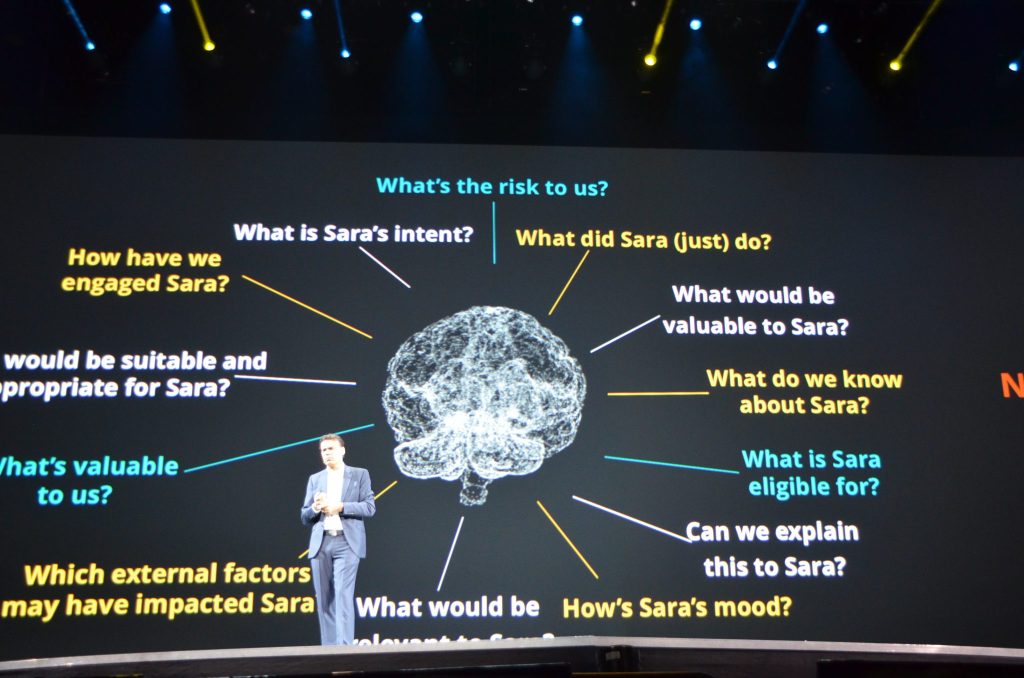
However, companies are not charities either, so AI will have to find the right balance as far as Walker is concerned. To this end, Pega will introduce the Customer Empathy Advisor at the end of 2019, part of the Pega Decision Hub. This is a controller, like the T-Switch, that shows the financial and empathic effects of a possible decision. For example, a decision will not turn out to be very empathetic if the context of the customer is hardly taken into account. Not only the question of whether an offer fits the customer's situation, but also the extent to which a company opts for relevance, determines the opportunity costs: the revenues of an alternative that has not been chosen. Simply put: are you betting on a hard product push or are you satisfied with a slightly lower yield with an offer that better suits the customer's situation? Empathy and relevance therefore have a link with sustainable business operations.
'Made by AI'
Customercontact.nl asked Walker after his keynote how organizations will ensure in practice that their AI-driven actions in the field of upselling and cross-selling via digital channels do not go off the rails. “Large companies often have a compliance officer. No algorithm goes live there until it has been inspected,” says Walker. “It is often laid down in policy which models may be used – for example, no complex neural networks in the credit acceptance process. In addition, especially in the financial sector, all elements of a proposal or transaction are recorded: the underlying logic, the data used on which a proposal is based and the response received from the customer. Auditors can therefore analyze that. Neural networks are more likely to be used for creative marketing purposes: what is the best banner photo for a specific web visitor? There is a good chance that you cannot properly explain such a decision.”
Consumers will increasingly have to deal - even without knowing it - with advice, tips and offers that have been created through an algorithm created by AI. In Walker's eyes, it is therefore becoming increasingly difficult to continue to see the distinction with decisions made by people. As far as he is concerned, it would not be a bad idea to label artificially made decisions. Who knows, we might soon find the message 'this proposal has been generated by artificial intelligence' in our online offer.
Text and image: Erik Bouwer


Also interesting
-
Which applications need further development before they can be used successfully and on a large scale?
-

Software provider Genesys has reached an agreement with Pointillist and Exceed.ai to complete an acquisition. With the two acquisitions…
-

Pegasystems still has to pay a mega fine to competitor Appian, after a lawsuit earlier in May this year about alleged industrial espionage.