
Last year, the KSF asked its members to express their opinion on the proposed revision of ISO 18295, the global quality standard for contact centers. It is now clear that the revision will continue; the only question is what changes will be implemented. The KSF intends to participate in the substantive discussions about these changes.
ISO 18295 has existed since 2017 and has not been updated since then. Developments such as working from home, AI and omnichannel customer contact play little to no role in the existing standard. For China, sufficient arguments to to make proposals which can be used to update the standard. In a webinar with approximately 15 participants Paul van Ladestein (including member of the supervisory board of the Dutch ISO 18295) explains what the proposed changes entail, how the KSF views these proposals and what the next steps are.
Interests
In various regions, major interests are involved in the standard. Many large contact centers are active in Africa, but also in China, India and Latin America. The rise of AI has major consequences for countries with a large BPO sector. It is not surprising that China – not a BPO destination, but a huge economy – has taken the initiative to adjust the standard; Van Ladesteijn refers to reports about the Chinese online retailer Alibaba, which is said to have retrained 200.000 contact center employees as AI trainers.
Revision of the standard
De proposals that China has made, are quite drastic, according to Van Ladesteijn. For example, KPIs would be added, there would be several separate guidelines for performance evaluation and lean services, and - most urgently - there would be sector-specific guidelines for different sectors. Think of separate standards for the financial sector, retail, aviation or government. This approach seems to have been 'copied' from COPC, but has not been met with much enthusiasm from European countries including the Netherlands. The idea of sector-specific standards also raised questions among the participants of the webinar: how should that work for facility contact centers that work for customers from multiple sectors?
Resistors
Because several countries (including the Netherlands through the KSF) have raised objections to the extension of the scope, including those sector-specific guidelines, the ISO organization will still consider how the standard should be adapted. Van Ladesteijn does not expect that all proposed revisions, including the proposal for sector-specific standards, will be implemented. But, he also says, many countries still have to express their opinion on this.
Revision process
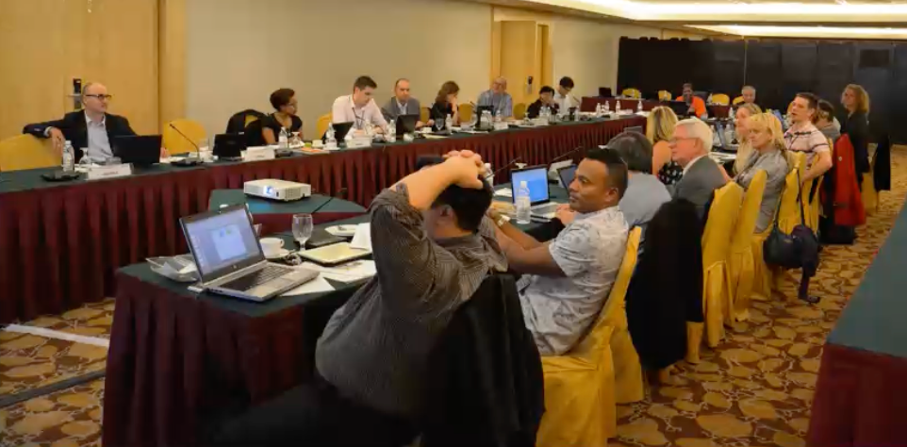 A revision of an ISO standard can take one to three years and starts with a meeting – possibly in China, which is also the lead country – of representatives who want to have their say. This option is open to everyone and is arranged for the Netherlands via the NEN. This body sets up a so-called standards committee and charges costs for each participant – this can be an organization or an individual. These costs amount to approximately 2500 euros per year during the revision process. Travel and accommodation costs are for the participants themselves, as is the required time investment.
Whether the KSF will sit at the table has yet to be decided. There are roughly three options for responding to the proposed revision: not responding, passively responding by only providing input or actively responding by ensuring a seat at the table. The Customer Service Federation currently appears to be opting for the latter approach; anyone who wants to influence the final result must hold the discussion on the spot, according to Van Ladesteijn. A maximum of five delegates per country can be given a seat at the table.
At the first meeting, participants will work towards a new design in a few days, taking into account available input. The concept will then be returned to all countries to collect feedback, which will then be processed centrally in a follow-up meeting. The KSF will also discuss the interim results with the constituency. As mentioned, this iterative process can take a few years. The new ISO standard is created on the basis of consensus: all participants must agree to the final result.
Consequences for existing certificate holders
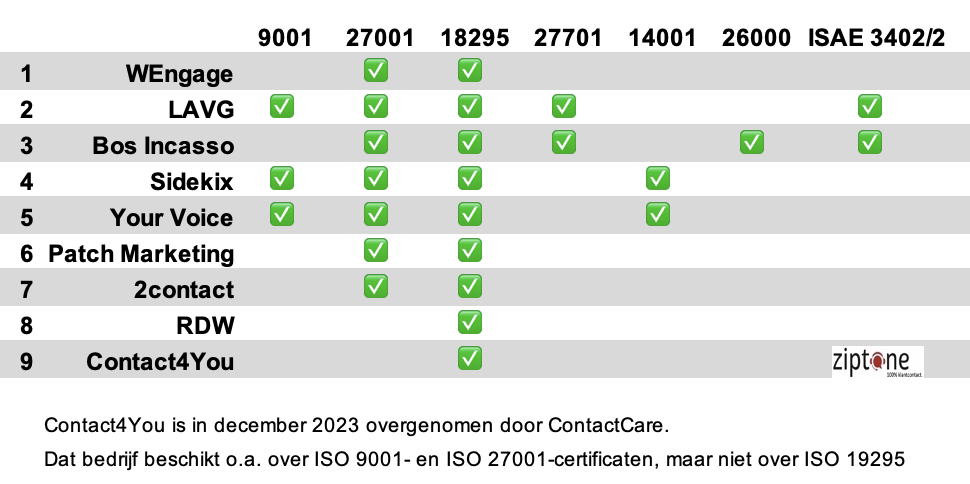
Status ISO 18295 September 2024, click for details
At the moment, an issued ISO 18295 certificate is valid for two years and nothing will change, according to Van Ladesteijn. Even those who opt for recertification in the short term will not be confronted with changes. But as soon as the revision is final, (re)certification will look different. The new standard will in all probability be more extensive and the standard will in any case not be lowered. At the moment, there are in the Netherlands 9 organizations that have the ISO 18295 certificate have achieved.
It is now up to the KSF to collect the net from members and within the professional field. Anyone who wants to invest in a say, says Van Ladesteijn, can join the standards committee or report to the KSF. One of the first steps that the KSF must take is to decide how the trade association will get involved in the revision. "There has to be support for that," says Van Ladesteijn, who expects the first international consultation to be planned before the summer. Most likely location: China.
(Ziptone/Erik Bouwer)
Also read: “ISO certification takes your organization to a higher level of maturity”


Also interesting
-

ContactCare's customer contact centers in Suriname and the Netherlands have been recertified for ISO 27001 and ISO 9001.
-

Kalff, active in donor and fundraising, has achieved ISO 18295 certification. Jerry Smit looks back on the process.
-

ISO 9001, 27001 or 18295? Whichever ISO certification you choose for your contact center: it affects the entire organization.