
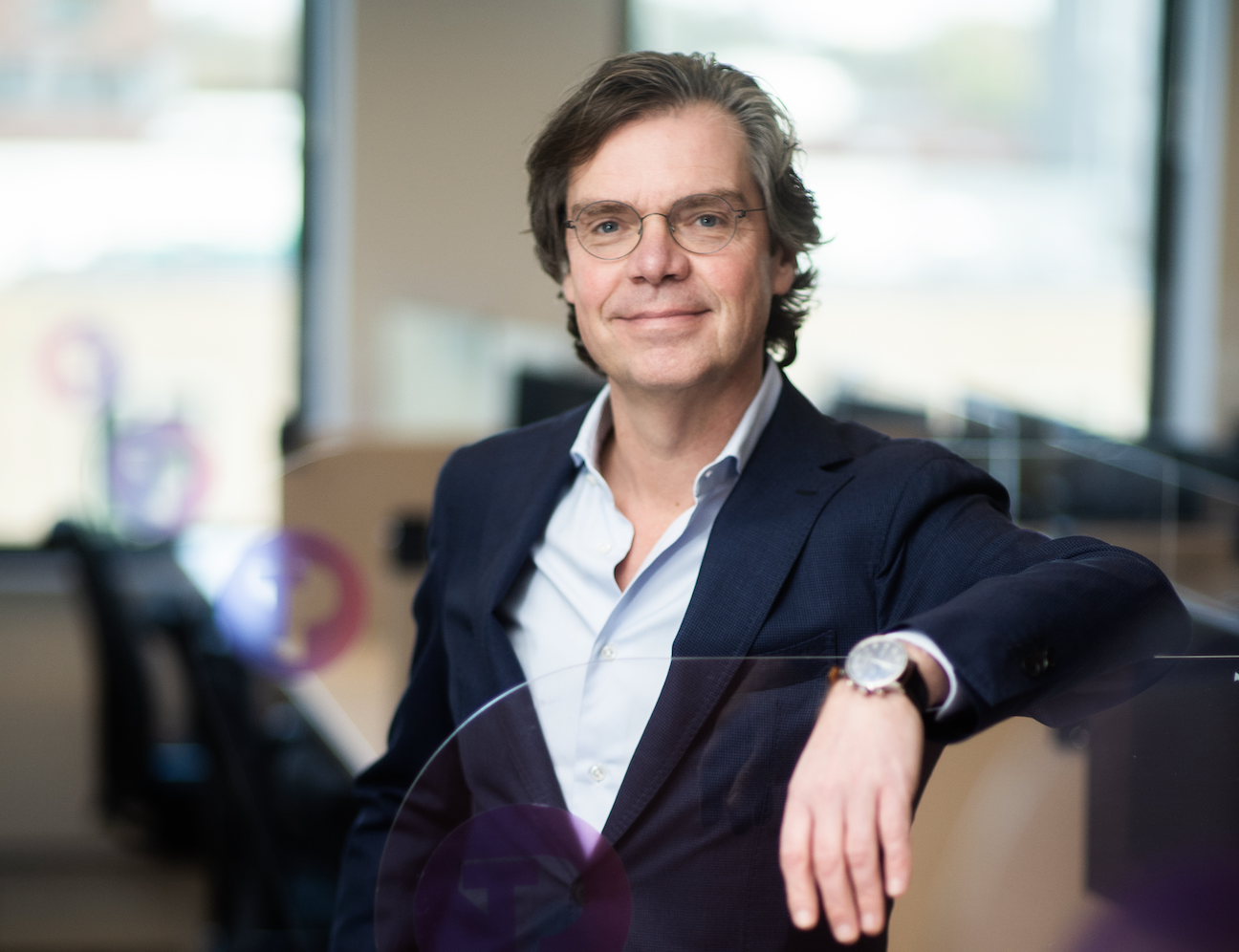
 Market leader Teleperformance is concerned about the way the Surinamese customer contact market is developing. Norbert van Liemt has therefore taken the initiative to set up an employers' association - including a quality mark.
Reason for the conversation with Norbert van Liemt, CEO Teleperformance Benelux & Suriname: the acquisition of Majorel by Teleperformance, last year. One of the most visible results of that acquisition: TP Benelux gained a branch in Suriname, namely Alembo. How is the integration of both organizations going and how does that relate to the global integration of Majorel and Teleperformance?
For the global picture – the combination has 500.000 employees and the turnover is more than ten billion euros – Van Liemt refers to Teleperformance Paris. He does want to say something about the differences between TP Benelux & Suriname on the one hand and Alembo on the other and about the way in which integration takes place. These differences later bring the conversation to the Surinamese labor market and the wage cost development. We also end up at the initiative to set up an employers' association.
Formal merger still to come
But first Alembo. Founded in 2006 by Frank Veldhuizen and just before the takeover by TP with around 500 employees working for clients such as Fonq, Intertoys and Picturae. Van Liemt explains that the integration with Alembo started in November last year, after all formalities surrounding the takeover had been arranged. Van Liemt then went to talk to the management team of Alembo in Suriname. “The formal merger will take place on 1 January 2025; at the moment Alembo is still an independent legal entity. Although the integration is already in full swing, current clients will not notice much of this. The daily service provision runs smoothly, with best practices and working methods being exchanged between the departments involved. Current clients are aware of this process, and there have been no negative reactions to the takeover from the group of clients that Alembo serves,” says Van Liemt.
Factor of a thousand difference
With approximately 500.000 employees worldwide, TP is more than a thousand times larger than Alembo. Nevertheless, Alembo has capabilities in-house that suit TP Benelux well, says Van Liemt. “Alembo's roots lie in BPO and back office activities, often with small-scale projects. With the takeover by Majorel, Alembo was able to welcome clients such as Booking.com, as well as Greetz. These were the first larger customer support projects. Alembo's back office services in particular are interesting for our Dutch customers who already outsource their first-line support to Suriname. Because wage cost pressure also plays a role in the back office. A back office team is already running on the Klipstenenstraat (TP's third location in Paramaribo – ed.). Part of our own internal back office has also been moved to Suriname.”
Back office services: market still modest
Van Liemt explains that for Dutch companies, the Dutch language is still a prerequisite when it comes to first and second line support and the associated back office processes. “If you do not want to use translation software and still want to save costs, Suriname is a good option. The competition in Suriname is mainly in the area of first line support. Back office activities are not yet that big in Suriname.”
Van Liemt also sees this back-office service provision as an additional opportunity for the local labour market. “The Surinamese labour market is not very large, there is a brain drain. If you can offer more here than jobs in first-line support, where some 6.000 Surinamese are already employed, that is positive.” The three largest players – TP, Concentrix and Yource – together already have some 4.000 employees and then there are about twenty other service providers, Van Liemt calculates.
What comes first for whom?
He also sees other advantages in the merger of TP and Alembo. “Alembo has always been a very people-oriented company. Although TP is the same, at TP the delivery of services, with a lot of attention for KPIs, reporting and quality systems, is a bit more central. The attention for people follows,” he explains. “At Alembo it is exactly the other way around. Alembo has its own image in Suriname. We would like to connect to that and strengthen both the focus on KPIs and the focus on people. Alembo invests a lot in people, in the form of activities and, for example, through scholarships for higher professional education outside its own field. The company has a strong ESG policy that fits in perfectly with our vision. Suriname is a country with a lot of poverty, not everyone can study.”
There were also differences in terms of employment conditions, which will be harmonised for all employees as of 1 October. Nothing will be taken away from anyone, so that means something will be gained for the vast majority of employees, Van Liemt assures. “The combination of both companies offers the best of both worlds to employees and customers. Alembo's people-oriented approach is reinforced by TP's stricter quality standards and efficient systems. This synergy is expected to lead to improved customer satisfaction and an even better working environment for employees.”
“Anyone who knows the country a little knows that uncontrolled extreme increases in salaries are unwise.”
Wage-price spiral
 “We want to ensure that people in Suriname have a job that gives satisfaction and where they can develop themselves. Of course, this also includes an interesting and market-conform salary. As Teleperformance, we consciously choose to invest in job satisfaction and the well-being of employees. Anyone who knows the country a little knows that uncontrolled extreme increases in salaries are unwise. In addition to causing a wage-price spiral, which leads to even more inflation, this creates more problems on the local labor market. Other sectors such as the hospitality industry, shops and even the government will have to adapt to this, something that is not always possible.”
Higher salary?
“The contact center industry, due to its size, would distort the labor market if it did not take into account the local economy. Increasing salaries dramatically may provide a short-term competitive advantage; then the entire market will move in that direction and the advantage will be gone. Worse still, other companies outside the sector may find themselves in dire straits because they simply cannot compete with these salaries. This would undermine the offshoring model – and then, after a while, many people would be out of work. We are very aware of the fact that we have a greater responsibility than our own interests. We want to contribute to the well-being of the entire country and strive for stable, sustainable growth. Our decisions are therefore well-considered and aimed at promoting a healthy labor market and a thriving community.”
Transparency in employment conditions – Providing scholarships is one way to stimulate the development of customer contact professionals, for example alongside their job. But have employers already thought about setting up a local vocational training for customer contact positions?
Yes, we are setting up a Surinamese accredited training for customer contact work, says Van Liemt. There is also a sore point: “We are now training our own people, that is not just agents, but also team leaders, trainers and trafficers.”
In addition, he sees opportunities for improvement in the area of employment, such as optimizing notice periods, flexibility in hours, and offering more clarity and certainty about employment conditions. Transparency in both primary and secondary employment conditions can contribute to a better working environment for everyone. “We pay the full health insurance premium, 50% of the pension premium, 17,5% in expense allowances and allowances for irregular working hours. These are essential provisions that contribute directly to the well-being of our employees, on top of the regular hourly wage.”
Of course, wages in Suriname will gradually increase, Van Liemt is convinced, “but we have to be careful that we are not spat out and that we ignore what is really important: good salary, challenging work, a pleasant environment to work in and develop. In addition, we are committed to supporting employees outside of work when desired.”
“Every sourcing region has its limits”
What happens when the Surinamese labor market for customer contact employees becomes comparable to that of the Netherlands in terms of scarcity?
“Every area has its limit, even nearshore regions such as Portugal, Spain and Greece have their maximum,” says Van Liemt. “That is why TP is also looking at other locations worldwide. The market in the Netherlands is shrinking. A few years ago, the WFC members were still good for 20.000 employees; I think that is now going towards half, because the work is no longer there. That goes to nearshore locations and Suriname, and of course digitalization plays a role.”
When the various near- and offshore destinations have all reached their 'max', then you can speak of global scarcity; and in that situation, Van Liemt states, "you can only really determine with whom you want to enter into a close partnership as a service provider."
Employers' association for facility contact centers in Suriname
In the meantime, the brand-new Surinamese employers' association is stepping on the gas. Van Liemt says that he held a first meeting a while ago and then transferred the initiative. The current state of affairs is that four management positions are divided within the employers' association. This month, in September, there will be another follow-up meeting. "We have to organize this very well, because previous initiatives have failed," explains Van Liemt, who speaks of fifteen to twenty parties that play a serious role in the Surinamese facility customer contact sector.
“One of the spearheads of the employers’ association will be a quality mark, which is about more than employment conditions. It is also about infrastructure, security and data protection. That quality mark is an important goal. And we believe that more is needed than ISO certificates. You will have to meet minimum standards.”
Quality mark
In the Netherlands, there is currently no majority for such a quality mark. In the past, things were different, says Van Liemt. Before the KSF, there was the employers' association WGCC, where there was also a quality mark including an audit. That audit determined whether you could remain a WGCC member. Why would a quality mark get off the ground in Suriname, while mainly Dutch (or international) companies are active there?
Van Liemt responds: “Because there are also companies active in Suriname that could damage the image of the industry, for ourselves and for the clients.”
And finally, the unions. Have they woken up in Suriname? Are they being talked to yet?
Van Liemt: “That is a topic for the employers’ association as far as I am concerned: are you going to wait for the union to come forward, or are you going to enter into discussions with them? Ultimately, you should have the same objectives.”
Majorel, TP and Alembo, what was it again? – In June 2022, Majorel acquired Surinamese Alembo. Less than a year later, in April 2023, Teleperformance announced that it would acquire Majorel. That news came a month after Concentrix had decided to acquire Webhelp. At that time, Majorel had 82.000 employees in more than 45 countries and a footprint that was highly complementary to that of Teleperformance. For the top 20 customers of both organizations, there is an overlap; according to TP CEO Daniel Julien, consolidation of the number of partners is an advantage for these mainly large multinationals.
The acquisition of Majorel fits in well TP's Cube strategy, according to TP's explanatory statements on the acquisition. Majorel adds complementary positions in key regions; there is a shared vision and a strong cultural fit; expertise in various sectors with a highly diversified customer portfolio is deepened. And, importantly, the acquisition will enable Daniel Julien to reach its target turnover of 10 billion euros two years earlier than expected, according to analysts. TP also believes it can achieve a synergy benefit of 100 to 150 million euros. This is confirmed in the company's latest financial updates. The costs of realizing these synergies (including the costs of IT integrations) will be charged to the figures in the first half of 2024; analysts therefore expect better performance in the second half of this year.
(Ziptone/Erik Bouwer)


Also interesting
-

Norbert van Liemt is stepping down as CEO of TP Benelux, Suriname, and Nordics of his own accord. TP has confirmed this.
-

Norbert van Liemt reflects on his leadership role at TP. He advocates for the merger of WFC and KSF. “We…
-

Bastiaan Groeneveld is the new CEO of TP Benelux & Suriname as of September 1, 2026. He also remains responsible for…