
 More realism about the range of AI innovations, that was the message at the event 'AI away from the hype' by TP, on June 12 in The Boathouse, Kralingen. What works and what doesn't (yet)? Real-time speech translation now belongs to the first category.
- Realism over hype: Not all AI solutions deliver immediate returns – but real-time speech translation does, TP stated at a tech event.
- The latency in real-time speech translation has been reduced from several to just half a second, making it practically applicable in customer contact.
- During a demo of Parloa it turned out that the remaining latency is barely noticeable to users with clever tricks. Real-time speech translation is “here to stay”
The temptation is great to refer too quickly to percentages of saved processing time in AI applications, according to Pascal Matern (Chief Commercial and Client Officer TP Benelux, Suriname & Nordics). And the idea that everyone should just start experimenting with AI also needs some nuance, according to Matern. Organizations often have concerns about data, or have to deal with legacy. Don Schuerman, CTO of CRM giant Pega, also recently mentioned technical debt, which hinders the use of artificial intelligence.
Realism about AI
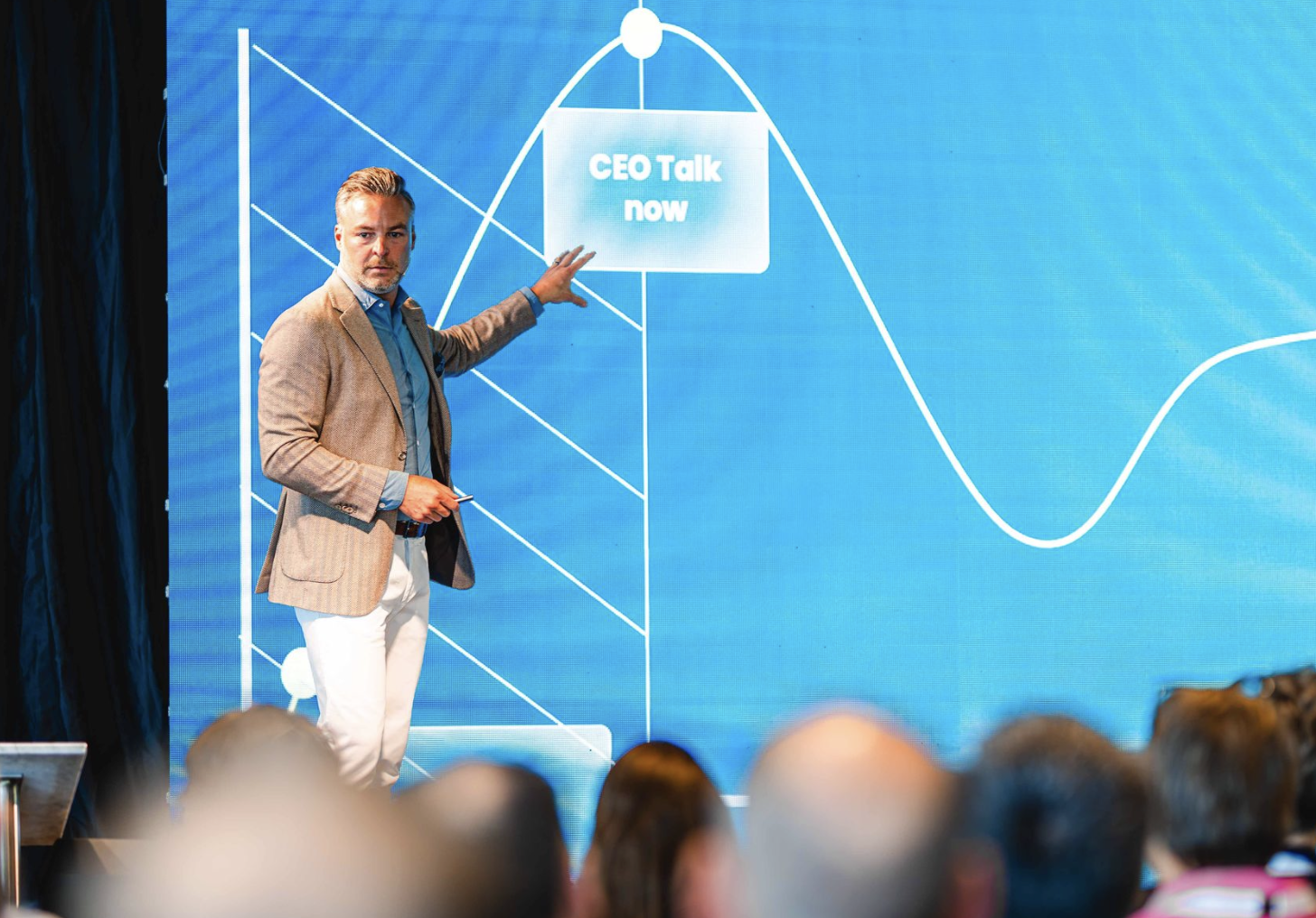
Pascal Matern, CCO TP Benelux, Suriname and Nordics
AI is an investment, the results of which often only become visible later, according to Matern. Customers who want to work on a foundation in this regard must be prepared to experiment. These results can ultimately lead to 'cheaper' or 'better' or a combination, but TP believes that you should not approach AI as a 'cost cutting tool'. Matern referred to Klarna: that company reported major savings on customer service through the use of AI. That not only turned out badly for our stock market value, according to Matern, but TP also lost Klarna as a customer. Klarna has now learned more, and is again in talks with TP. The developments surrounding Klarna prove that realism with regard to AI and customer contact, despite great potential or great promises, is certainly not a luxury.
What does work?
Still, TP was eager to show that there are AI applications that do work. In other words: from potential to practical. Remarkably enough, real-time speech translation was immediately put in the spotlight. In 2022, the latency was still several seconds, now it has been reduced to half a second, according to Matern. During a demo later in the conversation, it became clear that with some clever tricks, those half seconds are actually hardly an obstacle anymore. But of course, it can be expected that the delay factor with real-time speech translation will decrease even further.
Matern concluded with the warning that AI is not a magic powder that you sprinkle – especially if you do not have an AI strategy. Strong partnerships with transparency are the basis for innovating with AI and it certainly helps if you approach larger AI projects under the banner of change management. Tip from TP: hire for change. And for those who did not know: TP is looking for a COO for the Benelux, Suriname and the Nordics.
10.000 hours of practice and role-playing
TP had Jordy and Estrella van Toor flown in for a full but entertaining presentation on generations, digital first and digital wellbeing. Their story revealed that people need around 10.000 hours of basic work experience to become a professional. What does that mean for 'entry level jobs' such as those of many customer contact employees if we automate the simple work? Practicing 'simple conversations' about, for example, a move was always a great basis for learning the trade, but that material is no longer in your queue.
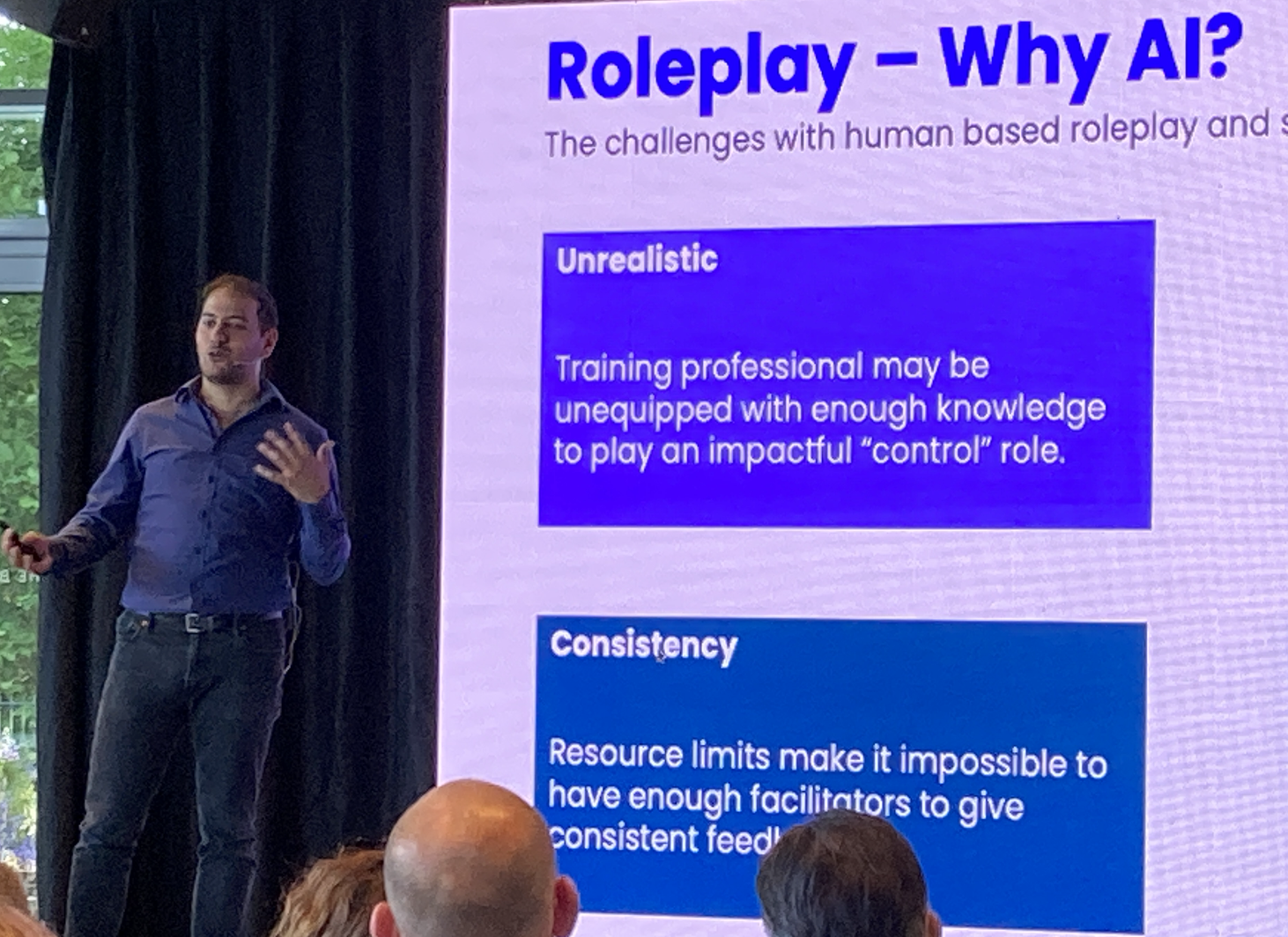 This practice was reflected in the presentation of Michael Ouzzan from Second Nature, an AI application for role-playing. The solution offers possibilities to imitate your own customer 'customized' in the form of an AI-based persona. Employees can train their conversations with it to their heart's content.
This is more scalable, consistent and detailed than using physical role-playing, which is also not always experienced as pleasant and educational. Playing impactful roles is also quite a challenge, both for the trainer and the trainee. Second Nature focuses on all kinds of disciplines, so in addition to service, for example, also on sales and HR. The tool offers extensive analyses. TP has used the solution at Vodafone, YoutubeTV and Google Trust Services. TP plans to use more Second Nature for other accounts as well.
Is my team still as empathetic as before?
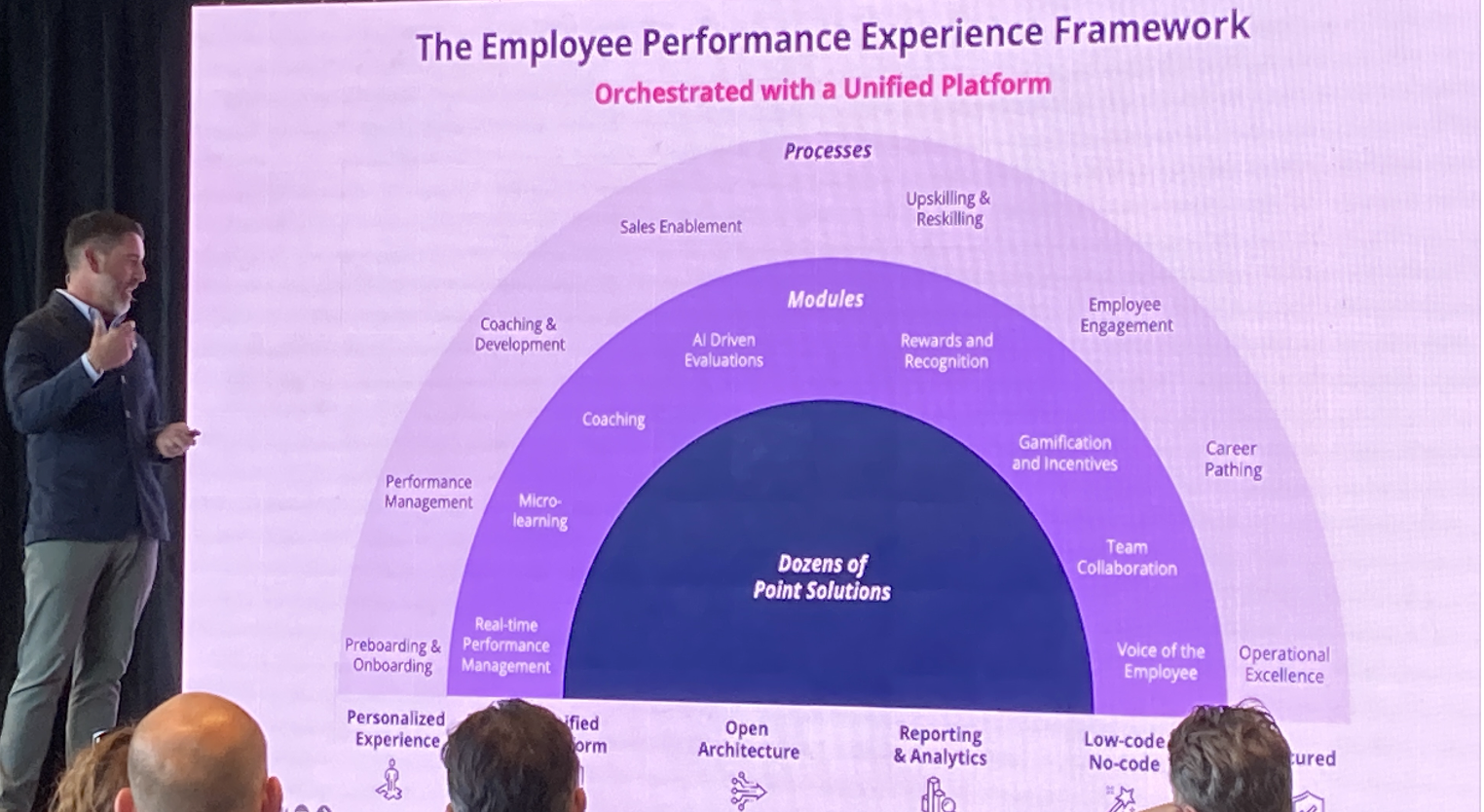 Centrical, the second solution presented, is an extension of Second Nature. Ian Chappell van Centrical presented the solution as a 'performance experience platform'. That platform should help to bridge the gap between the boardroom policy and the execution in the contact center. Or more practically: where the board would like to see the contact center contribute to the growth of the market share, the shop floor is more likely to think of something practical like 'working hours'.
Bridging the gap is often the responsibility of team leaders and supervisors. According to Chappell, they can be more successful if they provide their employees with empowerment, ownership and personal guidance. Centrical is an extensive coaching tool that shows who can improve and when on which points. This can involve conversion rate, but also root cause behaviour analyses based on recordings that lead to specific micro-learnings or tests. The platform contains gamification elements, so points can be earned when employees improve. Centrical also provides managers with insight: are things going in the right direction with, for example, empathy or politeness or is the level actually declining?
It all sounds quite technocratic, you could even replace your bilas with it – perhaps that is why TP itself added functionality by also asking about employee well-being. How are you, how does the workload feel, do you have something to report or feedback for managers?
Kirsten Nijmeijer in HR Practice about human transformation – When TP-CHRO Kirsten Nijmeijer started at TP two years ago, she immediately noticed something: “The incredibly highly engineered processes. Really astonishing, compared to companies in other sectors that I knew well.” In the interview, she also mentions that she understands that focus – “clients need to know in advance what they will get from us. We want to be transparent and predictable in terms of the quality of service.” But there is also a downside to those highly engineered processes, according to Nijmeijer: “you also limit the space of employees. Then you end up in discussions about KPIs. While I believe that a KPI should be seen as an outcome rather than a goal in itself.” That fact formed the starting point for Nijmeijer for a 'human transformation': a process-oriented approach with a more people-oriented approach. A step-by-step process, according to Nijmeijer, with the aim of TP being an employer of choice for many people – one of the strategic pillars of the company. (Read the full interview with Kirsten Nijmijer on HR Praktijk)
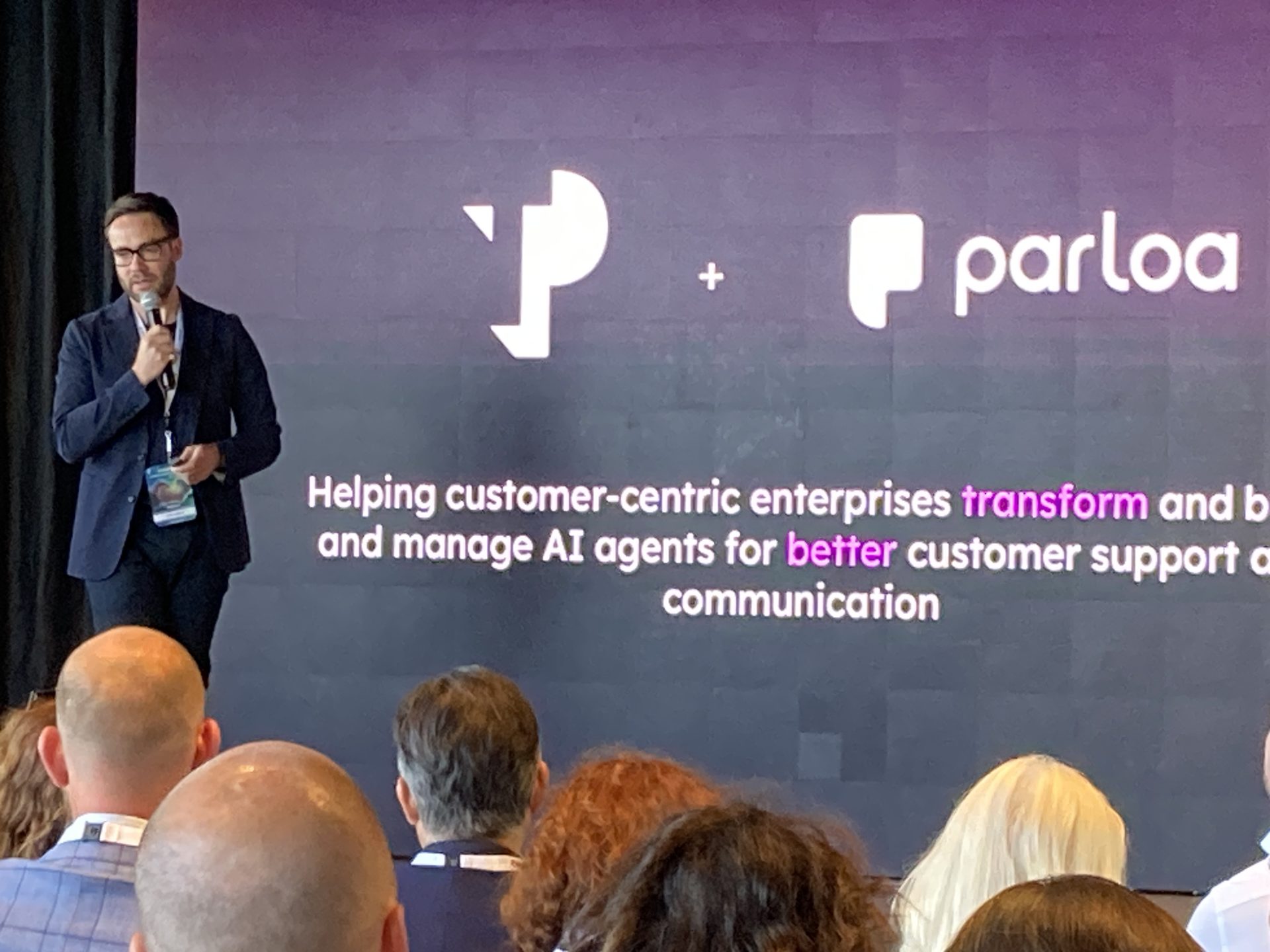
Tom Shaw, Parloa
The TP event concluded with a live demo of real-time speech translation from German Parloa, focused on speech services from the start. Voice is king, according to Tom Shaw from Parloa, which switched from rules-based to AI-first immediately after 2023 – the introduction of generative AI. The difference between the two is interesting, especially since rules-based chatbots have a bad reputation. With rules-based, building takes a lot of work, but testing is fast and easy, according to Shaw, and with autonomous agents it is exactly the other way around. Building is relatively fast, but testing is considerably more work.
The demo of real-time speech translation, cobbled together during a coffee break – SVB was cited as an example – was proof of this rapid development, of a prototype that is.
Conclusion? Getting AI to literally work in enterprise environments is no piece of cake, as Parloa also emphasizes. But RTT is here to stay. Interjections such as 'ehhh' and keyboard sounds camouflage latency very effectively. Technology is advancing in customer contact, also in the field of people management. It is not an unnecessary luxury to think about what this means for employees and, where necessary, to adjust the organization of work.
(Ziptone/Erik Bouwer)


Also interesting
-
TP CEO Bastiaan Groeneveld on declining call volumes, sourcing, sovereignty, and the move to a smaller office.
-
On the stage of CCMA Digital Conversation 2026: including ABN Amro, Eneco, VGZ, Univé, Lebara and the Norwegian Posten,…
-
Consultancy firm Vlirdens calls on customer contact professionals and WFM specialists to register their WFM team for the WFM Awards.