
In this article you can read everything about the service level. What is the relationship with planning and occupancy rate, what expectations do customers have about the waiting time? How can you calculate the service level?
Service level: what is it?
In contact centers, the service level is the standard for the percentage of calls that must be answered within a certain waiting time. In contact centers is it one of the most important management KPIs for (quantitative) accessibility.
As of November 1, 2022, Ziptone all knowledge articles put together. You can find them here, easily searchable. Read all about KPIs, costs, labor rules, tips for implementing cloud solutions, success factors for outsourcing and much more.
The program service level The service level maintained by an organization can be seen as a performance or quality standard. A commonly used service level is answering 80% of calls within 20 seconds. If the number of calls answered within 20 seconds is lower than 80%, the service level drops.
The service level may vary for various reasons. For example, it will drop when more people call. Or when fewer people are working. It is also possible that conversations (or the after-work time) take longer than what has been taken into account in the staffing.
Usually the service level is calculated at the end of the calendar day; then the KPI gives a good picture of the performance of the contact center over that day.
 In the past, the number of times the telephone was allowed to ring was sometimes calculated. Waiting twenty seconds was equivalent to 'ringing' three to four times. That was often seen as the point when callers went to call centers started thinking about disconnecting. There are differing views on what callers will and will not accept in terms of waiting time – in certain situations, but also in certain countries. More on that later.
Service level: what can you do with it?
The service level is an operational KPI, which says something about the extent to which the contact center is accessible. This accessibility is influenced by all sorts of things. In addition, accessibility is an elastic and subjective concept. The service level can also be an indication of the quality of the WFM process and the quality of employees.
The service level plays an important role in the creation of the roster of contact center employees. In the Erlang-C formula used for contact center personnel planning, the service level (next to supply volume, average call duration and average after-hours) is the fourth value that determines how many employees you have for certain periods (intervals of, for example, XNUMX minutes or half an hour). must have available.
Anyone who does not score well on the service level will be inclined to schedule more employees; if the service level is too high, there is a temptation to remove people from the roster or give them other tasks. But conversations may take longer than planned, for example because your employees are not properly trained or because IT systems are too slow. These things can also cause queues and put your service level under pressure.
In addition, the service level can be a standard with which you can compare your own organization with other organizations. The service level can also provide guidance for questions such as: how much extra traffic can our contact center handle (such as campaigns), how hard do agents have to work and what are the costs of a certain level of accessibility?
High or low service level?
 There are no standards for service levels, but when it's essential that callers get someone on the line quickly – think emergency or emergency services – then, for example, a service level of 95% answering within 5 seconds can be used.
A high service level means that you have a relatively large number of employees available compared to the number of telephone calls, so that there is little chance that the customer will have to wait. With a high service level, there is a greater chance that employees will not be offered work once in a while. The productivity of employees can therefore decrease.
You can also let the height of the service level be determined by other things, such as the expectations of the customer. Some companies use different service levels or response times for different channels and target groups. Those who have a sales line where the response to TV commercials is handled will prefer a fairly high service level: you want to speak to as many customers as possible.
A contact center that is unexpectedly overwhelmed by a multiple of the normal volume of calls cannot put a multitude of employees to work at the same time. Sometimes companies choose to adjust the service level downwards in a specific period - for example when it is very busy for a long time and it takes longer than usual to get the occupancy up to standard. Several contact centers have experienced this issue at the beginning and at the end of the corona pandemic.
When determining the right service level, both a percentage of calls that are accepted in relation to the offer and a maximum waiting time must be chosen. Examples of service levels are, in addition to 80/20, also 90% within 120 seconds or 80% within 300 seconds.
How long do people want to be on hold?
Many studies have been done on what consumers and/or customers accept waiting time. In general, the conclusion is that the willingness to wait depends on several factors. Consider, for example, the situation and circumstances in which the caller finds himself, the type of company or the type of service, the reputation of the company (is poor accessibility the rule or the exception) and the options for contacting in another way.
When customers have to wait too long, they may hang up before speaking to an agent. These calls that are terminated prematurely become abandoned calls .
Service level: how to calculate?
The service level is one of the most important KPIs reported by contact center platforms. The KPI can be calculated in different ways. Some ACD and WFM solutions offer options in this area. The different calculation methods each have their advantages and disadvantages.
1. (Calls answered in Y seconds + calls abandoned in Y seconds) / (total calls answered + total calls abandoned)
This method is preferred in most situations because it involves all traffic received by the ACD. This calculation gives a complete picture of what is happening, because all calls are counted.
2. Calls answered in Y seconds / total number of calls answered
This alternative calculation only assumes answered calls and therefore does not accurately reflect all activity. Abandonment is completely ignored.
3. Calls answered in Y seconds / (total calls answered + total abandoned calls)
This option seems to be the least popular among contact center managers, because all calls that are abandoned negatively affect the service level – even those that are abandoned before the service level goal is reached. This calculation method is suitable in situations where calls end up in a queue after the callers have heard a waiting text.
4. Calls answered in Y seconds / (total number of calls answered + calls abandoned after Y seconds)
With this calculation, abandoned calls only negatively affect the service level when they are abandoned after Y seconds. Calls dropped before the Y seconds target do not affect the service level. As a result, this is a suitable method to avoid penalizing the contact center for callers who hang up quickly, without completely overlooking abandoned calls. This method is acceptable.
Occupancy rate
The service level is partly determined by the occupancy rate. The occupancy rate (also known as occupancy) indicates the extent to which the scheduled employees are actually busy handling calls. The occupancy rate in turn depends on all sorts of factors such as adherence to schedules, accurate planning that takes sufficient account of shrinkage, the size of the teams that have to handle the call volumes of queues and the design of your call flow (can callers overflow from one queue to another).
With forced calling you can ensure that employees do not wait to take the next call. By looking at various factors in ACD reports and combining this information with monitoring the work floor, you gain good insight into how the service level is influenced positively and/or negatively.
Service level and rethinking – Organizations that opt for a service level of 80 percent within 20 seconds accept that a number of customers are structurally not helped within 20 seconds. Maintaining a certain maximum abandonment rate is comparable to this: you also accept that a certain group of your customers will not be served or will be served poorly. You don't know in advance which customers they are (your best customers who are profitable or new arrivals).
From the perspective of the individual customer, such a choice means that in a number of cases you will not be helped (or not properly). If you apply this vision to the hospitality sector, say a five-star hotel, a certain proportion of the guests would not receive breakfast, no made bed and no service at the pool. If a customer has signals in advance that a five-star hotel applies the 80/20 rule, he will probably continue to look for a better alternative.
(Ziptone editors)


Also interesting
-
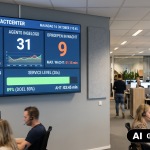
Accessibility is the most measured and at the same time the least understood variable in customer contact. Why is that?
-

In the first part of this knowledge article, we explain what omnichannel customer contact is and what it can yield for…
-
What legal requirements apply to the accessibility of your customer service in the Netherlands, and who supervises this?