
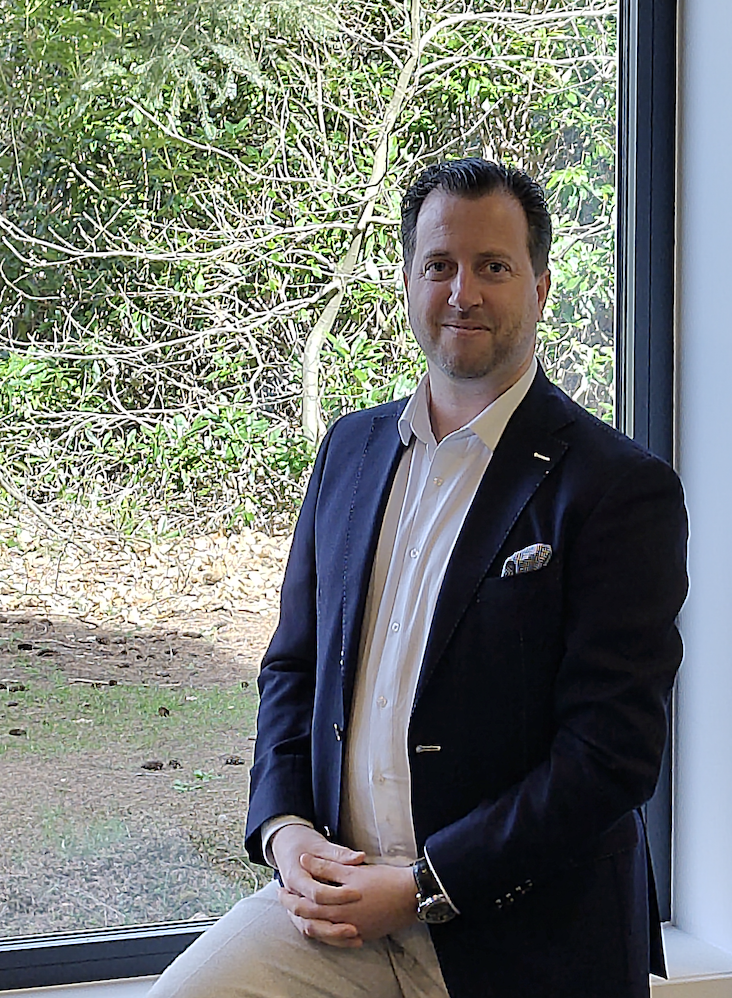
Mark Elschot, business developer at Vlirdens – Image: Ziptone
Mark Elschot has been in the customer contact business for 25 years. Reason for an interview. But because he is not the only one with that track record, this article also marks the start of a new series about seasoned (and not-so-seasoned) veterans in the field. As a bonus: every interviewed veteran gets to nominate a fellow veteran for the next interview. But first: on the love of Mark Elschot (Vlirdens) for this field.
You have been working in the customer contact field for 25 years this year. In your opinion, when does someone become a customer contact veteran?
“My first association is that you’re old then, but I was born in 1982, and from that perspective, I’m nowhere near a veteran yet. When I think of veterans, I also think of a group that is busy passing something on to a new generation. I’m not doing that yet; I still enjoy doing everything myself far too much. Perhaps you are a veteran if you have gone through a certain phase. Think of the phase before and after the arrival of AI. By the way, I also come from the era before social media. So I have to admit that I’m not the youngest anymore either.”
What was your first step in the customer contact field?
“For me, it was a second choice at the time. I was studying Commercial Economics at the Haarlem Business School, and to keep the fridge stocked, I had to look for a part-time job. I thought at the time that it would be really cool if I could work at a beverage wholesaler: driving the forklift until half past nine on Thursday evening and then picking up something tasty for that same evening at cost price. The wholesaler where I work supplied a lot of hospitality businesses in Haarlem and Bloemendaal aan Zee, so on Saturday morning I had to get back to work with that forklift at half past seven. That went wrong a few times, and then there I was, without a job but with fixed expenses. Then a fellow student pointed me towards working in a contact center: ideal, working a few hours every evening. That was in February 2001, at Profinesse in Haarlem.”
What appealed to you about outbound telemarketing?
“It was mainly the enormous energy that hung in the department. Coming together at the start of work, hearing the latest tips and tricks, and everyone wanting to go all out. Hard work, big parties. I thought it was fantastic: talking to lots of people, training your commercial skills. And I was good at it, so I was soon taken off the line: you go train and coach and develop other people. That’s when things got even more serious. After that, I was brought in by Jansen Venneboer, which was later acquired by Leenart & Heemskerk. During that time, I learned a lot about calling, coaching, and creating propositions. We used the computer to create scripts, which were then printed out. Employees also used the computer to record the results of their calling campaigns. The schedules were created in Excel, then printed out and hung up in the canteen with a piece of tape. Alongside that was a piece of string with a pen and Tipp-Ex attached for making changes. That was employee self-service 0.1.”
Were there already things back then that surprised you?
“No, I didn’t have any other frame of reference. But it did feel like a suit that fit like a glove. I was always looking around, though: what is the next step? I saw people like André Filippini, Cees Zwezerijn, Steven Voorn, Peter and Pia de Weijer, and Geert van Ouwerkerk. I found them interesting people. A number of them were in Household Supplies, a select group that brainstormed creatively about new market opportunities, often prompted by news reports. Those brainstorming sessions were based on a fictional company that sold household items such as dish brushes. Everyone at the table contributed to business operations based on their own expertise. With a bit of bravado, I managed to get on board, because to get a seat at the table, you really had to have earned your stripes.”
 What was a striking learning moment for you in your career?
“I once really overreached myself when it came to the capacity for change within a somewhat smaller organization. Unlike a larger organization, that company could not bear as much risk and was also a bit more conservative. I shifted into fifth gear, but the company remained stuck in second gear. At the time, I thought, 'how complicated can it really be?', but we parted ways quite quickly after that. That certainly got me thinking: it is important to carefully consider what fits. And what suits me to thrive.”
Was there a specific moment when you thought: customer contact is my field?
In my case, it was a gradual process. In addition to outbound, I also became involved in things like temporary staffing, because I started at a contact center label – Telematch – while working from Start People. After that, I worked for a software company, then returned to facilities management companies, and eventually moved into consultancy.
It is certainly a field that matters and is constantly evolving. You get a glimpse behind the scenes at many other sectors, which I find one of the most enjoyable aspects. Whether you work for a travel agency or for 112, the customer contact processes all have their own nuances.
How do you view this field now?
“In my opinion, there is a real difference between the execution of customer contact and the field as a whole. The former is going quite well, but in the latter, I still strongly see that Calimero effect: everything used to be better. But back then, there was one trade fair, the Telecommerce Days, and one gala. That offering is now considerably larger, with, for example, the WFM Awards, the Team Leader Awards, the Customer Contact Quiz, and the Manager of the Year. The range is broader; we should be quite a bit prouder of that. We have brought this field to a much higher level in recent years. At many organizations, it is normal to deliver good customer contact. And what I am personally proud of: the WFM field has also developed well. WFM has been taken out of the broom closet and brought to the table with the board.”
“On the other hand, that greater maturity of customer contact as a whole is both a curse and a blessing. It is a blessing that it is seen as more important. Responsibility for customer contact lies more often with a Customer Service Director. The downside is that with greater maturity, silo thinking has also increased. Control—who is actually taking care of our customer—is sometimes a bit lost. There has been a lot of talk lately about AI literacy, but I would like to make a case for customer literacy.”
Is the lack of direction a major problem?
If things go wrong, yes. The results of the latest National Voice Monitor show that consumers are satisfied with the chatbot's response in only 12% of cases. I saw that chatbot emerge a long time ago. It is unbelievable that we still haven't moved past this level! I think that the contact center manager, in particular, needs to take on that coordinating role more. How often do customer contact managers, or even customer service representatives, use their own chatbot? Eat your own dogfood.
Are there matters in the field that you are currently worried about?
“Yes, of course there are concerns. We are on the eve of yet another major next step. There is a shortage in the labor market, customer contact is going to change, and automation is taking off. I often think: how are we actually going to organize this? For example, I am concerned about the speed at which the profession of the traffic manager is changing. As the linchpin of the organization, they ensure that the service level remains up to par. That profession is going to change fundamentally. There will be many more data sources. A higher level of abstraction is expected – think of working with scenarios. In the past, it was about 'adding or removing an employee,' or, in the event of panic, canceling breaks and training. The effect of that was only visible after some time. But with current technology, you can see everything coming sooner. That is, however, for it to be possible to tag metadata and have scenarios ready.”
After years of music on hold, waiting times were under control for a while. But in recent years, we have been struggling with longer waiting times again.
That is also a cause for concern. Especially since there is still a lot of resistance to technology that allows you to automate easy work so that more staff become available again. Contact center managers have to work much harder. Perhaps we are too focused on continuous innovation? Do we enjoy picking up something new too much, instead of further developing what is already there? We do the latter with employees, whom we try to make a little better all the time. We should do the same with technology.
Are there any remaining taboos in this field that you believe should be open for discussion?
I am always surprised that consumer programs feature outsourced contact centers exhibiting cowboy behavior by selling energy or telecom contracts in a not-so-ethical manner. There are clients who have engaged these parties but are not held accountable. That is a task for everyone, including the industry associations.
What is the biggest challenge we face as a field?
“How do we keep it all manageable? That includes AI, although that is sometimes less daunting than we might think. I still encounter questions like 'is there AI in that WFM software?' We have been using algorithms for years, and speech analytics is also old, even though many IT departments are hesitant about it right now. As a result, technology is deployed only to a limited extent. Exactly the kind of example where we should be accelerating.”
And what is hopeful?
“The specialization will always exist and is becoming more important and broader. We are increasingly moving towards remote service provision for companies and institutions; you can see this in the decline in bank branches and also in healthcare. What also makes me hopeful is that the field still includes many customer service departments that are not yet clearly visible. Think of new software companies or companies in the sustainability sector. They may call their department something different, but they simply act as a customer contact center with the same technology and processes. The field is not shrinking, but is actually still growing. In other words: there are still many players who do not yet know that they belong in it. The question is how we are going to reach those people. That is something for the KSF, but also for all of us. For example, by looking behind the scenes at each other's operations more often. It is also positive that this field is seeing an increasing number of lateral entrants. In the past, many customer contact managers originated from the contact center. Now there are more people bringing other expertise. I find that a refreshing addition.”
Many veterans become wiser and gentler as they get older. To what extent does that apply to you?
Certainly, I used to worry about everything. In that respect, I have become calmer. I react less quickly when I see something online that I don't like.
In the next edition of this new series, Mark Elschot's choice:
Ziptone in conversation with customer contact veteran Judith van Paridon.
(Ziptone/Erik Bouwer)


Also interesting
-

Premature deployment of GenAI chatbots and virtual agents for customer contact will lead to increased consumer skepticism, according to Forrester.
-

CX expert Blair Pleasant calls for a more realistic view of the impact of AI on customer contact. She warns of…
-

Will the human touch disappear as we further automate customer contact, or will technology actually make it possible to provide real customer service?