
 How do you use the power of the different generations and how do you ensure balance in the needs of different generations? And what generational issues do contact centers have to deal with? SUSA organized a new SUSA Workshop on these questions on March 20. Guest speaker and generation expert Claudia van Dalen kicked off.
Let's get one thing straight, says Claudia: no one fits exactly into a box. Or to put it another way: differences between generations can just as well be similarities. However, there are a few regularities. For example, there are currently four generations in the workplace: the baby boomers, Generation X, Generation Y or millennials and Generation Z. The first group will become smaller in the coming period, the last group will become larger. And finally: cooperation is inevitable. The participants of the Work College also agree: realizing good cooperation is everyone's responsibility.
“We have employees on board from 17 and 18 years old to people who are almost retired,” said one of the participants. In that example, there are differences in speed, among other things – with Gen Zers deviating positively in terms of performance such as average call duration. In another example, the employee population is somewhat older and the arrival of a group of students mainly brings “extra energy” and “new dynamics”.
Sometimes, as a manager, you have to provide additional education to Gen Z'ers in your team. You may encounter problems in the area of self-reliance and not everyone is equally decisive or proactive. Or as one of the participants says: that recovery work exposes where the generation gap lies.
A lot can be solved with good onboarding, according to the group. Explain to new employees what is expected of them, what kind of organization they work in and what support is available for them. A daily or weekly start can also help. Communicating often, even if it is only staccato via apps, is essential.
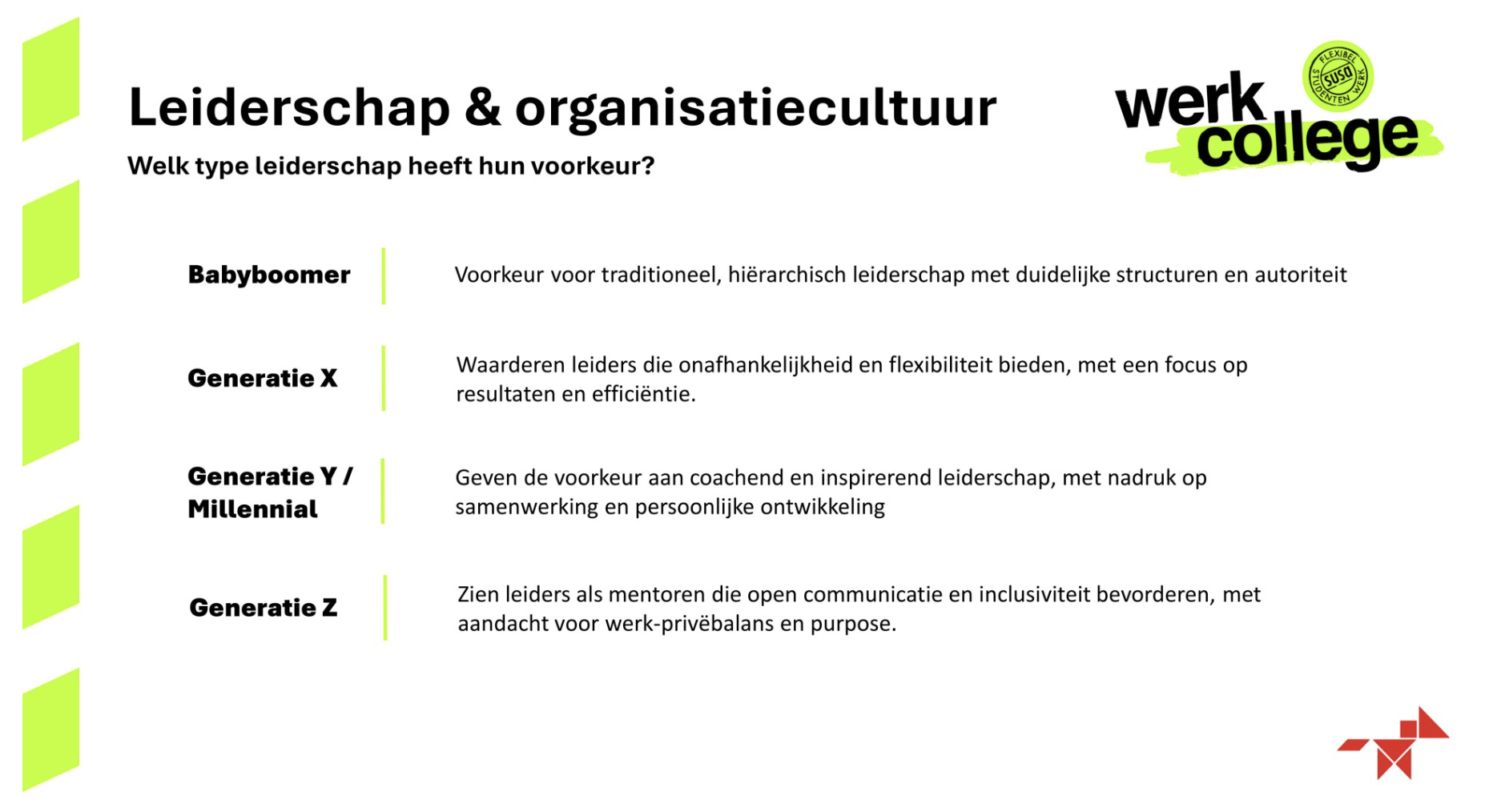
Which generation prefers which type of leadership? – click to enlarge
Of course, it depends on the extent to which there is a shared vision of leadership, but where that vision is lacking or less strong, you run the risk that older people are somewhat more task-oriented than younger people. That does not always work for younger people, so adjustment is then necessary and that is often somewhat more complicated for older employees. The manager has an exemplary role in this and of course the most important thing is that objectives must be shared and supported, even if there are differences in views on and preferences in leadership between generations.
Feedback remains a complicated thing
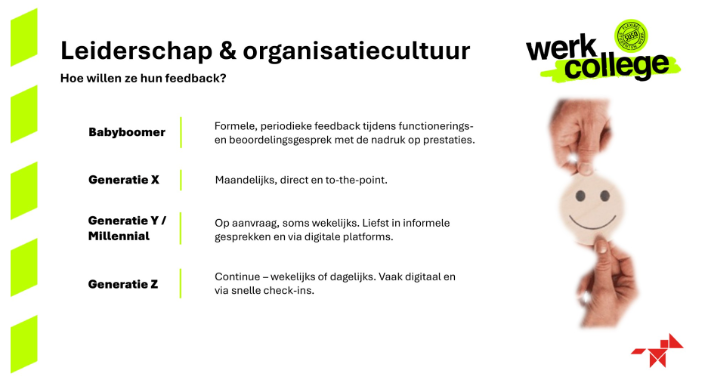
Preferences for giving and receiving feedback – click to enlarge
Giving and receiving feedback is important in leadership: Gen Z prefers this to be high-frequency, short and concise and often also digital; older people attach more importance to formal moments that are planned periodically. Dealing with feedback, the group reveals, is complicated for many, regardless of age. Older people are less open to feedback, young people are less resilient if feedback has a negative component or comes down to 'no'. And giving feedback on content is easier for all generations than giving feedback on attitude and behavior. One of the participants in the Workshop has therefore introduced the Feedback Challenge, based on the Oscar Feedback Model.
Synergy between generations
It is a fact that young and old can each contribute their own insights and experiences. The great added value of diversity in teams has also been scientifically proven. Young people bring a fresh perspective, among other things. Older people are important in socialization and in training on the job. This sometimes includes the elephant paths: workarounds to circumvent cumbersome processes. Sharing these workarounds is not always positive, as is evident from the experiences of some participants. It can also lead to neglecting important company procedures, such as in financial services.
Gen Z wants to develop and older people have a wealth of knowledge and experience. This is an important opportunity to create connection. Claudia has more tips to gain added value from the combination of different generations, or a diverse team (in terms of age).
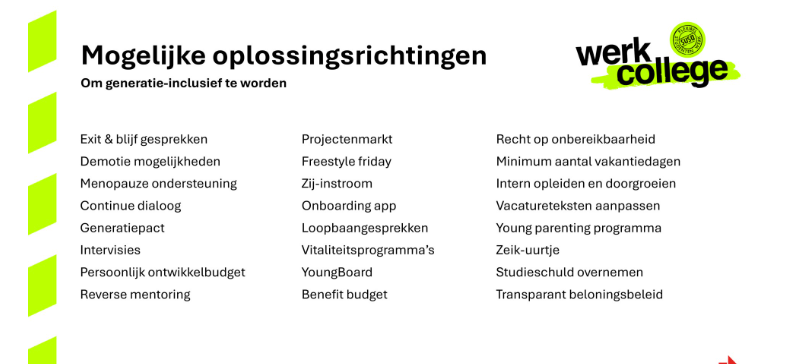 Tip 1: Understand and respect different perspectives – It starts, as always and everywhere, with communication. Encourage conversations, where genuine curiosity, for example about each other's motivations, is a good starting point. You can organize these conversations explicitly, but you can also just start them during the daily lunch.
Tip 2: Encourage knowledge sharing – In addition to initiating dialogue, it is important that everyone is aware of the unique knowledge and insights of the other. You can use this as part of reversed mentoring, a method in which older and younger people coach each other as a couple in specific areas. This can be temporary or for a longer period, according to Claudia. It is also possible to set up a 'Young Board'. In this case, you put someone from Gen Z in the MT or set up a young board of directors in the way that Vattenfall has done, for example.
Tip 3: Create an attractive working environment – Taking each other into account is part of this, as is ensuring a safe culture. 'Freestyle Friday' emerged as a striking example from one of the participants: on Friday you work on a project of a colleague or another department. "This contributes to connection." What does have an influence is how employees and projects are 'matched'. Are you assigned by a senior without consultation or can you sign up for a project that appeals to you, for example via a so-called internal project market?
Bonus tips from the participant group
Tip 1: Development time – One of the participants talks about the way in which working hours are viewed. The employer in question assumes a maximum of 8 hours of telephone work for an 5-hour working day. 1 hour is added to this for customer contact work via other channels. What remains is seen as 'OT' or development time. This can be used for bila's, brainstorming, projects, training, e-learning or watching communication videos. The result of this approach: more work is done in the five hours than previously in the eight hours.
Tip 2: Login time is work time – If you require employees to be 'logged in and ready' at 09.00:XNUMX to be able to speak to the first customer, you can schedule them a quarter of an hour earlier. That quarter of an hour can then also be used to go through the latest information. Incidentally, you can (generally) assume that login time or other forms of necessary preparation time are also paid working time is.
Tip 3: Be available – or not – The right to be unreachable can be an issue, especially when you want to approach customer contact employees at the last minute with a request to work extra hours. One of the participants has a tip: only approach people who have indicated via an app that they are available for extra hours. Make agreements about apps and other messaging: for example, about when you do or do not expect a response.
SUSA's Workshop is an informal way to focus in a short time knowledge and gain experience through experts and exchange with colleagues on a relevant and/or current issue regarding flexible working. In a maximum of 2 hours you will be updated online. The last edition of SUSA's Werkcollege was attended by: Vattenfall, ABN AMRO, Essent, Fox Reizen, NN Triodos, Zilveren Kruis, Mediahuis.
(Ziptone/editors)


Also interesting
-

Norbert van Liemt reflects on his leadership role at TP. He advocates for the merger of WFC and KSF. “We…
-

A persistent story is circulating in the world of customer contact about 'interest'. What is going on here?
-

Organizations save up to fifteen percent on wage costs with a flexible pool on their own contract, while SUSA is the driving force behind…