
Some providers claim you can have a chatbot up and running within a week. But VANAD Engage doesn't believe in plug and play. Domain knowledge of customer contact and your own customer contact process is essential for generative AI applications to work effectively.
The chatbot is called Archie and at VANAD Engage it is the platform for a range of generative AI applications: from a knowledge base and (real-time) agent assist to a voice bot and process automation.
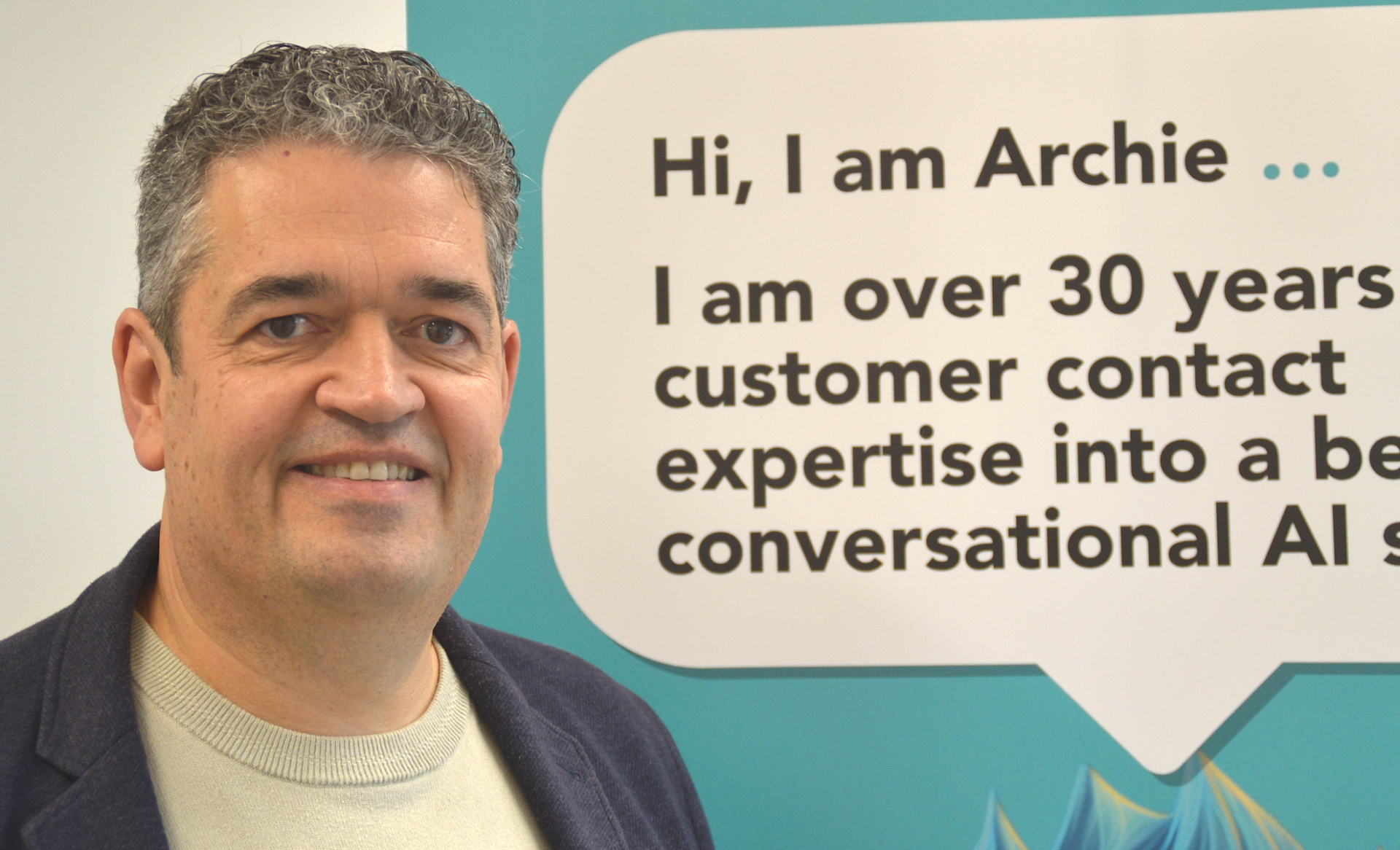
François de Leeuwe
But before we get to Archie and the meaning of "domain knowledge," let's first delve into the future of customer contact. Further automation of customer contact seems inevitable. The number of interactions between companies and consumers will continue to increase in the near future. François de Leeuwe, digital experience director at Archie: “At the same time, there will be fewer people available to manage all those interactions; labor market shortages will increase.”
Volume of interactions is growing
Lenhard Los, CEO VANAD Engage: "Everyone thinks of digitalization and AI primarily in terms of 'less contact.' The volume of live contact—human to human—will indeed shrink. But the number of interactions is constantly growing. That's not a bad thing; quite the opposite. As an organization, you should embrace this if you want to stay connected with your customers. The challenge for organizations is to remain open to all these customer signals. But our experience is that companies are becoming increasingly closed off. Direct accessibility is something few companies still offer."
VANAD Engage, like its sister company QuandaGo (more on that below), has strong ideas about how to develop and deploy technology applications. For example, Archie works exclusively in conjunction with Retrieval Augmented Generation (RAG). De Leeuwe considers this a fundamental design principle. Another key feature of Archie is its Dutch software product, a factor that has gained significant relevance since the beginning of this year.
Reduce risks with RAG
"RAG implies that the LLM, based on prompts, only consults designated, isolated sources—such as a knowledge base," De Leeuwe explains. "This significantly reduces the risk of incorrect answers or hallucinations, due to inconsistent and ambiguous information." While using RAG doesn't guarantee error-free output (an LLM might consult the wrong documents in a knowledge base or encounter ambiguous or contradictory information), these kinds of problems can largely be prevented by continuously monitoring the quality of both the LLM and the knowledge base. After all, a knowledge base is never finished, and LLMs also continue to develop.
In addition, De Leeuwe explains, users can configure Archie's reliability. This is particularly relevant for more complex questions. "If there's a certain degree of uncertainty—or if the answer can't be found at all—a question can be escalated to an agent who takes over the conversation. Or to a quality control officer who takes action if the knowledge base falls short."
Knowledge base is the success factor
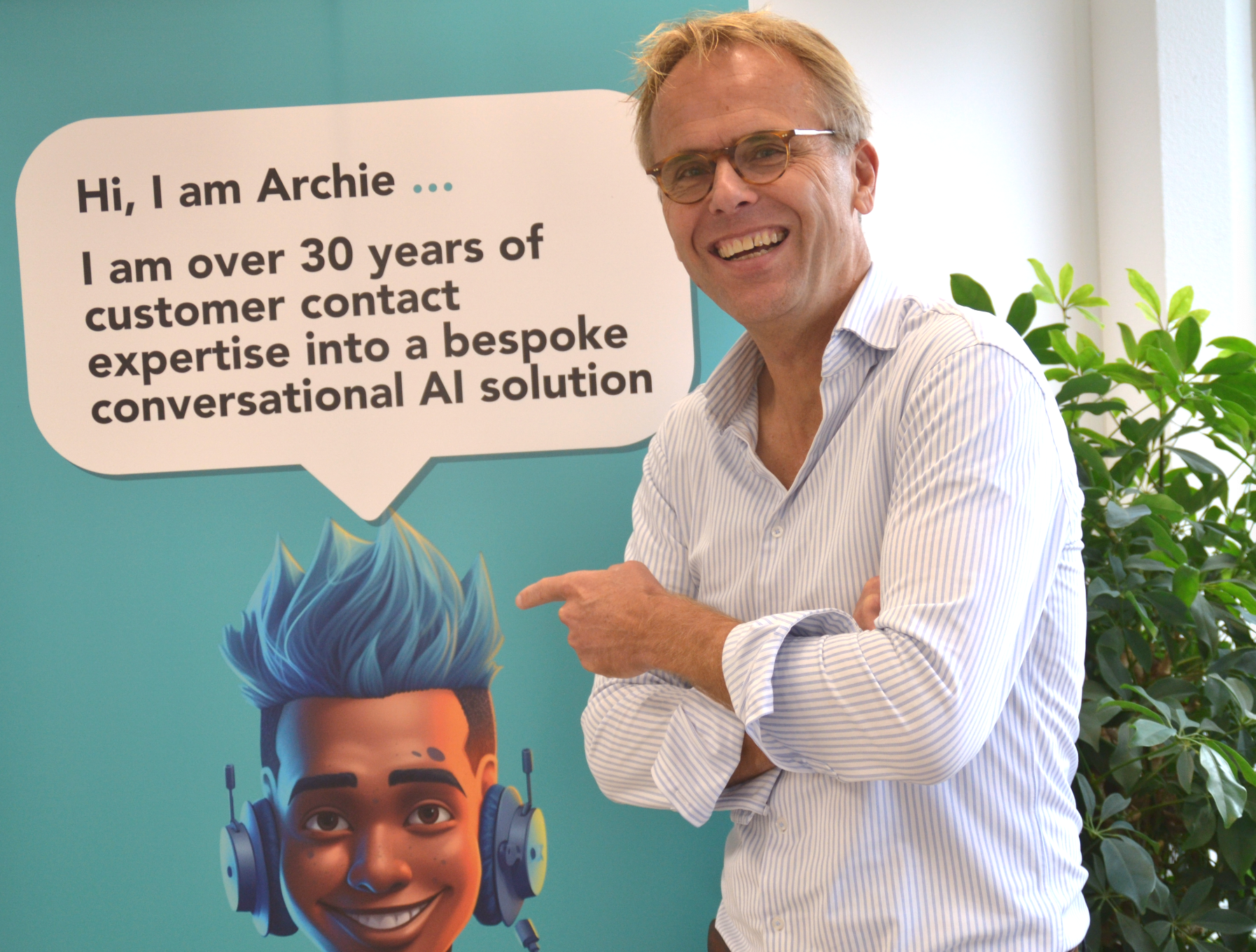
Lenhard Los
Anyone who wants to get a chatbot up and running in just a few days needs an excellent knowledge base. In practice, however, the knowledge base is often flawed, leaving consumers to contend with a frustrating chatbot.
Los: "There are many new entrants in the chatbot market. If you just purchase technology without domain knowledge of customer contact, you're only getting one piece of the puzzle. Anyone who starts working with this technology can't avoid looking at customer contact holistically. What are all those thousands of questions about?"
"Often, there's a knowledge base, but it's poorly structured, meaning a chatbot can't deliver much quality," says De Leeuwe. "We retrieve 25.000 recent conversations from our client, which we then apply to the client's existing knowledge base. Ideally, this results in a reasonable response to about two-thirds of the client's questions. These results give you a good idea of the questions that require improvement in the knowledge base. We can point out what's missing, but the client is responsible for validating the content."
Los adds: "The speed of this process also depends on the capacity a client dedicates to it. A knowledge base process like this is quite labor-intensive. The work is mainly in formulating answers to the more complex questions."
Support for automation
Archie's approach not only clarifies what all those customer inquiries are about, but also provides guidance in deciding which questions should be handled by a human agent and which are suitable for automated processing. "It's an ongoing process that you carry out together," says Los. "That's why we don't believe in plug and play: just give all your questions to a chatbot and go."
To prevent Archie from getting lost when follow-up actions are required after answering a question, all work instructions and processes are included in an intermediate layer. These instructions are, of course, not presented to the customer via a bot, but to the employee. "Consider an action like changing the email address in the customer information. The customer can make such a change themselves in the My account, but the employee can also do it for the customer," De Leeuwe explains.
DNA of Engage
The fact that VANAD Engage, of all companies, offers a solution like Archie aligns with Engage's DNA. Years ago, the company was the incubator of the contact center solution Aloha, which was then spun off and incorporated into sister company and CCaaS provider QuandaGo. That platform, too, is evolving from a CCaaS platform to a SaaS solution for process automation in customer contact.
Archie is also offered as a SaaS solution. Its customers include VANAD Engage's BPO clients, as well as those who don't use BPO facilities. This aligns well with the changing role of facility contact centers, which are trying to climb the value chain from their customer contact practices. Or, in plain English: fewer agents, more software and consultancy.
Transformation
Los explains: "VANAD Engage has consciously chosen to offset the gradual decline in FTE-related services in the coming years with other service providers. We make these choices together with our clients: what do you want to address first? We also agree on the level of support the client needs, for example, to get their knowledge management in order. Because some clients are much further along in this process than others."
"The bottom line is that the TCO for customers can gradually decrease while the number of interactions potentially increases – that aligns well with the pursuit of lower costs, which has long been standard practice in this industry. We're also exploring ways to achieve this while also improving the customer experience," says Los. "And as mentioned, it's important that customers stay connected to your brand. For example, as a retailer, you want to be increasingly close to your customers. If you run out of peanut butter and say 'order peanut butter' to your voice assistant, you want that jar to end up in your shopping cart."
Impact on customer contact job
What impact does Archie have on the agent's work?
Los considers the agent assist functionality a valuable asset. "Automated call summarization or logging—sometimes extensive, sometimes with a code—can be neglected when a contact center becomes more busy. And agent assist is a real advantage for employees, who can now fully rely on an interactive and tailored resource for help with their daily work. Contact centers often still rely on acquiring a wealth of product, process, and system knowledge in just a few weeks. Then, several weeks or months of onboarding follow. After a year or so, it all starts over again. You can now truly streamline the contact center's knowledge management process."
De Leeuwe: "In a traditional knowledge base, you have to search as an agent, and the search result is a knowledge article. Now, employees can ask a specific question and receive a suitable answer. That's the merit of AI."
Customer facing AI is a big step
Furthermore, the number of simple questions will decrease once you make the chatbot available to customers. This step is possible once most of the missing knowledge has been filled in: you then have a thorough understanding of how well Archie can answer all questions.
Customer-facing is a big step for many companies. Anyone who wants to take that step still needs to give Archie access to dynamic data like real-time order information or financial information.
"The next step is agentic AI," says Los. "We already have a customer who uses this to automatically handle all returns. It's currently still rules-based, but it will soon become agentic because then all the databases will be in order. That's precisely why agentic AI hasn't taken off yet. Companies are running into all kinds of backlogs and legal and capacity issues."
Archie Voice is the basis for real-time agent assistance
VANAD Engage is now preparing for Archie Voice's go-to-market. This will enable both real-time agent assistance and customer-facing voicebots. The first API is ready, specifically for Amazon Connect; other platforms will follow soon, according to Los and De Leeuwe.
With AI increasingly advancing into the front office, the question arises: what do we still need employees for? Is the answer, as always, "empathy"?
Los is clear about this. "If you have a chip in your windshield, you can do without empathy. But if you're involved in a collision with personal injury, you're grateful to speak to a human being."
De Leeuwe adds: "Adoption varies from person to person and from situation to situation. Do customers prefer to report the death of a family member to an empathetic bot? Or do they still prefer to speak to a human?"
Los: "It's up to organizations to keep an eye on the balance, but as mentioned, we've seen that companies have generally become less accessible in recent years. I think that also presents a challenge for customer contact professionals. How do you ensure that your company is there for the customer at the right time?"
Logical roadmap for GenAI in customer contact
The path companies can take with their customer contact seems to be clearly defined: from agent assist, to real-time agent assist, to customer-facing chatbots and voicebots. Finally, real-time speech translation, with or without a voicebot, is the next step.
De Leeuwe expects that last application will take some time to materialize. "I don't see the feeling of a good conversation being realized within a year. It's not just about latency, but also about interruptions in the dialogue—people are constantly interrupting each other, and speech technology can't handle that process well enough yet."
Synergy
And finally. The conversation with VANAD Engage takes place on the same campus where QuandaGo is located. Next door, work is underway on AIDA, QuandaGo's AI agent. What are the differences with Archie?
De Leeuwe: “We automate knowledge, QuandaGo automates processes. VANAD Engage starts from the customer contact practice of the BPO, so CX. When further developing Archie, we regularly involve line employees: 'What do you do when this question comes up? What needs to be done then?' Starting from the practical side instead of the IT side gives us a competitive edge.”
Los: “Of course, we collaborate with QuandaGo. But we have in-house domain knowledge that we can market, including through applications. We're seeing the economies of scale of BPOs diminish in relevance. On the other hand, we're becoming increasingly closely involved with our clients' processes. Perhaps business process optimization is a better description of BPO. We're transforming from a technology and capacity company into a knowledge and consultancy firm.”
(Ziptone/Erik Bouwer)


Also interesting
-
VANAD Interactions is preparing for the next major change in customer contact: after offshoring comes further automation and digitalization.
-

At VANAD Engage, Zaman will be responsible for attracting international clients and optimizing the relationship with these…
-
Inspire’s BPO activities now fall under VANAD Interactions; Inspire itself is spreading its wings and broadening its portfolio of…