
The global customer contact BPO industry has finally begun its long-awaited transformation. This is leading to various shifts.
Analysts have long agreed: traditional outsourced contact centers must adapt their revenue model. Whenever the potential of AI made the news, the share prices of major BPO players suffered damage. This became a serious matter due to the strategy reports from Klarna, but the sector was already under pressure much longer.
In recent years, many BPOs have started shifting course, and Dutch outsourced contact centers are no exception. The transformation is now taking serious shape: it is visible in multiple places.
For those who want to understand what is happening, it is good to look at the Philippines, for years the global breeding ground of the BPO sector.
Philippines as indicator

TP Office, Manila – Image: Shutterstock
The figures of the Philippine trade association IBPAP a “reasonable indicator of the health of the sector”, according to trade journal HRDIn 2025, $40 billion in export revenue was recorded with approximately 1,9 million employees. For the end of 2026, $42,3 billion in revenue and 1,96 million employees are projected. That is considerably lower than the original forecast (published in 2022 and extending to 2028): that projected 59 billion dollars in revenue and 2,5 million jobs.
IBPAP attributes the decline to AI, changing purchasing behavior, and increasing global competition. And, importantly, the decline is caused by a contraction of voice services. BPO services in healthcare and finance are still growing.
Part of that contraction may be invisible because large Philippine BPOs often have thousands of employees with 'floating status'. These are employees who are included in available capacity and employment figures, but who are not paid (for up to six months). Furthermore, in the Philippines, it is not common to announce (mass) layoffs.
Growth, yes, but not primarily in FTE
HRD reports that the outsourcing industry is not 'demolishedbut will function differently. It is the familiar story: simple work is increasingly disappearing due to automation, leaving complex tasks behind. In certain cases, these complex tasks can be moved to offshore hubs, because AI tools make it possible to deploy less experienced employees. Technology reduces the quality gap between onshore and offshore. This does not make offshoring redundant, but can actually make it more attractive. It explains the rise of a range of new sourcing destinations.
That raises the expectation that there is room for further growth in terms of FTE, yet that is not a given. Independent research by analyst agency Cavell showed that global demand for human contact center employees continues to grow from 15,3 million in 2025 to 16,8 million in 2029. But Cavell also calculated that automation will result in the absence of 1,9 million new customer contact jobs during the same period. A similar development appears to be occurring in SurinameCompanies expect to grow, but not primarily in seats or FTEs. The difference lies in the deployment of AI-based tooling for employees and process automation.
Changes in the business model
BPOs are applying generative AI on a large scale in their customer contact operations. In doing so, they are also investing in new capabilities – analytics, process automation, consultancy – and in technology. Tech investments sometimes take place via acquisitions or partnerships, and sometimes they originate in-house. This is also visible in the Netherlands, for example at Archie (Vanad Interactions), iX Hello (Concentrix), FabAI (TP), Vavox (ContactCare), and Yava (Yource). Even small Dutch niche players who explicitly do not opt for the offshore model, investing in AI.
Changes in competencies
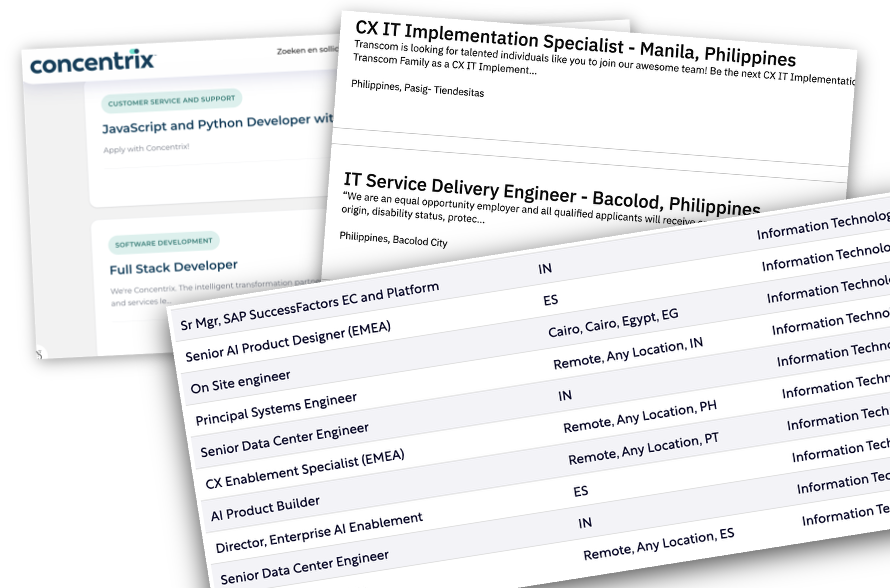
A second effect of the transformation is a changing staffing need within the BPOs themselves. This adjustment is sometimes gradual and sometimes abrupt. Customer contact service providers active for Dutch clients will, in the coming period, be looking more for developers, architects, application specialists, data scientists, and conversational designers than for coaches, team leaders, and contact center managers.
New locations
For some, this is a hard-to-digest message, but service providers are constantly finding new opportunities regarding wage cost advantages. Outsourcers are responding to this, which has been the case since a a few years leads to substantial investments in new delivery hubs. In 2025, Ziptone reported five emerging destinations in Africa: Benin, Cameroon, Ethiopia, Rwanda and TogoLess than a year later, it became clear that a number of larger BPO players were opting for Egypt, including TP, Konecta, TTEC, Foundever, Alorica, and Transcom. South Africa has also experienced a significant growth spurt and is particularly popular among British companies.

Cairo, Egypt – Image: Shutterstock
In our own country as well, it is increasingly heard that the growth of the local BPO sector has not been taking place in the Netherlands for some time. With regard to destination and work packages, service providers active in the Netherlands are increasingly opting for locations and clients that enable a higher margin.
That course, aimed at higher margins, was already set years ago by TP Benelux. At the time, the market leader said goodbye to 'squeezing contracts' or clients who “purchasing capacity at the lowest possible priceSince then, TP has focused on “projects higher up the value chain, where healthy margins are possible,” said former TP Benelux CEO Norbert van Liemt to ZiptoneHe mentioned six to seven percent.
Soleo, a smaller Dutch player, also opted for operations in Turkey some time ago, alongside an existing location in Curaçao and collaboration with partner Custom Connect in Suriname. Jac Vermeer mentioned in this context the razor-thin margins in facility customer contact.
Transcom is one of the BPO players that the strategy, aimed at destinations with higher margins, explicitly names and realizes. Also Vanad InteractionsContactCare and Change CX are explicitly selective in customer choice and in (foreign) destinations. Custom Connect expanded to earlier this year Hungary, Croatia and Poland. Most recent example of a BPO player who adjusts the internal organization: TP.
Moreover, offshore locations are developing qualitatively: for example, the Surinamese BPO sector cannot be compared to that of twenty years ago, when the first BPOs set foot ashore there.
Repricing
The British BPO sector is remarkably outspoken regarding margins. Although British BPO players are anticipating a 19% volume loss through 2027 due to AI, they expect to grow by nearly 9%. The British CCMA explains this contradiction by stating that the market is 'repricing' itself. Incidentally, these expectations from the 28 surveyed companies range from -25% to +30%.
What does that pricing entail? In the CCMA report, BPO players send a clear message to their clients: either pay more or offshore. CCMA UK believes that (fixed) input pricing no longer works in many cases. Instead, outcome-based billing models will need to be considered. For example, models based on CSAT, revenue or retention targets, or productivity and efficiency improvements. CCMA CEO Leigh Hopwood phrases this as a shift from models built on volume and costs to models built on capability, accountability, and outcomes.
True partnerships remain complicated
Whether that will succeed is the question. Writing in a contract that you want to bill based on outcome is one thing, but putting this into practice without putting the relationship under pressure is another. That requires a broader mandate from the BPO party; outsourcers often find it difficult to understand that they will have to pay a higher price per interaction with lower volumes and more automation.
It must be said: the report by the British CCMA is primarily a market view from the perspective of the 28 large and smaller BPO companies active in the British outsourcing market. Together, they account for 52.000 (local) FTEs, distributed across 193 delivery centers in the United Kingdom. The British business community has been a frontrunner in offshoring and outsourcing since the 90s; the British government also participated in this for a long time. Of those 52.000 FTEs, over 21 percent work on assignments for the public sector.
Over 80 percent of British BPO players expect clients to offshore more in 2026/27. The question is no longer whether companies will opt for offshoring, but rather which work packages they will designate for this, according to CCMA UK.
Pay more, further from home
Paying more for local services or offshoring is hardly a dilemma for most outsourcers anymore. What is new, however, is that alternative destinations have emerged that yield additional wage cost benefits. This benefit can only be realized if outsourcers' data and content are suitable for further automation using AI. If BPO players raise their rates—and trade unions also play a role in this—a new wave of offshoring, including in the Netherlands, cannot be ruled out.
(Ziptone/Erik Bouwer)
The CCMA UK report can be requested here.


Also interesting
-

weWow aims to redefine BPO with an AI-first approach that guarantees results. Dirk Jan Dokman explains.
-

Premature deployment of GenAI chatbots and virtual agents for customer contact will lead to increased consumer skepticism, according to Forrester.
-

That annual Christmas dinner... it's surprisingly similar to the WFM meeting in a typical customer contact environment.