
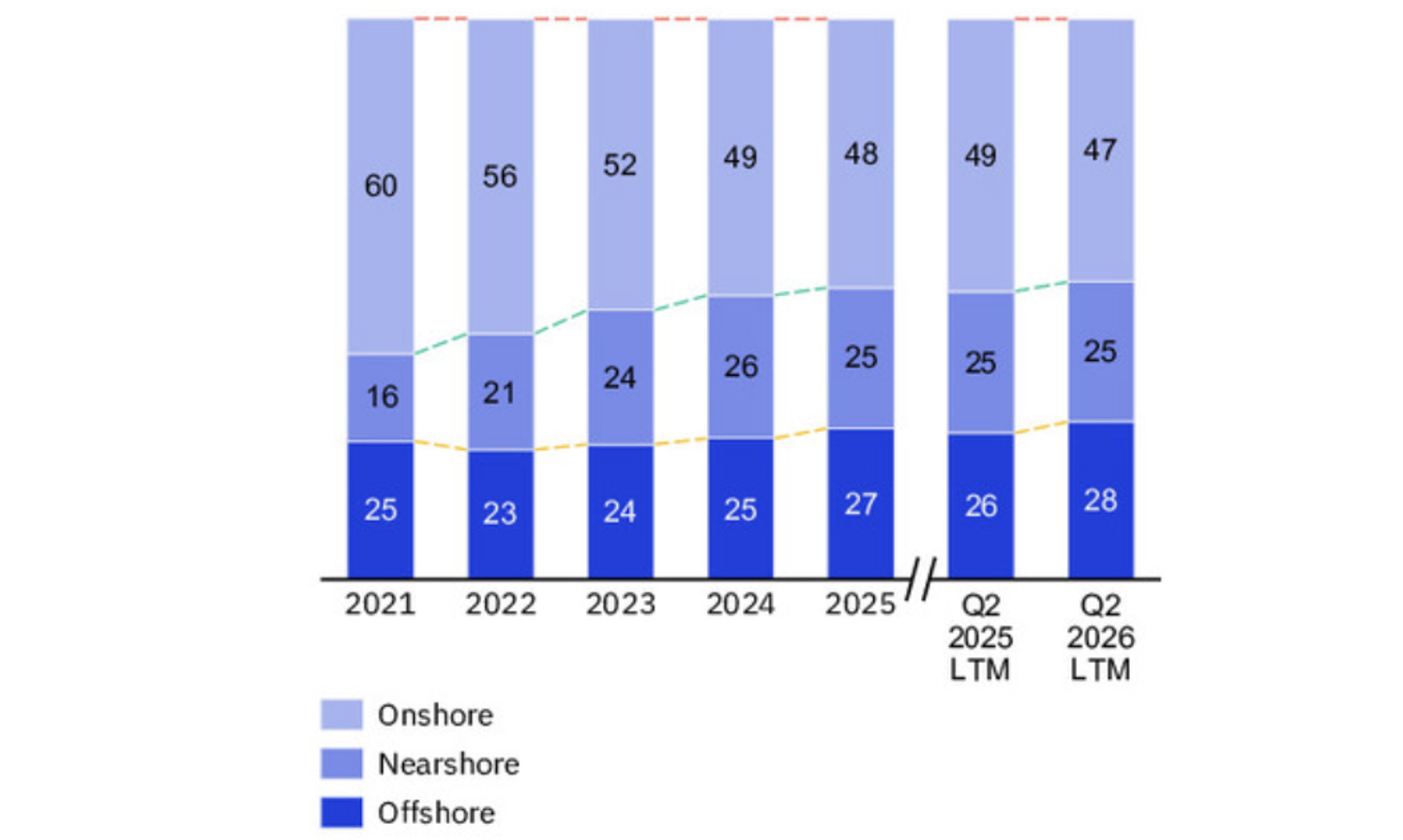
Share of revenue by type of delivery, %. Source: Transcom
The transformation of BPO service provider Transcom is virtually complete, and the company is explicitly choosing both clients and sourcing destinations that contribute better to the margin. With this, Transcom appears to be preparing for an exit.
That can be deduced from the earnings call of July 17, in which the CEO Brian Johnson and CFO Cecilia Bergendahl provided commentary on the quarterly figures. These were unequivocally good: nearly 6 percent organic growth, a rising EBITDA margin, and a significantly lower debt burden. An important signal comes from the sharp decline in one-off expenses. In Q2 2025, the company still booked €8,7 million in one-off charges, including for reorganizations; in the past quarter, this was reduced to €1,1 million. Furthermore, there is no longer any impact from site closures. At group level, revenue rose to €185,1 million, and the EBITDA margin increased from 8,3 to 9,5 percent.
Less onshore, more offshore
Low incidental costs, declining debt, and rising margins go hand in hand with the tightened sourcing strategy. The share of onshore revenue fell from 60 percent in 2021 to 47 percent in the figures through Q2 2026, while offshore rose from 25 to 28 percent and nearshore revenue remained stable at 25 percent. Of all new contracts in the first half of 2026, 84 percent were near- or offshore, of which 67 percentage points were fully offshore. This shift also explains the margin improvement. The UK, strongly offshore-driven division is growing rapidly and generates a margin of 14,4 percent. The larger, but fragmented European division is growing at a slower pace, around 1,5 percent, and yields a margin of 7,4 percent. Transcom is also shifting towards higher-margin sectors, such as e-commerce and tech, and services and utilities.
In 2024, branches in Germany (Berlin and Essen, closed as a result of bankruptcy, the company recently ended operations from the Netherlands with the planned closure of the location in Groningen.
Growth in offshore destinations
The decision to offshoring is leading to further expansion in the Philippines, India, Egypt, Tunisia, and Colombia, among others. New sites are being opened in various countries, while sites are being closed in Europe. That operation is not yet over, according to Bergendahl: “We are really continuing to reduce the number of sites in EMEA and Europe.” From now on, this will primarily be done through regular contract termination or subleasing, “so that we do not necessarily have to incur closure costs.”
Job relocation is taking place in combination with AI – and for the latter to work, people are still needed. “There will be an evolution in which more is done with less,” said Johnson, who also stated that people will not become redundant but that their role will change. According to him, technology will “not so much slow down revenue growth, but rather the need for extra people to serve that growth.” Incidentally, no AI revenue figure was yet visible on the slides Transcom showed.
In the shop-window
Transcom has been wholly owned by the Swedish private equity firm Altor since 2017, which took the company off Nasdaq Stockholm at the time with a bid that yielded more than 98 percent of the shares. In the Q&A, Johnson and Bergendahl were asked about the owner's progress in finding a buyer, something that owner Altor had done before. suggestedJohnson was clear about the direction during the earnings call: “Our ultimate goal is to find a potential exit path, but for now, we are focusing on further improving the business.”
Last year, Altor successfully reached arrangements regarding its debt burden. This has reduced the pressure for a quick exit. In the meantime, Transcom is visibly working on its sellability: attractive in size, strong in offshore, and strongly AI-driven.
(Ziptone/Erik Bouwer)


Also interesting
-
BPO player Transcom has improved margins in 2025 and is focusing on AI and offshore growth, particularly in India…
-

Transcom Egypt won bronze, gold, and silver for "Best Customer Service in Europe" with TUI and Samsung, respectively.
-
Transcom launches Transcom Leading Voices, a new thought leadership platform that brings together various types of content in one place.