
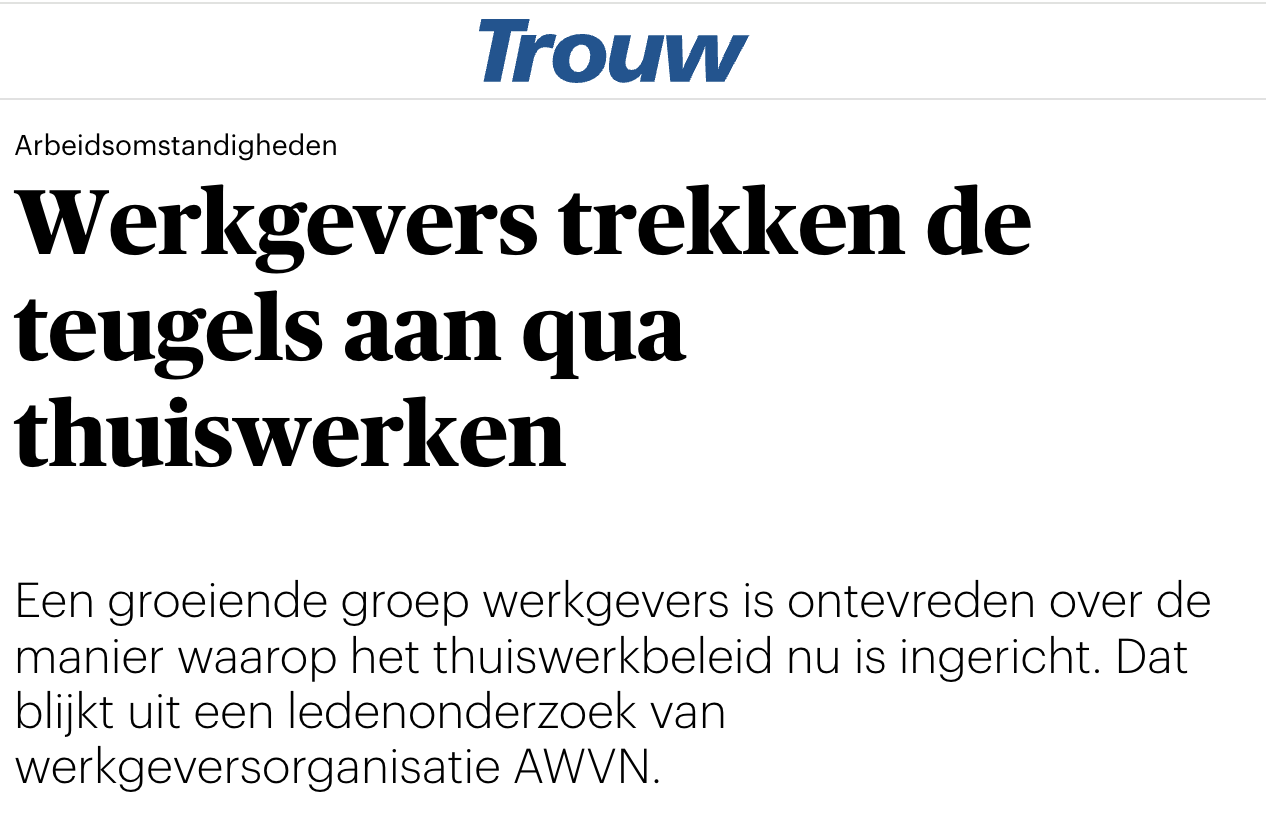
 It is becoming clear that more and more employers tightening the reins when it comes to working from homeDespite the benefits employees experience—such as less travel time, increased concentration, and a better work-life balance—the pressure to return to the office more often is growing.
The reason? The organization is experiencing lower employee engagement. Management is resorting to the Pavlovian response to gain control. I hear this more and more often in the customer service sector. But time and again, I wonder whether this is due to the type of employee or the fact that they're working from home. But let's be honest: a sense of decreased engagement and control isn't the fault of the employees, nor is it the fault of working from home. It's the fault of leadership.
Many managers struggle with managing remote teams. They miss the informal coffee breaks, the spontaneous meetings, and the direct supervision. Instead of adapting their leadership style to the new reality, they fall back on old patterns: control, presence, and visibility. But that's not a solution—it's a symptom of a deeper problem: a large group of fearful managers who have little confidence in their environment.
Engagement isn't created by physical presence, but by good leadership. Managers who inspire trust, set clear goals, and show genuine care build strong teams—regardless of where those teams operate. If these qualities aren't present, you're not a manager, you're a damager. Working in the office is more likely to lead to high turnover.
Johnny Heitinga's situation at Ajax is a prime example. None of the players worked from home; he simply had them in front of him during training sessions and matches. Despite his experience as a player and his commitment to Ajax, he failed to inspire the team to cohesion and performance.
The lesson? Engagement and high performance aren't a matter of location or effort, but of leadership. And leadership requires development, reflection, and the ability to adapt to the times. Three tips for leaders who want to boost employee engagement – even remotely.
1. Trust in autonomy and focus on output
Let go of the need to "see" your employees to lead effectively. Give them the trust and the necessary tools to do their work. Consider, for example, a good knowledge base so they can find all the information they need and don't have to constantly visit a team leader or resource. Manage output or outcomes by deploying the right systems effectively; AQM and analytics tools to understand the topics of conversations can help with this.
2. Communicate with rhythm and empathy
Establish regular contact moments, both formal and informal. Don't just ask about progress, but also about well-being. A simple "How are you really doing?" can make all the difference. Digital communication doesn't have to be distant—as long as you make it personal and show genuine interest.
3. Create a healthy culture
Engagement thrives in a culture of trust, appreciation, and connection. Organize virtual team moments, celebrate successes together, and involve employees in decision-making. If possible, make decisions together. And if not, inform them about the decision-making process. Show them that everyone matters. This leads to engagement and a desire to meet in person.
Rolling back the freedom to work from home is a missed opportunity
I love socializing and enjoy celebrating successes with drinks. Celebrating birthdays at the office. Brainstorming in a conference room where, at the end of the day, you can smell the hard work. Or just spending a day with colleagues. But completely reversing the work-from-home option isn't a solution to a leadership problem. It's a missed opportunity.
Organizations that want to thrive in a hybrid world must invest in leadership that connects, inspires, and builds trust. Because engagement doesn't start at the workplace—it starts with how you lead. And if you, as a manager, don't see that, you might as well go home.
(Ziptone/Mark Elschot)


Also interesting
-

It doesn't matter which process you want to transfer or automate. First, make sure the process is in order and optimized...
-

For contact centers, a full return to the office would be a fool's errand. Anyone who makes working from home impossible is shooting themselves in the foot...
-

A housing association talks about "Information Booklet" and "Consultation Hour." Is treating your clients like toddlers the solution if you...