

Image: Shutterstock
The court has ruled that Booking.com may require employees to be in the office for 40 percent of their working time. Ziptone surveyed nine contact centers regarding their work-from-home policy.
Following the ruling in the Booking.com case, Ziptone surveyed the situation. How are outsourced and in-house contact centers handling the work-from-home policy? The differences are significant: ranging from an average of 80 percent working from home for customer service representatives to working largely in the office. Both models work and require specific measures.
Booking.com filed a lawsuit against its own works council because it did not agree to a new policy requiring employees to be in the office for at least 40 percent of the time. The existing work-from-home arrangement was voluntary, resulting in practice in only 27 percent of employees being in the office for 40 percent of their working time. The Amsterdam District Court finds it reasonable that Booking.com requires employees to be in the office for 40 percent of working time, according to the ruling of October 28. Booking.com's argument that mutual contact is conducive to the work culture is convincing in the court's opinion; mandating it is permissible because the voluntary arrangement has not worked so far.
Ziptone asked various Dutch outsourced and in-house contact centers about their policy regarding working from home, and about their experiences and intentions concerning this policy.
Facility contact centers
With market leader TP The work-from-home policy varies by job group. For customer service representatives and supervisors, the project, the employee's personal preference, and sometimes the customer determine how much work is done in the office. On average, this group works from home about 80 percent; for staff and other support functions, an office standard of at least 60 percent applies, according to TP.
At ContactWorx Working at the office in Rijswijk is currently the starting point. A small number of employees work partially from home, based on individual agreements. The company does not apply a fixed distribution or percentage. “We are currently further developing our agreements regarding working from home.” The company knows that many employees have a need to work from home part-time, “and we take that into account.”
The organization, which is currently only active in the Netherlands, points to the nature of the work: “We work with sensitive personal data for many clients, including in healthcare and insurance.” Although security is technically manageable, what is and isn't possible varies per campaign. “Some of our clients explicitly request execution from our location.” (…) “Where the work and the client allow it, we want to offer flexibility; where that is not possible, we explain why.”
ContactCare applies a fixed rule: a maximum of 60 percent of the time at home, provided the employee meets their KPIs. The company established this rule as soon as the government's advice to work from home during the coronavirus pandemic was lifted. New employees work entirely at the branch for the initial period for onboarding and training. The rule applies to full-time and part-time employees in the Netherlands and Belgium, and to all clients. In Suriname, working at the office is the standard, unless it is not possible to come to the office with the permission of the clients due to, for example, flooding. ContactCare expects managers to work at the office for more than 40 percent of the time.
New employees start at the office
ETB Support Solutions does not apply a fixed division between office and home for customer contact employees. “We determine per client which working arrangement is necessary and possible.” In doing so, the company takes into account the client’s requirements, the complexity of the work, the sensitivity of the data, and the employees’ need for guidance. Employees work at the office, in a hybrid model, or entirely from home. ETB also opts for a phased approach: “New employees start at the office and switch to hybrid or home working as soon as they demonstrably meet targets. If performance declines, temporary guidance returns to the office.” ETB expects management members living in an office city to work in a hybrid model and be at the office regularly. “A fixed number of office days does not apply in this case.” ETB has been using this approach since 2020.
At Change Every new employee starts at the office. “That is a conscious choice. We believe that a socially safe working environment forms the basis for effective functioning, learning, and development.” From that foundation, Change looks at possibilities for flexibility and working from home, where employee experience, necessary guidance, and agreements with clients play a role. “For us, therefore, flexibility begins with a solid foundation of trust, connection, and independence.”
Concentrix calls hybrid working “a fixed part” of work for many employees since the corona pandemic. “However, the optimal balance between working from home and working in the office varies by situation and depends on various factors, such as the position, the nature of the work, the composition of teams, and individual agreements.”
The collective labor agreement and the home/office division – De current collective labor agreement for facility contact centers Contains no agreements regarding mandatory working in the office. Bob Mols, chairman of employers' association WFC, says that within the WFC there is also no need to include rules regarding mandatory working from home in the collective labour agreement. “It is also not a topic in the discussions with the social partners. Agreements have, however, been made regarding the allowances that apply to working from home. We leave further agreements regarding working from home or in the office to the individual members of the WFC.” They can coordinate agreements with their own works council and include them in the employment conditions regulations.
In-house: from 50/50 at Bol to one day at ASN

Image: Shutterstock
At Bowl The policy for customer contact employees is 50 percent from home and 50 percent in the office. “With this, we support effective collaboration within teams, which leads to the best results for our customers and sales partners.” For some parts of customer service, it may be desirable to work more in the office, “and that is indeed what happens.”
ASN Bank works in a hybrid manner and calls flexibility the starting point. “You work from home where possible and come to the office when this contributes to collaboration, learning, creativity, well-being, and strengthening our culture.” The bank’s current collective labor agreement (2025-2026) states that employees must work at the office for at least one day per week on average.
At Essent There are no general rules. “Every department handles this in its own way.” In practice, there are often a number of days per week when colleagues initially work together in the office, and they fill in the rest of the week at their own discretion.
Employers are turning the work-from-home switch – The most recent study by employers' association AWVN (from November 2025) shows that 78 percent of employers already apply a minimum number of office days, usually two per week. Only about one in five collective agreements contains provisions regarding working from home, and these more often concern compensation or the workplace than the mandatory number of office days.
FNV Website – Image: Ziptone
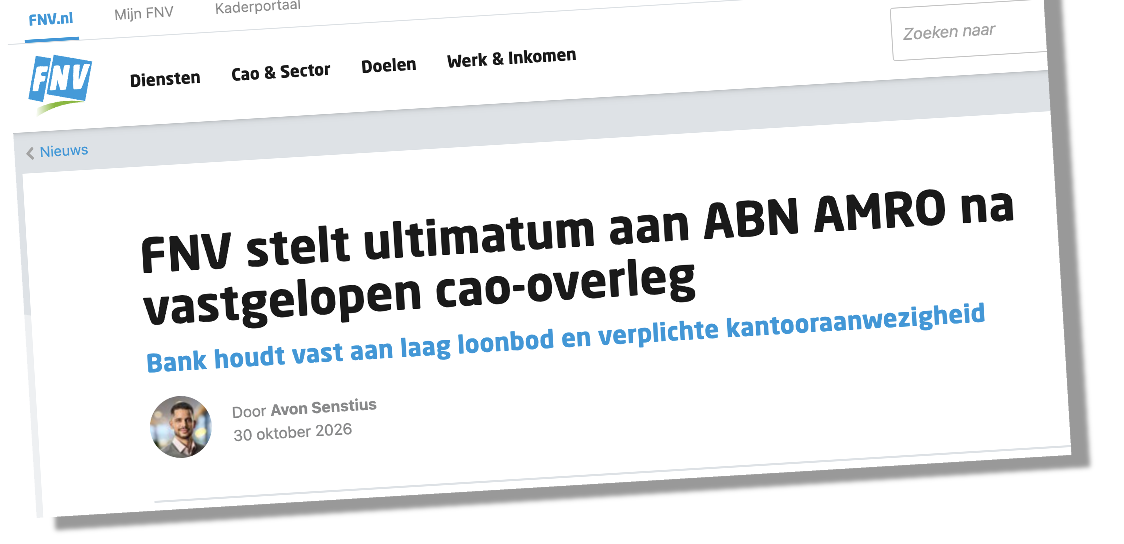
Booking.com is not the only major employer tightening its work-from-home policy. Also VodafoneZiggo recently announced that the company would like employees to henceforth three days a week come to the office. The arguments are similar to those of Booking.com. The plans for new policy are still with the Works Council; currently is two days of presence is still the guidelineFor employees who are unwilling or unable to comply with the new rules, there will be a departure scheme that is temporary and voluntary. In June 2025, demanded ING that employees at least two days a week show up at the office. According to ING, only 60 percent kept that appointment; according to an FNV survey, it was only 42 percent. ABN AMRO announced at the end of May this year that it wanted to stipulate in the new collective labor agreement that employees work at least half of their working time in the office on average. That led to resistance from the trade unions: they are opposed to a general attendance standard; the collective labor agreement negotiations have, moreover, stalled.
Booking need is recognized, contact centers establish their own policy
So much for the policy. Most outsourced contact centers recognize Booking.com's need as an employer to ensure a good connection. They take various measures themselves to this end.
TP reports: “We are pleased that the judge has provided clarity on this matter and ruled in favor of Booking.com.” TP explicitly mentions the benefits of working partially from home: it contributes to flexibility, reduced travel time, and a better work-life balance. TP also states that hybrid working increases recruitment opportunities and reduces office costs. However, the situation is different for operational roles, as the emotional aspect plays a much larger role there. “The work is becoming more complex, and customer inquiries are becoming more difficult and emotionally heavy. After an unfriendly conversation with a customer, customer service representatives are quicker to seek reflection and emotional support from colleagues they truly know.”
When asked at TP, there are hardly any differences between performance for remote workers and office workers. The picture is different regarding absenteeism: “In the first year of working from home, the absenteeism rate was lower than ever, but it is now higher than before the pandemic. It is difficult to pinpoint this specifically, as many factors play a role. However, we do see that the well-being of employees working entirely from home requires extra attention, especially now that work is becoming more complex.”
TP organizes return days, with a budget for snacks and drinks, and invests in online engagement programs, from team sessions to bingo. And TP is once again recruiting more consciously in the vicinity of physical offices, but maintains a broad perspective.
Connection, culture and learning from each other
Also ContactCare agrees with the statement. “We fully recognize Booking.com’s 40 percent; it actually aligns seamlessly with our own rule.” In Amersfoort, ContactCare deliberately chose a smaller building designed to maximize connection rather than providing as many workspaces as possible. “Ultimately, you can work for many companies from home, but at the office, you get a feel for the organization and for each other. This is essential, especially for educating and training new employees.” Connection, culture, and learning from one another are things that quickly fade when working entirely from home, especially for new hires, according to ContactCare. Through the 60 percent rule and the layout of the branches, ContactCare says it keeps this in balance.
Change acknowledges the importance of an initial period in the office, but also states: “At the same time, a strong culture does not automatically develop simply because employees are present in the office for a certain percentage of their time. You can sit next to each other five days a week and barely experience any connection. And you can work remotely and actually have a strong sense of engagement with your colleagues and the organization.” According to Change, remote working requires “extra attention to leadership, development, and mutual connection.”
Solidarity can also happen online

Image: Shutterstock
Also ETB Support Solutions states that working from home and hybrid working can function without sacrificing togetherness. This requires conscious attention to leadership, coaching, and mutual contact. “Simply providing a workspace is not sufficient, regardless of whether it is at home or in the office.” Employee competencies, the complexity of the work, and the client's wishes are guiding principles for ETB. “Our experiences currently provide no grounds to introduce a similar general obligation.” ETB does note, however, that remote guidance and connection must be consciously organized: “Spontaneous contact arises less naturally.” At ETB, a team leader is responsible for a maximum of fifteen employees.
At ContactWorx The opposite is visible. “Booking is bringing people back to the office after years in which attendance was optional; for us, (working at the) office has never gone away, and the question for us is rather where and how we can make room for working from home.” According to ContactWorx, employees learn a lot from the colleagues around them, especially in the beginning: “Quickly asking an experienced colleague or team manager for clarification, listening in on how someone handles a difficult conversation. That is easier in the office than remotely.”
Reasons for policy adjustments
We also asked whether organizations see any reasons or opportunities to adjust the work-from-home policy.
ASN states: “Due to all the discussions about whether or not to come to the office more, people almost forget the many benefits of hybrid working.” These include, among other things, less commuting and therefore less CO2 emissions, less travel time, less office space, and fewer distractions. Nevertheless, ASN Bank would also like to see employees come to the office a little more: “Not in the form of mandatory attendance days, but because they want to and see the benefits.”
TP intends to focus more on in-person moments in the coming period, “because we are convinced that there is added value in that. It is a way to positively distinguish yourself as an employer” compared to an online connection. “But working from home will not disappear; it is here to stay.”
ContactCare sees no reason to adjust the policy now: “It works for us.” However, the company continues to review the function of the office: “fewer square meters, more meeting.”
Also ETB en Essent see no reason to deviate from the current policy.
Change sees no immediate reason to adjust the policy, but is investigating the organization of the work itself. This concerns targeted learning and coaching, and the ability to structure one's own workday – such as sufficient variety and room to recharge after intensive customer contact. “Perhaps as a sector we should talk a little less about where people work and a little more about how we organize the work.”
According to ASN Bank There is no formula that determines where and when the work can best be performed. “It is important that employers and employees understand each other's wishes and find common ground in making good agreements on how and where the work is to be done.”
Accountability – Ziptone posed a number of questions to several in-house and outsourced contact centers: what is the current policy regarding working from home and in the office; to whom does the policy apply; what do they think of Booking.com's requirement; what advantages and disadvantages do organizations experience; to what extent do they measure differences between employees who work primarily from home and those who work primarily in the office; to what extent has the policy been adjusted following the COVID-19 pandemic; and to what extent do they see reasons to further adjust the policy? Responses came from the employers' association AWVN, WFC, TP, Concentrix, ContactWorx, Change, ContactCare, and ETB Support Solutions, as well as from the in-house contact centers Bol, ASN Bank, and Essent. Not all organizations responded to every individual question.
(Ziptone/Erik Bouwer)


Also interesting
-

UJET, a provider of a cloud platform for AI-driven contact center solutions, has opened a development hub in the Portuguese city of Porto.
-

The new location is smaller than the previous one, but the number of workstations in the office is no longer the determining factor for facilities…
-

ContactCare starts with twenty workspaces in the heart of Antwerp, but has room to scale up further.