
What results in very good customer service? This is often difficult to calculate. What has been demonstrated is the cost of very, very poor customer service.
Many companies are investing in automation of customer contact. Organizations can opt for it eliminating personal contact; promoting the use of cheaper service solutions and making processes more efficient to save costs. The question is whether service there – in the eyes of the customer – is better and whether that contributes to (increase) turnover. Investing in better service is the counterpart of the costs of poor service and quite a bit of research has been done into this.
'The cost of poor service'
'The cost of poor service' is a concept that is especially popular in the US among customer experience advocates. Anglo-Saxon companies are more obsessed than in Europe with the impact of poor service – with the most negative outcome being losing customers to a competitor.
The question is to what extent customers stop doing business if there is poor service. Qualtrics XM Institute conducted research into this and listed the facts at the beginning of this year. The company surveyed more than 28.000 people in 26 countries about how they react to recent bad experiences. Dutch consumers are also involved in the research, which was released in January 2024.
The most important conclusion: the risk of customers leaving due to poor service varies per country, per company and of course per customer; and this also applies to the ultimate financial impact.
What is at stake?
click to enlarge. Source: Qualtrics
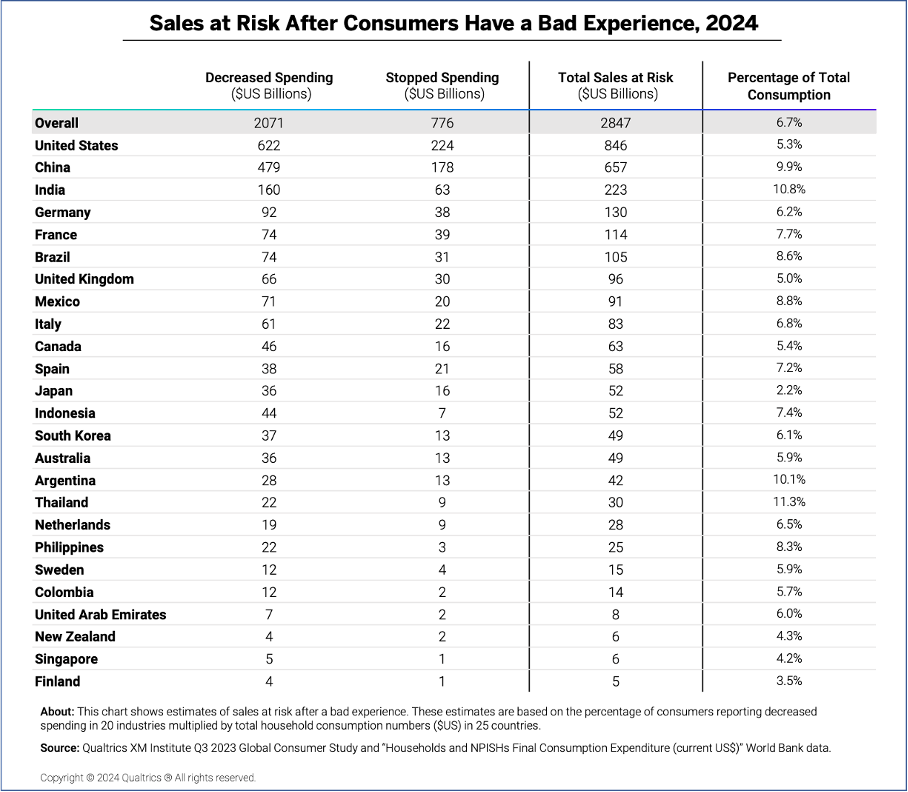
To “monetize” the cost of poor service, Qualtrics calculated the size of “sales at risk” by multiplying the percentage of bad experiences by the percentage of consumers who spend less or nothing at all.
The researchers arrive at a total 'turnover at risk' of 7%. This percentage varies from 2% in Japan to 11% in India and Thailand. Across countries, the percentage who spend less or no more at a company ranges from 37% in New Zealand to 63% in France.
Governments are good at delivering bad experiences
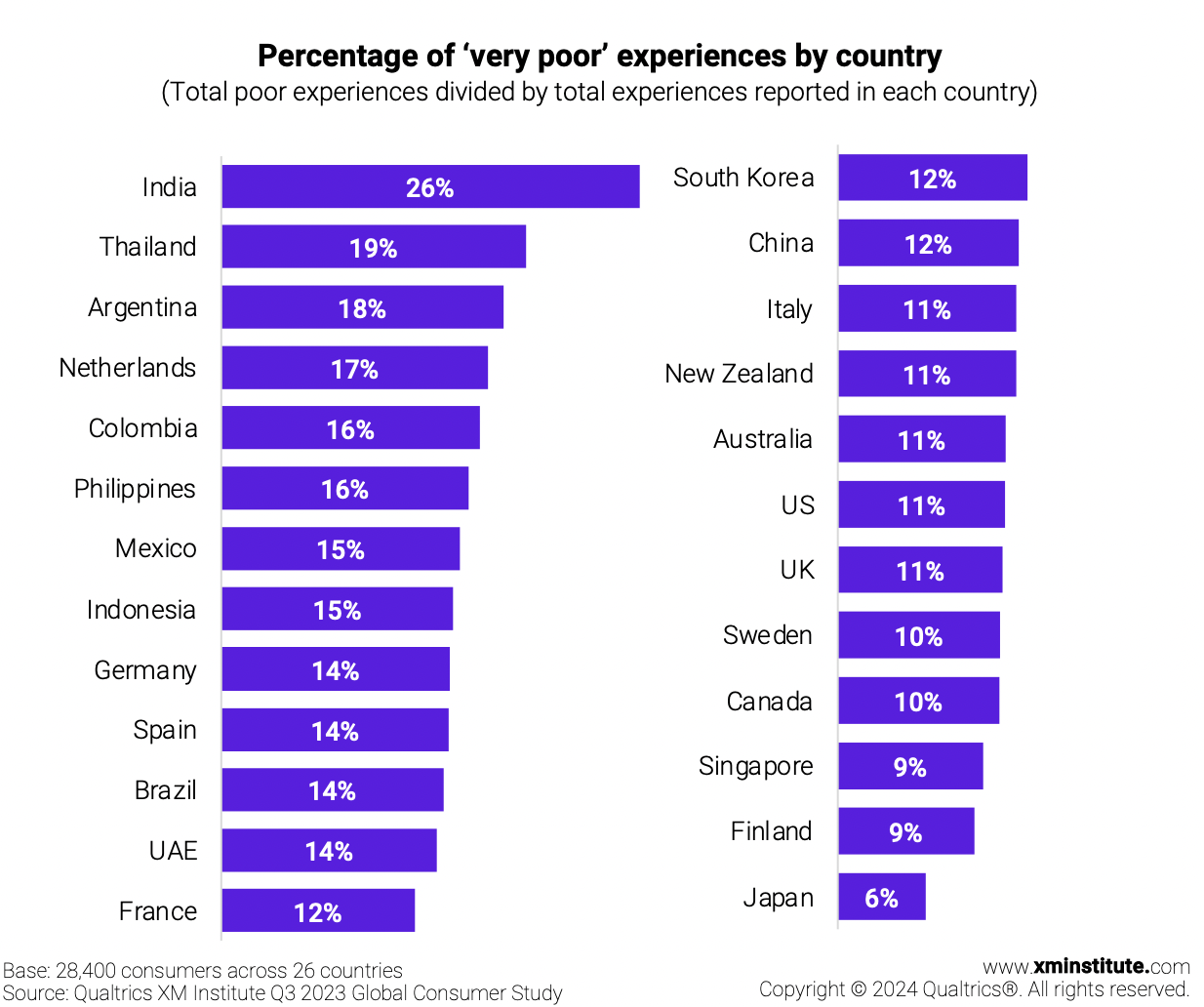
A second conclusion is that across all sectors and countries, organizations deliver 'very bad' experiences in 14% of cases. This happens most often to consumers when doing business with government institutions (26%), more than 4 times as often as bad experiences with supermarkets (6%).
Of the 26 countries, the Netherlands is in the top four worst scoring countries with 17 percent of Dutch people having experienced 'very poor service'. Organizations in only 7 of the 23 countries themselves saw an increase in reports of bad experiences, with Thailand leading with +6,1 points, followed by the Netherlands (+4,9 points).
Dutch parcel services do not score well
Source: Qualtrics
The effects of poor service differ per sector. It is striking that fast food runs the greatest risk of losing sales completely to a competitor; Car companies also run a relatively high risk of losing customers. In the Netherlands, shops (20%) and parcel services (26%) in particular score very high when it comes to 'recent negative experiences'.
The global impact of poor service, the researchers said, is that $3,7 billion in sales is at risk. That amount breaks down into $1 billion associated with ceasing business with companies that provide very poor customer experiences and $2,7 billion associated with spending less with companies that provide very poor customer experiences.
The researchers also find that consumers' propensity to do less or no more business with companies that deliver poor customer experiences has increased compared to the previous year (2022). The strongest increases are visible in fast food, parcel services, car dealers and airlines.
Other research
Qualtrics' research is not the first (and won't be the last) into the costs of poor service. Ten years ago a large-scale study conducted BDO Accountants and Advisors, carried out in 2014 by the Intelligence Unit of The Economist see that poor customer service has a detrimental effect on companies' bottom lines. This study surveyed 800 executives worldwide and interviewed several independent experts in the field of service. Nearly two-thirds (59 percent) of businesses surveyed admit that poor service has a visible adverse effect on their company's financial performance. A quarter (27 percent) even lost customers and about the same proportion (23 percent) had to pay customers compensation due to poor service.
Despite understanding that there is a relationship between customer service quality and financial results, companies struggle with how to connect service and the bottom line. The effect of a lack of deeper insight into the mechanisms is that 27 percent of companies surveyed - despite the adverse financial impact of poor service - did not invest in customer service in the period 2012-2013. (Ziptone/editors)
View the full Qualtrics report


Also interesting
-

Is bankruptcy the result of poor and inaccessible customer service or of the warnings from the Consumers' Association or Radar?
-

Customer focus? That should start with a manifesto on your customer service page: “customer service first, then shareholder value.”
-

Shep Hyken comes across all kinds of things in his search for the pillars of customer service, but not the word 'respect'.