
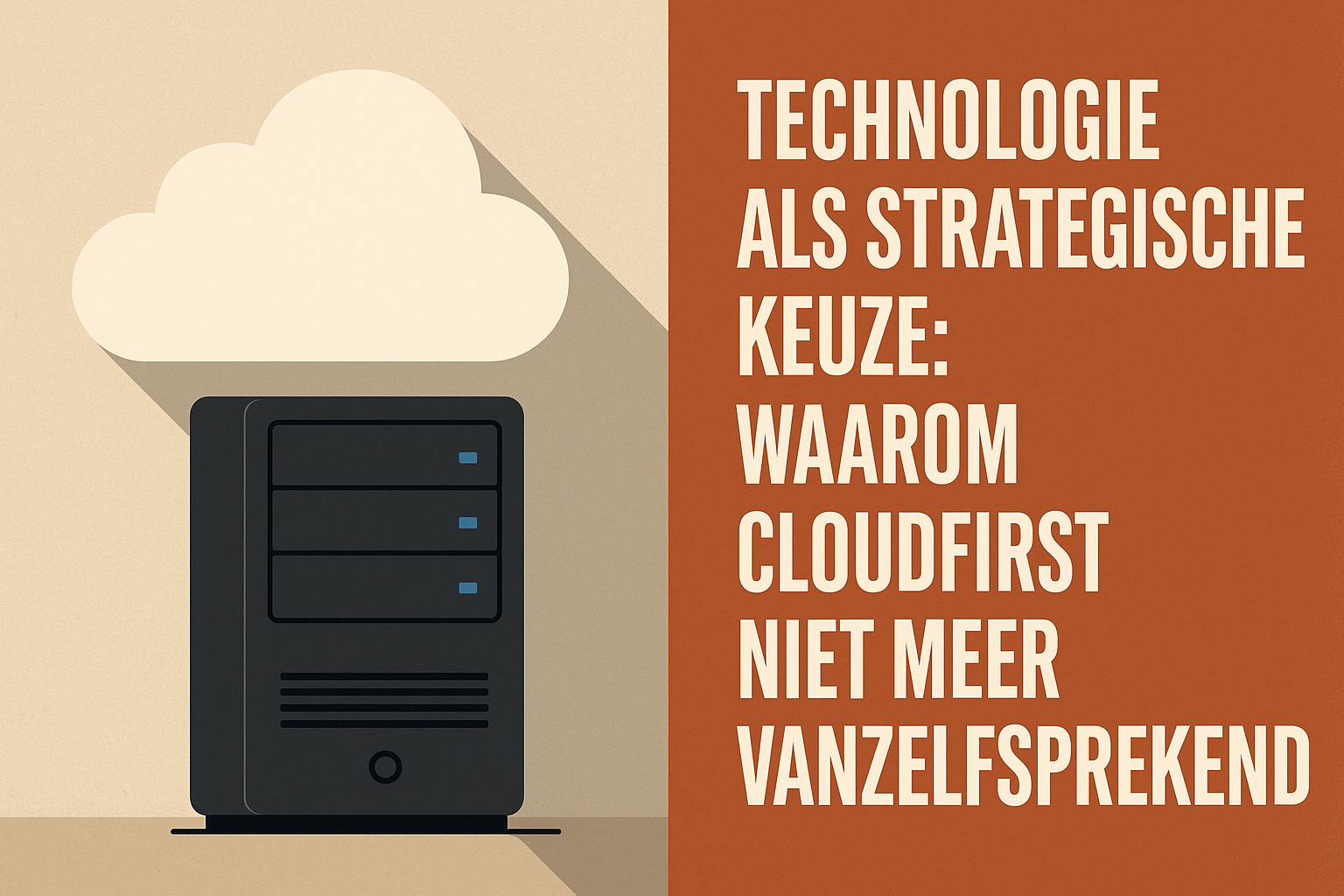
 A word of caution to those who think "cloud-first" is still a given: with growing attention to strategic autonomy, the on-premise contact center solution is also making a comeback.
In the early spring of 2025, Rob McDougall (CEO of a Canadian provider of, among other things, contact center software) wrote on Customer Think that companies are increasingly opting for an on-premise installation of their software.
Of course, the public cloud has been completely mainstream for the past ten years or so; some companies even consider it a commodity—though, in reality, it's definitely not. Even with cloud governance in place, you can still discover many hidden costs and unforeseen limitations. McDougall explained, adding that companies like Barclays and Basecamp have scaled back their operations to on-premises or private cloud solutions and achieved enormous savings.
Boiling point
According to McDougall, the choice for on-premises (or possibly a private cloud) is primarily the result of understanding the full costs, flexibility, and security, as well as the actual benefits and limitations. Incidentally, McDougall wrote his piece when the trade war between the US and Canada had reached a boiling point.
During the same period, Ziptone continued its market exploration 'CCaaS made in Europe', prompted by the emerging discussions about strategic (and technological) autonomy. This market overview also revealed that 'on-premises' (in addition to the private cloud) was not an uncommon option for several of the 73 European contact center software providers.
Canada is also awake
The call to increase technological autonomy and reduce reliance on US CCaaS providers is clearly visible in the Canadian contact center and CX sector. Canadian companies such as ComputerTalk en Netagen promote their 'made in Canada' solutions, while specialized cloud players like ThinkOn and Micrologic emphasize their wholly Canadian roots. Analysts report that data sovereignty is becoming an increasingly important requirement in technology choices, and that the Canadian offering is still developing. Years of preference for American technology won't be replaced overnight by a more balanced procurement policy. Sounds familiar, doesn't it?
On prem?
According to McDougall, private cloud and on-premise solutions offer more and better options for customizing their software. This is, of course, a disgrace in the IT church, which has spent decades building custom solutions that we now call legacy. On the other hand, large companies are gradually all working with the same – or very similar – core systems, while everyone is emphasizing the importance of increasing their innovation capacity and competitive advantage.
McDougall also argued that CCaaS solutions make you dependent on "collective" security, while he believes it's better to manage security yourself—a fact that's also blasphemous in the IT church, which has struggled for years with a dire shortage of security capabilities, competencies, and specialists—while facing increasing and even greater threats. In any case, the cloud is no panacea and, besides its advantages, also has serious limitations.
Made in USA? Then it's good
Recently there was a LinkedIn post by Serge Poppes Past, CEO of Pegamento. He also championed sovereignty and on-premises solutions. There's nothing wrong with Dutch solutions, including those from competitors, which are absolutely no less than their American counterparts. "On the contrary: customers who operate 100% locally with us experience the benefits. But purchasing behavior tells a different story," says Poppes: "As soon as 'USA' is on the box, it suddenly seems safer, better, more proven. And yet our solutions have also been running smoothly for years with thousands of users."
Poppes points to the persistent reflex that 'foreign technology' is associated with innovation, scale and reliability, while existing Dutch technology has to prove itself again and again.
The image of a VOC flag at his post raises some questions: is it about the Voice of the Customer (which too readily requests American goods) or about the VOC era? The latter has a somewhat tainted past, but you could also say the same about the "made in USA" reflex that we need to get rid of.
Cloudfirst?
Times are changing, Poppes agrees. There's a growing realization that technology isn't a neutral commodity, but a strategic choice. Every organization has specific needs at every stage. Cloudfirst is no longer a given. More control can be a reason to opt for on-premises.
A similar realization recently dawned within the Dutch government, which previously owned dozens of data centers. Rutte I launched the National Data Center Consolidation Program in 2011 to reduce the number of government data centers to a maximum of 60 or 4 centralized, high-quality data centers. A year later, that data center policy quietly transitioned into cloud policy. Now, after this massive rationalization drive, government IT professionals are looking with envy at the Tax and Customs Administration's data center in Apeldoorn. It's quite a change from AWS, Azure, or Google, which you can't just walk into.
IT managers recover
We'll see this rethinking of cloud and "made in the USA" more often in the coming period, and in multiple areas. Contact center managers can brace themselves: they'll soon be dealing with IT managers and CIOs who not only want to do things differently, but also want to do things themselves again.
(Ziptone/Erik Bouwer)


Also interesting
-

The VNG will further support municipalities in increasing digital autonomy and announces, in addition to existing forms, new forms of…
-
With the acquisition of Sikom, BSI Software is giving substance to its platform strategy. Both companies focus explicitly on sovereign IT.
-

What do sponsors and exhibitors have to offer and share at CCW2026 in Berlin? Content Guru leads the way.