
Facility contact centers have become a fixture in the Surinamese job market. But what does it really mean to work there? Surinamese customer contact professionals share their experiences. Working in customer contact offers opportunities and puts pressure on others.
Text: Jomara Roletti and Morena Leter
For Djamil Mijnals (28), a customer service expert at Vanad Interactions, it all started with curiosity. He discovered the industry through ads on social media. "I wanted to experience what it's like to work in customer service," he says. For a 23-year-old WeEngage employee, who wishes to remain anonymous, gaining work experience was key. Many companies ask for previous work experience when applying for a job, which she, as a recent graduate, lacked. Working in a call center offered her the opportunity to catch up and take her first steps into the job market.
Study medicine and customer contact
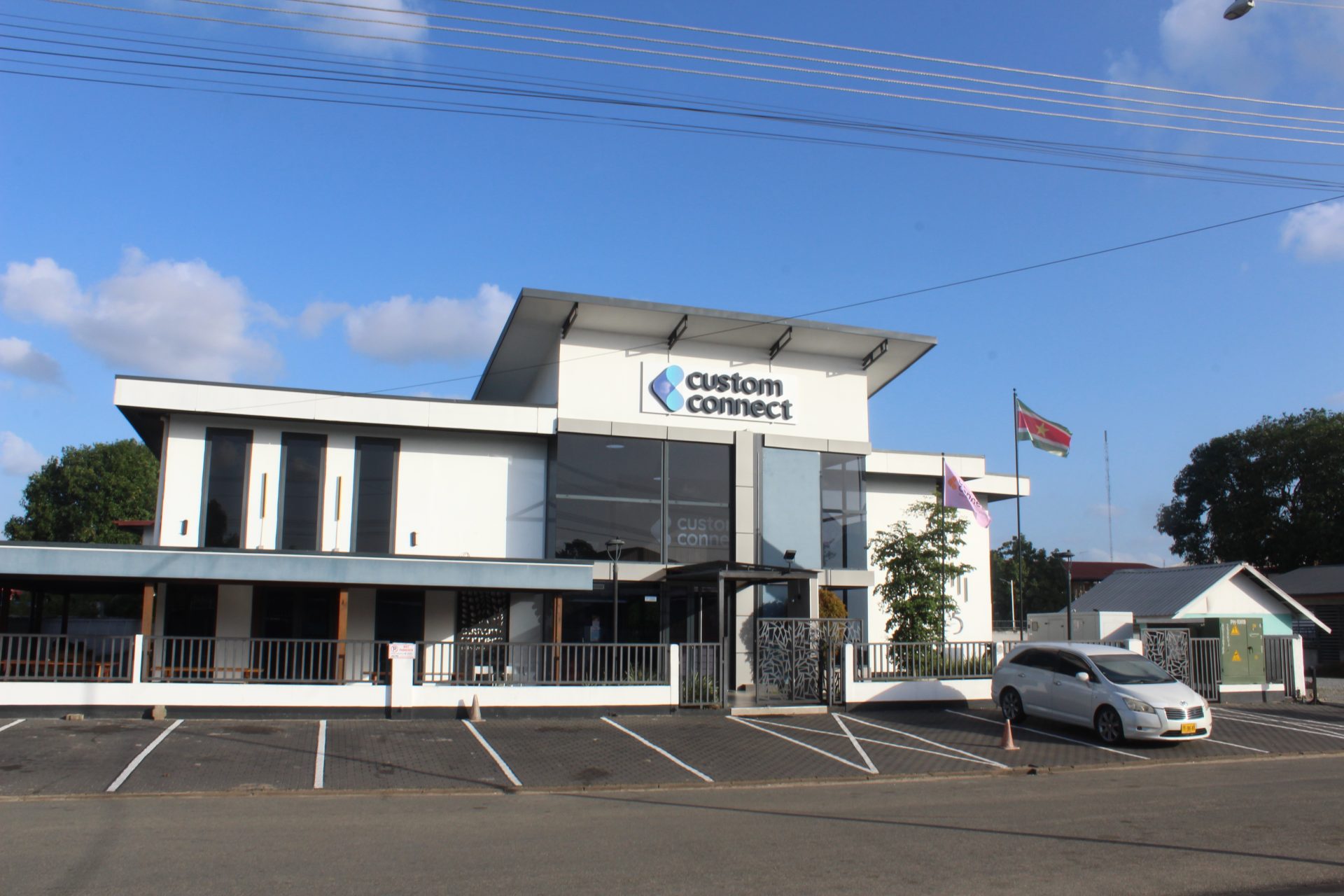
Custom Connect – Image: Morena Leter
Fifth-year medical student Aashika Sewnarain (22) sees her work as an investment in her future. She's been working as a junior customer service representative at Custom Connect for three months. She combines this work with a job at the GP Emergency Department at Sint Vincentius Hospital. She sees her income from contact center work as a necessary stepping stone toward her future career in healthcare. "I really need this work so I can specialize later," she says.
Law student Gilliano Trustfull (24), who works at ContactCare Suriname, also sees the work as temporary. Four years ago he looked for a job that he could combine with his studies and found it in the flexibility of the sector. Call centers often work with split shifts: shifts that are split into two or sometimes three blocks, with longer breaks in between. "It's a relatively easy way to earn money alongside my studies, so I take advantage of the opportunity."
Not everyone enters the sector with a clear plan. A 29-year-old employee, who wishes to remain anonymous for privacy reasons, has been working as a call agent at ContactCare Suriname for two years and has a total of five years of experience in the industry. After dropping out of college, she primarily wanted to do "something productive" and applied to her first call center, Alembo, where she was quickly hired, without knowing exactly what to expect.
Induction period and training
Expectations are partially coordinated during the job interview. Candidates discuss their availability and schedules to clarify the work requirements. Most employees we spoke with described the subsequent onboarding period as structured. During the training, they learn step by step how a workday works and what is expected of them.
Employees typically first undergo language and cultural training, which aims to familiarize them with language nuances, communication styles, and cultural sensitivities. "Teleperformance provides that," confirms an anonymous call agent who has been working for over four years. According to him, this preparation helps them better anticipate customer expectations and prevent misunderstandings during contact. "Dutch culture is very different from Surinamese culture," he says. "Dutch people are straightforward. You learn not to take too long with a conversation. The customer is paying for the call or has already spent money, but is dissatisfied with the product or service. So that needs to be resolved quickly. Every cent counts."
A 27-year-old call agent at Concentrix began such a training period to see if the work was a good fit for him. "During the training, I received guidance and explanations about the work. I quickly realized it wasn't all that bad," he says. That experience gave him the confidence to stay. After a year of experience, he was eligible to work from home due to the coronavirus pandemic, which made his work considerably more flexible.
A ContactCare Suriname employee also emphasizes the importance of good guidance. Thanks to training in conversational techniques—listening, summarizing, asking follow-up questions, and showing empathy—she learned to calm even difficult customers. Gradually, her self-confidence grew, a development she describes as "a game-changer." This experience made her realize that she truly feels at home in customer service.
Being mentally strong
For many, the workday begins before sunrise. Due to the time difference with the Netherlands, the work rhythm shifts to the early morning hours. "You have a routine that's not the norm. It can be really tough, especially if you're not used to going to bed early," says the anonymous Teleperformance call agent. It's especially challenging in December. "Everyone's partying, but you're in bed at 18:00 PM because you have to be at work at 03:00 AM. You're sleepy, you're tired. I can't tell you how many times I've looked at that phone and said I'm going to call in sick. Or I've hoped it would start raining so I could say, 'I'm underwater, I'm not coming to work.' Getting up early is very difficult." drainage. "

Yource – Image: Morena Leter
“I get up at four in the morning and start work at five,” says Edwin Ewijk (26), who has been working as a call agent at Yource for two and a half years. “The contact with customers is very diverse. We call, chat, email and WhatsApp.” “I currently handle about 50 to 60 calls a day,” says colleague Rudolf Boedhram (28). “That can go up to 80.” Multitasking is a must. “I take notes during every call,” Ewijk explains.
Nightmares
According to Ewijk, customer contact work requires mental resilience. "You have to be mentally strong and stay calm, regardless of how the person on the other end of the line speaks to you. People usually call with a problem. For example, if a customer bought internet and it's not working, I understand they're frustrated." The work has made him more patient. "Sometimes you get older people on the phone who are less familiar with technology. You really have to take your time to explain everything properly." Relaxation is a priority on the work floor. "Massages are offered on-site. They really help."
An anonymous WEngage customer service advisor says her work now has little impact on her, although that wasn't the case at first. She started having nightmares about things she hadn't handled. "I'd wake up at night with a start, feeling like I'd forgotten something." Trustfull also experienced mental health issues initially. His mother noticed him talking about work in his sleep. "I also had conversations with emotionally demanding clients, like someone who started crying because her partner had passed away. Or people who were incredibly frustrated and took it out on me." Such conversations could affect his motivation. At the same time, he found it satisfying when clients thanked him and told him they felt better after the conversation. That actually gave him new energy.
The WEngage employee has since found a balance. When customers scold her, she remains calm and regularly receives compliments for her calm demeanor. She tries to empathize with the customer, realizes that small amounts can mean a lot to some, and helps them as best she can. On the advice of a colleague, she learned to strictly separate work and personal life: "As soon as I shut down my computer and go home, I leave everything behind until the next day." That helps her maintain a distance.
Foreign currency
The early shifts and numerous calls don't discourage young people from taking on the work. Salaries that are higher than in many other entry-level positions make working at a contact center attractive. "If you compare the salary in a call center with, for example, civil service work in the government, you often earn more," says the WEngage employee. She is satisfied with her salary and calls it a nice advantage that she can earn between SRD 16.000 and SRD 18.000 for sedentary work and calls (360 to 400 euros at current exchange rates, ed.), especially compared to physically demanding work that pays less.
A different perspective comes from an anonymous Concentrix employee who works from home and is paid hourly. He believes the pay could be better. "Compared to other companies, and especially to people in the Netherlands doing the same work, the salary here is lower. In Suriname, the income is reasonable, but the difference remains striking." He occasionally discusses this with his team leader; small raises follow the longer he's been employed. There are opportunities for advancement, but for those who work from home, these remain limited because higher positions often require being present in the office.
ContactCare employees also receive monthly benefits. A female customer service expert who wishes to remain anonymous explains: "If I work fewer hours, I earn around €400 to €500 per month. If I work more, my income is between €500 and €700. With the holiday bonus, that can increase to almost €900."
In addition to their salary in foreign currency, employees benefit from fringe benefits. "I have insurance with a local health insurer," says Ewijk. "We also receive a travel allowance."
There are also opportunities for advancement within the company. However, not everyone chooses this path. "I could grow, but I'll remain a Customer Experience Officer because I want to maintain contact with customers. If I continue to grow, I won't have that anymore," says Boedhram.
Targets, pressure and micromanagement
The work has peak periods. "In winter, people usually watch more series because they're indoors. With electronics, orders can be busy all year round," explains the anonymous Teleperformance employee. Employees are supervised by a manager. "My manager is so good that when he says 'jump!' I don't even question why. As soon as he says, 'Guys, this needs to be addressed,' or things are slowing down a bit, the team immediately picks it up," the anonymous employee continues. According to him, experience plays a key role in this. "My manager has over ten years of experience in this field."
The intensity of the work is not only determined by peak periods; the way employees are monitored also plays a major role.
According to Yource's anonymous recruiter, work in call centers is highly micromanaged. When he was still working as an agent, he was closely monitored. He explains that as an agent, he experienced direct pressure due to KPIs, customer satisfaction scores, and strict monitoring of performance and breaks. There was an operations manager who oversaw every mistake. It was often discussed among colleagues that international teams, for example, in Spain, seem to be assessed less rigorously than the Surinamese team. "Our KPIs are monitored more rigorously. It sometimes feels like discrimination, although there's no hard evidence to support that. It's more of a suspicion that exists on the work floor," he says.
In his current role, he still experiences pressure, but that mainly comes from management, which focuses on deadlines and recruitment goals. The atmosphere at work is generally pleasant, and he has great colleagues, although there are always different personalities. As a recruiter, he needs to be more professional, and that's something he's also paying attention to.
Constant monitoring
Trustfull works as an agent on an email project, which also has strict targets. For example, he has to handle twenty emails per hour; if he works four hours, he has to process eighty. If he reaches 79 instead of 80, he often has to meet with the team leader to discuss the missed target.
This constant monitoring can be frustrating. Trustfull tries to put it into perspective: a missed target is compensated the next day, as long as the weekly total ultimately matches. Furthermore, uncertainty surrounding customer reviews plays a role. Agents can fully meet their targets and still receive a negative rating based on surveys. According to the 23-year-old WEngage employee, this can feel unfair. "If a customer is dissatisfied with a company procedure, I, as an agent, sometimes receive a negative rating, even though I simply followed the protocol. That sometimes feels unfair, because it's not always my fault, but it's still held personally accountable."
Workload
Contact centers in Suriname are still expanding, albeit at a slower pace than before. While Teleperformance is the largest player with five locations, the smaller ContactCare opened its doors in February 2026. second location in Paramaribo.

Global Support Company – Image: Morena Leter
But expansions don't come without consequences. Jonathan Leidsman (26) made the conscious decision to move to Global Support Company after three years at Teleperformance. "I worked at Teleperformance until January 12th, and I'm starting at my new employer on February 23rd. Teleperformance is a good employer. You learn a lot and they put a lot of effort into you, but they're getting so big that the focus is now really business-like instead of personal."
The workload became too much for him last year. "Certain things aren't realistic, like when a situation arises for which you have no solution. How do you expect me to satisfy that customer then? Processes have to be clear." Leidsman approached Global Support Company on his own initiative. "I approached them because they had vacancies. I've heard from other people who work there that it's quite quiet there, so I'm going to give it a try."
To be late
Boedhram was thanked by Teleperformance after two months. "One of my biggest setbacks was being late. The third time I was late, I was thanked." He switched to Yource. "They don't immediately fire employees there. They offered to put me on a Performance Improvement Plan. Yource is a bit more tolerant of employees and employee retention." Still, he keeps things businesslike on the work floor. "Call centers aren't meant to be recreational areas. Come, do your job, and leave. It's very simple."
Despite the rise of AI and the increasing outsourcing of contact center work abroad, employees don't seem worried about their job security. "Honestly, I'm not worried. You do need some proper training, but Surinamese people are very customer-friendly. If I compare them to agents in the Netherlands, we go above and beyond. We offer service plus, I can say," says the anonymous Teleperformance employee. Medical student Aashika isn't worried either. "I don't think about it at all, because I don't expect to be doing this job for very long."
Accountability – For this article, the Surinamese journalists spoke Jomara Roletti en Morena Leter Between January 13 and February 16, 2026, twelve customer contact professionals were interviewed: eleven agents and one recruiter who previously worked as an agent. Five of them combined their work with their studies. Six of the twelve wished to remain anonymous in this article. The full names, current employers, and positions of all individuals interviewed are known to the editors.
Also read:
Dutch customer service under the Surinamese sun: exploitation or mutual benefit?


Also interesting
-

Premature deployment of GenAI chatbots and virtual agents for customer contact will lead to increased consumer skepticism, according to Forrester.
-

CX expert Blair Pleasant calls for a more realistic view of the impact of AI on customer contact. She warns of…
-

Will the human touch disappear as we further automate customer contact, or will technology actually make it possible to provide real customer service?