

Image: Ziptone
Eliminating the poor handover from chat or voice bots to live customer service representatives is what Ronald Rubens has set his sights on with the AI application ExpertLoop. This handover can be significantly improved, and all the necessary information is readily available.
First contact resolution is and remains the Achilles heel of customer contact, as we know Ronald RubensHe has nearly 30 years of experience in customer service. A significant part of that career has been shaped by implementation projects at large customer service departments, primarily with Avaya, since the early 1990s. Rubens also worked for Avaya in the US for several years and then continued at various startups in the Netherlands.
And now he has his own startup: SentioCX. The reason: a truly terrible experience renewing his own energy contract with Eneco. "I was talking to a bot that didn't understand me, and the customer service phone number was nowhere to be found. I was literally stuck and thought that was strange. But if you think about it, you realize this can happen at all kinds of other companies too. My idea was that there had to be something that could smoothly manage the transition from chatbot to live agent."
From chatbot to live chat: black hole
Rubens knows from his years of experience with routing solutions that voice calls are routed to generic queues, but traffic from a chatbot often requires specific expertise or authority from an agent and is thrown over the fence when escalating, disappearing into a black hole. “More and more customer contacts are starting digitally. Despite improvements in chatbots, the transition from chatbot to a live agent remains problematic – something for which Forrester warned earlier this yearA chatbot dialogue that needs to be escalated to a live chat agent is placed in a queue. From that point on, you, as a customer, lose control.
CX is getting worse
This situation is similar to what happens after an IVR: you end up in a queue without all available information being used to prioritize and route. This is not good for the customer experience, which has recently improved. has fallen further.
Several reasons can be identified for this decline, Rubens explains. "First of all, the promise of AI is greater than it can deliver. Chatbots' first contact resolution rates vary, but ten to fifteen percent are common. That's a primary source of frustration. Low first contact resolution has a significant impact on churn: especially when it concerns a commodity product, customers are more likely to leave."
Secondly, when escalation is necessary from a chatbot, you end up in a queue; that's also not conducive to customer experience. And thirdly, there's a good chance you'll end up with the wrong agent. Precisely because we're automating so much of the simple customer contact, the right expertise of the live agent is more crucial than ever. If that doesn't work well, the risk of dissatisfied customers or even churn increases significantly.
Churn and commodity markets
That churn is mainly a headache in commodity markets, according to Rubens. That churn is mainly a headache in commodity markets, according to Rubens: for energy companies, it is around 11 percent, for telecom companies this can rise to over 30%.While the price of energy products may be clear upfront, the final cost is often opaque and uncertain. Customer service remains the most important way to differentiate yourself.
Rubens: "When a customer is considering switching energy contracts—which happens about a million times a year—you naturally need to connect them with the right representative, prioritized and with a highly targeted approach. Some CCaaS providers claim to route based on priority, but this usually refers to a priority queue, meaning everyone placed in it gets priority. That doesn't improve first-contact resolution."
Emergency care as a source of inspiration
So much for the problems. Rubens searched for a solution and was inspired by the way hospitals handle prioritization and routing. “Anyone arriving at the ER as a patient is immediately triaged. You don't end up in a queue waiting for a specialist to come and see you and then say, 'I don't know anything about this.' That triage is all about prioritization and determining which expertise is needed. That specialty is then brought to the patient at the appropriate speed. And if anything changes in the patient's situation, the plan is, of course, adjusted.”
The product Rubens developed from SentioCX relies on two similar principles. “ExpertLoop doesn't place the customer in a new or separate queue. We reverse this. We keep the customer 'stuck' in the chatbot or voicebot environment until we can match them with the right specialist. This offers the advantage of continuous communication with the customer: for example, 'We're going to call the right employee for this question, which takes an average of one minute.' Another advantage is that a well-considered, continuous triage process is used.”
Triage
That triage process is ExpertLoop's most important engine, Rubens proudly announces. You can assign different weights to different attributes, allowing you to determine the business impact. In other words, steer towards the desired outcome. "We start by looking at the customer's intent. We also consider sentiment and incorporate signals from the CRM environment. Is there, for example, an increased churn risk? As mentioned before, you forward that to a specialized employee as quickly as possible."
This triage isn't a one-time process, but an ongoing one; a methodology SentioCX has patented in the US. So if circumstances change or the customer provides additional information—for example, a customer who says, "I don't want to change my contract, I just want to cancel it"—the decision is made again. Because in that example, it's not wise to keep the customer waiting long, Rubens explains.
Attributes such as the channel used (voicebot or chatbot), skills, skill levels, sentiment assessment, and intent recognition are all aggregated by ExpertLoop from existing solutions—think chatbot solutions, CRM platforms, and the CCaaS platform. To facilitate such integrations, ExpertLoop was recently added to Salesforce's AppExchange, among others.
Digitalization makes good handover increasingly important
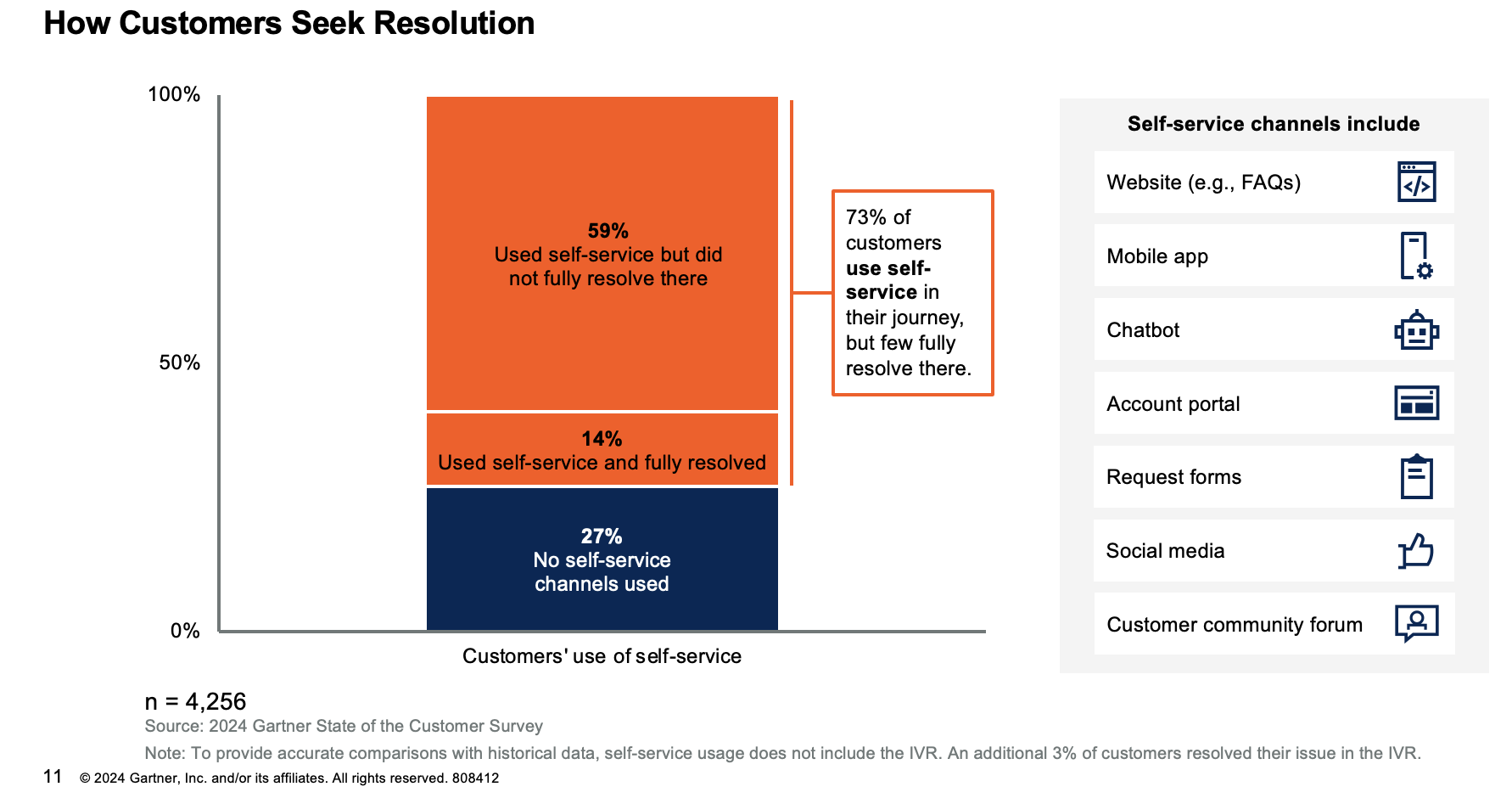
Source: 2024 Gartner State of the Customer Survey Click to enlarge
From the choices that larger organizations make in their customer contact strategy, it can be deduced that chatbots and voicebots are playing an increasingly important role.
"73% of all interactions between customers and companies now begin with some form of (digital) self-service, according to the 2024 Gartner State of the Customer Survey; think of agentic AI, chatbots, and voicebots. AI vendors like to tell us they can extensively automate customer contact. But we'll never reach 100%. When issues like trust and emotion are at stake, people prefer to talk to a human rather than a system. Think of emergencies, fraud and governance, or interrupted customer journeys like shopping cart abandonment. Ultimately, people just want to talk to people."
Closing the gap

Image: Shutterstock
"Even if you strive for maximum automation, properly organizing that final phase of human customer contact is becoming increasingly complex," Rubens predicts. "This requires increasingly precise matching between customer, customer request, and employee. Current contact center queuing technology falls short in this regard. For example, you want to avoid having to deploy your best employees—think specialized support staff—to low-priority contacts during busy periods."
There's another reason to bridge the gap between AI-based self-service and live agents with smart technology: there are people who struggle with digital services. "In the UK, governments are legally required to pay extra attention to helping vulnerable groups. Increasing digitalization only makes this more important."
SentioCX's technology also allows you to partially reverse the contact center process: the solution identifies those calls that require a specialist. Triage can, for example, reveal whether it's wise to assign a specific back-office employee to the call because they have the right expertise, Rubens explains. "You can then send such a specialist a notification via Slack, for example, so they can jump in and handle the call. That's something a traditional CCaaS solution can't do."
Business impact and pilot
Anyone who uses SentioCX gains insight into the business impact of customer contact and can then manage it accordingly. For example, by indicating (via the internal AI function) that if there is a 60% chance of cancellation, the call should be prioritized to a specific specialist. The pilots that SentioCX is currently running show that there is much to be gained in this area, says Rubens. "With ExpertLoop, the first contact resolution rate can be increased by up to 60%. This not only reduces a lot of repeat traffic, it also has a positive effect on the customer experience. And employees are more empowered: they receive questions that are relevant. This has a positive effect on the employee. You reduce the risk of turnover."
For ExpertLoop, it doesn't matter which channel the customer uses: voice, especially when delivered via a voicebot, is also a digital channel, just like a text-based chatbot. Consumers do expect escalation to a human agent to be faster with a voicebot than with a chatbot, according to Rubens – although expectations are constantly converging. "Who doesn't remember the days when you sent a chat message to KLM, only to have the response arrive a few hours later?"
Positioning and ecosystems
SentioCX's solution fits into Salesforce's portfolio, which has continued to invest in Agent Force to date – for example, in mid-September 6 billion dollars invested in developing the Salesforce AI hub for the UK and Europe. SentioCX, in addition to Salesforce's Salesforce AppExchange, is also part of Zendesk and is in discussions with other ecosystems, according to Rubens.
AI investments in customer contact in the coming period will have to focus primarily on the front end of organizations, says Rubens. "Not so much because that's where you should start automating, but because that's where the greatest wealth of information lies, allowing companies to understand their customers' intent – including data from CRM and CCaaS solutions."
Moreover, the CRM environment is increasingly becoming the default workspace for customer service representatives: "If more contacts flow from chat and voice bots to the contact center, CCaaS could become significantly less important than CRM," says Rubens. "In any case, contact centers should rethink the traditional queuing model of CCaaS solutions. That model is outdated."
(Ziptone/Erik Bouwer)
Webinar - On October 23 (4:00 PM CET), SentioCX is organizing a webinar about the application of ExpertLoop in customer contact. More information and/or registration


Also interesting
-
On digital self-service channels, it is not always visible whether an action is performed by the customer themselves or by an AI agent…
-

Most consumers are done with IVR. With the advent of AI, more customer-friendly alternatives are emerging, such as…
-

The Customer Experience Battle of the Belgian industry association Customer Contact & CX Forum is now called the Customer Experience Challenge.