
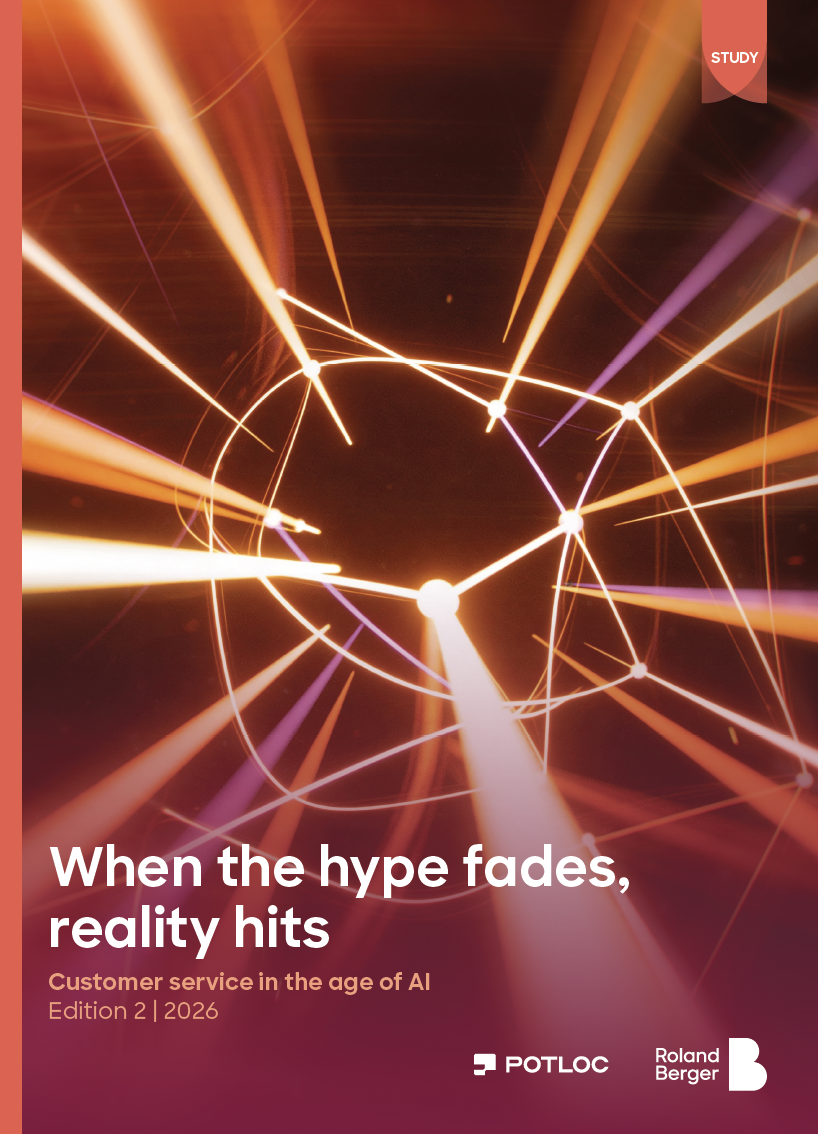
 A year ago, 95 percent of customer contact managers said they used AI. In the new edition of the study by Roland Berger and Potloc, that figure is 54 percent.
Roland Berger attributes this decline primarily to the fact that respondents in the periodic survey have started making a sharper distinction between what does and does not count as AI. For instance, applications that are closer to traditional automation than to AI are no longer included. In addition to this tightening, it also appears that companies have completed many pilots and discontinued applications because the financial impact remained limited or scaling up was unsuccessful. The figures were collected up to and including March of this year; the report was published in June. The agency surveyed 550 customer service managers from the US and Brazil (150), Europe (200 from Germany, Italy, France, UK), and 200 from Asia (China, Singapore, Japan, Thailand).
Agent assist at the front
The majority of AI projects in customer contact primarily focus on employee support. Within the group of AI users, 44 percent have implemented AI support for employees and 39 percent conversational AI for self-service. Fully autonomous end-to-end handling occurs in 17 percent, but has not yet been proven or scaled up. China stands out: there, end-to-end automation is actually the most implemented AI category in customer contact at 35 percent, while Thailand, Singapore, and Japan are around the average.
The most used applications are automated status updates (57 percent), agent assist (55 percent), and automated written customer communication (53 percent). These are followed by spoken responses to the customer (35 percent), personalized recommendations (32 percent), predicting customer needs (29 percent), sentiment analysis (25 percent), and multilingual AI (20 percent). This picture is homogeneous across sectors and countries.
Challenges in AI implementations
The challenges have not fundamentally changed. The balance between cost and quality is at the top with 52 percent, followed by rising customer expectations (44 percent), laws and regulations regarding data protection (38 percent), internal organizational complexity (34 percent), and personalization (26 percent).
Only 13 percent still see value in outsourcing, nearshoring, or shared service centers. Roland Berger concludes from this that BPO service providers will have to revise their operating model to remain competitive.
As A-applications in customer contact increasingly relate to customer-specific data (personalized), these applications are discontinued more frequently. This concerns applications in the areas of sentiment analysis (24 percent discontinued), customer needs forecasting and proactive approach (21 percent), and personalized recommendations (20 percent). Roland Berger researchers report that these applications require large amounts of high-quality labeled data. In practice, this leads to inconsistent results among respondents across languages, cultures, and channels; deep integration with CRM, marketing automation, and customer data platforms is often lacking.
To earn back
Roland Berger has also gathered insights about the ROI of AI in customer contact. Among organizations using AI, the average response time improves by 19 percent and the NPS increases by 10,7 percent. Process efficiency rises by 11,5 percent, operational costs decrease by 11,7 percent, and occupancy shrinks by an average of 11,8 percent. Of the AI users, 43 percent say the impact exceeds expectations and 52 percent say it meets expectations. However, differences by sector are visible in the report.
Changing roles
In 59 percent of organizations, job profiles have been slightly modified, and in 29 percent significantly, with new skills and shifted responsibilities. 96 percent of employees say their daily work experience has improved. Staff reductions exceeding 20 percent are reported only in Europe and America: there, AI in customer contact is driving substitution. More managers than last year see AI changing the role of employees. 46 percent now view humans as a last resort for major complaints and escalations, compared to 20 percent last year. At the same time, the proportion believing that technology can take over the majority of requests dropped from 40 to 22 percent.
A quarter of the surveyed managers expect to insource again.
AI and outsourcing
Questions were also asked about future operational organizational models for customer contact. Just over a third do not expect major changes due to AI, but a quarter of the surveyed managers expect to return to insourcing – a doubling compared to last year. 17% of respondents opt for large-scale full automation of customer service; 16% plan to outsource more; nearly a halving compared to last year. Eleven percent plan an increase in nearshoring (bringing services closer to home), while ten percent are considering switching from nearshoring to farshoring.
About the research – Roland Berger and Potloc surveyed over 550 customer contact managers in ten countries between November 2025 and March 2026 for the study 'When the hype fades, reality hitsTogether, they are responsible for more than 210.000 customer service employees.
(Ziptone/Erik Bouwer)


Also interesting
-

93 percent of 18- to 24-year-olds already use AI for online product research. Among older generations, this is less common.
-
The KSF, together with the HvA and Thuiswinkel.org, will conduct research into how the quality of chatbots can be improved.
-

In sectors heavily reliant on AI, such as contact centers, a relative decline in the number of vacancies can be observed…