
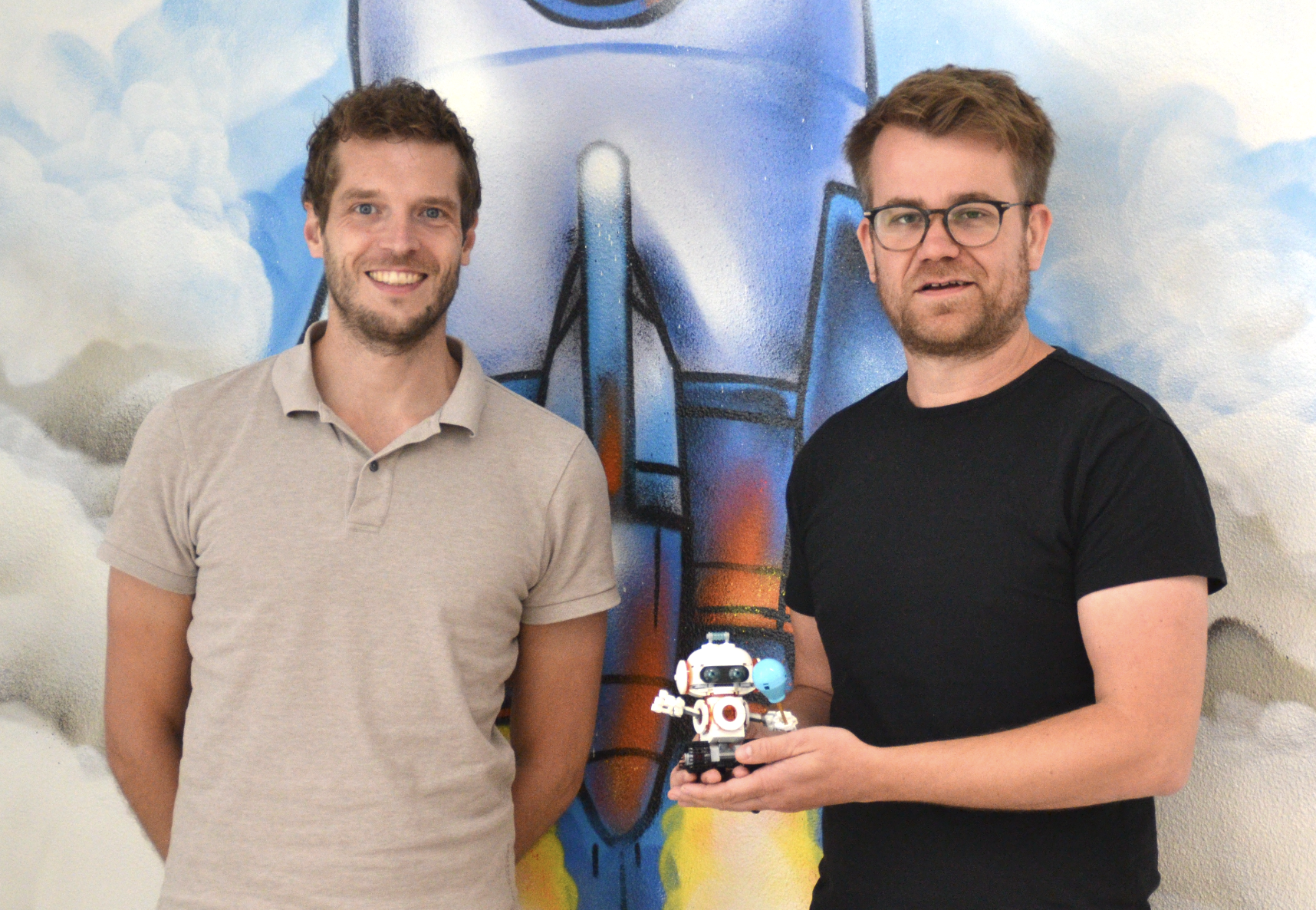
 The way contact centers handle customer contact is constantly evolving. According to Raoul Fasel and Jeroen Kromme of QuandaGo, we're in a clear transition: bots are taking on more and more tasks. QuandaGo is choosing a different, yet safe, approach to automating customer contact processes.
In brief:
- CCaaS becomes a commodity – but remains necessary
- QuandaGo shifts the boundaries and opts for safe process automation with AI
- The company believes that processes, not conversations, should be automated
Some time ago, QuandaGo communicated that the company would be rolling out its own CCaaS solution would offer for freeThis choice clearly demonstrates that QuandaGo has shifted course: from an integrated routing solution to a suite of automation solutions, with AiDA as its flagship.
IDAA In this case, "doesn't refer to a telemarketing acronym, but rather the name of the digital agent developed by QuandaGo. Especially when it comes to agents, developers like to give them a name, and in this case, the product's characteristics—artificial, intelligent, digital, and agent—were enough.
AI agent or digital agent?
Raoul Fasel, QuandaGo
"'Digital agent' isn't used very often; people usually talk about AI agents. But a digital agent doesn't always have to rely on AI as a counterpart to a human employee," says Raoul Fasel.
Fasel, a self-described "technical jack of all trades," is responsible for managing the developers working on AI solutions as AiDA product manager at QuandaGo. He argues that we're in a transition: consumers are moving from primarily keyboard-driven interactions with Google and other apps to other forms of interaction. In other words, less through search engines and more through bots. The most important change is that rules-based interactions are giving way to real dialogues. "Instead of going to your banking app on your phone, you literally say to your assistant: 'Transfer 50 euros to Jeroen.'"
Jeroen Kromme, head of products & data at QuandaGo, adds: "We're moving towards a situation where you talk to your own personal assistant, who then communicates with an agent in an app via an MCP protocol. This will change how you interact with your bank, for example. This change is happening faster than we think, but the road to get there is also longer than we think."
Acceptance plummets when AI makes mistakes

Jeroen Kromme, QuandaGo
By this, Kromme means: the biggest strides have been made, but the bottlenecks lie in the details and in the last few percentage points of accuracy and reliability. As AI begins to perform more complex and critical tasks, our tolerance for making mistakes quickly declines to zero; just look at the self-driving car.
The "last mile" is therefore particularly challenging for developers, but the path ahead is clear: an evolution in which we gradually transition from agent assists supporting employees to employees monitoring the output of AI (or multiple AI agents). In both cases, you can speak of a hybrid workforce, according to Kromme. AI agents are becoming increasingly better and more specialized. Yet, it is precisely at this point that QuandaGo takes a different path than most parties active with AI agents.
Safe process automation
Fasel: "Our solutions don't give AI agents full access to all sorts of systems and databases. If you do choose to do so, you have to do everything possible—through prompts and guardrails—to mitigate risks and prevent problems. And if there are problems with the outcomes, it becomes complicated to explain afterward how a decision or result was reached. As far as we're concerned, that's not the way to go in the foreseeable future."
That's why QuandaGo chooses to work with processes that have predefined inputs and outputs. You can have such a process initiated by an AI agent, but it doesn't have to dig through your data itself. "Those processes, which we model based on rules with our Processes"The solution is the same as the one that can be used by human agents," Fasel explains. This approach not only leads to more reliable outcomes, but also makes audits and governance much more feasible – something that is easily overlooked, according to Fasel.
What role does AI play then?
That might sound like QuandaGo is struggling with generative AI, but the opposite is true: "For the conversational interface, you can simply use GenAI; in fact, the technology is very good in that regard," says Fasel. "Think about determining the intent. And AI can also help decide which workflow you want to initiate. The AI agent can even play a role in initiating different workflows that are related—for example, gathering data needed for another workflow by asking verification questions."
In short, the customer talks to an AI bot, which can then initiate a standardized process, instead of having itself or another AI bot make an API call to a database.
Let bots and agents work with the same processes
This approach, according to Kromme, also makes escalating a dialogue or process to a human agent much easier. If the digital agent can't figure it out, the human employee can choose from the same processes. As mentioned, there may be room for an AI agent within those processes—think of reviewing a completed document, including determining whether it's approved or still needs to be reviewed by an employee. "But a process like verifying a customer's identity, we don't let an AI agent handle that. That would make the process vulnerable. We strongly believe in AI, but only on the condition of good governance. With that in mind, QuandaGo won't just start deploying customer-facing digital agents," says Kromme.
There's another reason to be cautious about customer-facing digital agents. In the projects we've completed so far, we've seen clients regularly encounter issues they weren't aware of. This starts with assessing the quality of the knowledge base, but sometimes it also involves processes that appear to work differently. Many of our clients aren't database explorers or data scientists," says Kromme.
CCaaS now free
A few months ago, as we mentioned at the beginning of this article, the decision was made to offer the CCaaS platform ('QuandaGo Interactions') for free alongside the suite of other solutions such as Processess and AiDA. Processess is available in the Genesys App Foundry; AiDA is available in the AWS Marketplace.
But the change of course doesn't mean the CCaaS functionality is any less important, says Kromme: "Of course, you need a CCaaS platform to route customer conversations. Many of our competitors are working on agentic AI to automate that customer conversation. We look further: as far as we're concerned, the conversation is only one part of customer contact. If the conversation leads to a follow-up action, then something actually needs to happen. We call those two components together 'hyper automation'. ”
CCaaS is becoming a commodity, but remains necessary
 CCaaS is becoming a commodity, says Kromme. “In the Ziptone study CCaaS made in Europe There were 73 providers in Europe alone. CCaaS alone won't win the war.
"But you can't do without it yet," adds Fasel. "The transition is in full swing and far from complete. There's still a need for second- and perhaps even third-line support. There are also organizations that continue to rely entirely on people for customer contact."
Speaking of transition, what are contact centers doing now? Automating conversations or processes? Or are they, quite wisely, looking for the root cause of customer contact?
"The differences are enormous," says Kromme, "especially between commercial enterprises and government agencies. There are also service providers who don't benefit from reducing the number of interactions because of their revenue model, but they often strive for a shorter AHT to improve margins."
More tech isn't always an improvement for CX
"The introduction of technology over the past decade has been accompanied by lower customer satisfaction, lower efficiency, and lower quality, as research has repeatedly shown. We believe that insufficient adjustments are being made to processes. When chatbots were introduced, people first had to transcribe all conversations. This often involved choosing topics that were well-documented," says Kromme. "These are the same issues customers already encounter elsewhere: for example, in FAQs or the My Account section. This approach leads to more frustration, more customer contact, and less efficiency. We believe AI can significantly improve this, but it will be a gradual process." (Ziptone/Erik Bouwer)


Also interesting
-

QuandaGo AiDA launches three autonomous AI Agents, targeting use cases for utilities, financial services, and IT management.
-

The VNG will further support municipalities in increasing digital autonomy and announces, in addition to existing forms, new forms of…
-

Hyperautomation, aimed at end-to-end automation using a combination of technologies, is on the rise.