
Bad news for the customer contact sector: the shortage in the labor market could triple by 2030. At least that is what consultancy firm McKinsey says, assuming a continuation of the current growth of both the economy and the labor force. Does the customer contact sector have a problem or is the field possibly part of the solution?
That tripling represents a labor shortage of 1,4 million people, or a demand of 390 people per 100 unemployed. However, McKinsey is careful with this prediction: factors such as sector-specific policy choices (investments, subsidies, etc.) can reduce the labor shortage to 0,9 million. But a higher deficit is also possible, up to 1,8 million.
McKinsey expected too that technological innovations can reduce pressure on the labor market and cause shifts in demand. Between 2022 and 2030, 150.000 jobs are expected to disappear in segments with declining demand and 400.000 jobs will be created in segments with increasing demand.
Shifts
Source: McKinsey
These shifts are likely to exacerbate existing shortages in three critical work areas in particular: skilled manual labor, digital and tech jobs, and health and social care. In those areas, a regular new influx of workers is therefore not sufficient to fill all jobs.
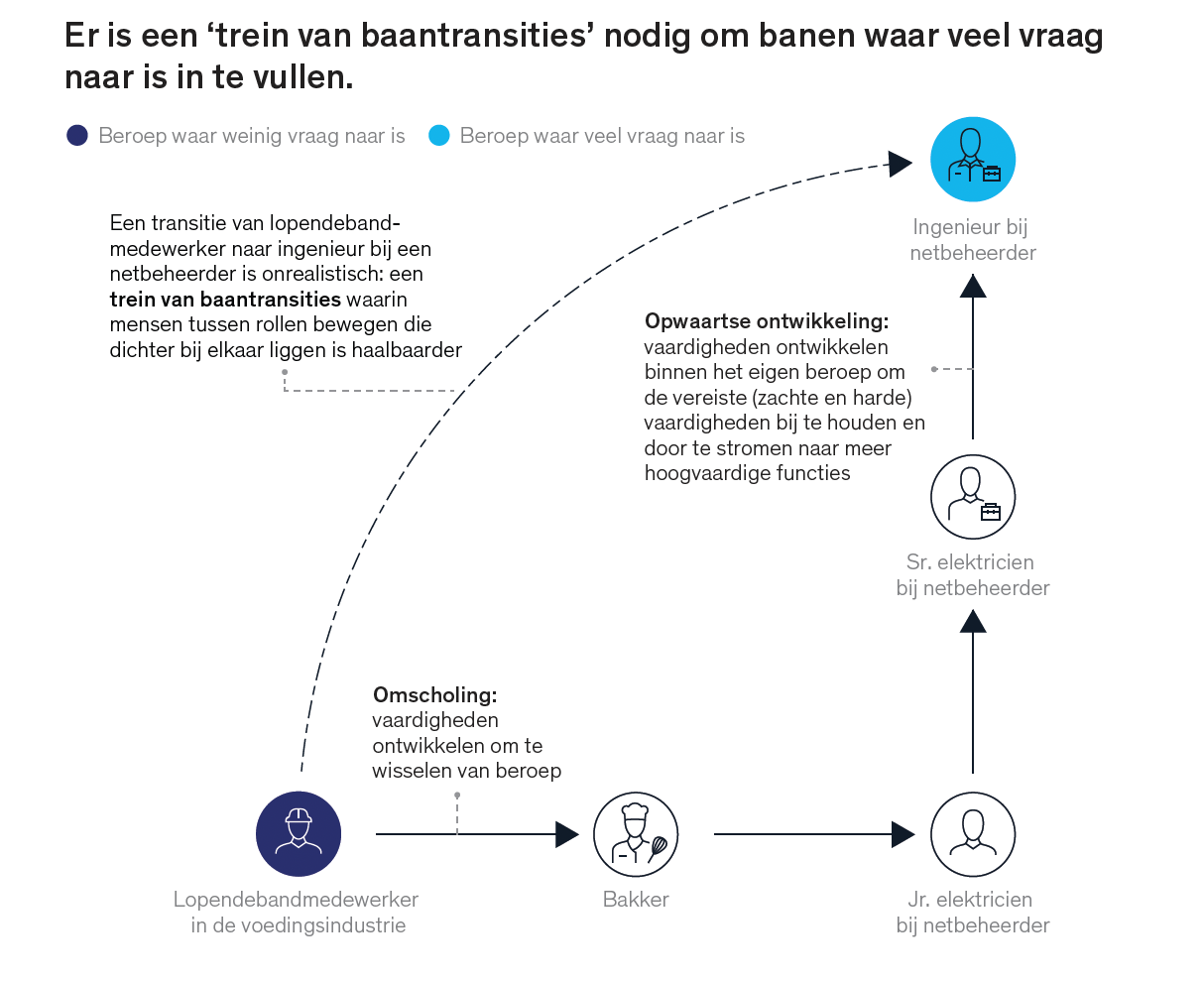
McKinsey argues for a 'train of job transitions' in which several people learn new skills and change roles to fill open needs. The annual number of people in the labor market requiring retraining is expected to multiply by 1,4 compared to the period from 2010 to 2020.
Customer contact employees
It is notable that the report explicitly mentions 'customer contact employees'. According to the report, they are part of a group of knowledge workers who carry out 'practical knowledge work'. When it comes to knowledge work with 'advanced skills', demand is increasing significantly. The demand for knowledge work at the lower levels actually shows a decrease.

Hagar Heijmans. Source: McKinsey
In response to questions Ziptone asks Hagar Heijmans, partner at the Dutch McKinsey organization, that this mainly concerns restaurant service, cashiers, telemarketers and counter staff. Other customer contact employees such as customer service representatives and sales representatives are part of the group of 'knowledge workers' divided into 'office staff, IT support staff, low-level supervisors & salespeople' (with a basic skill level) and 'middle management staff, managers & specialized office staff' with an intermediate skill level. The definition issue has to do with the fact that the research is originally in English and the demarcation is still being examined, according to Heijmans.
Shrinking labor force: known for years
Apart from the definition issue, the research is in line with other research that - although ten years old - is still trend-setting. It's about a infamous research from Boston Consulting Group in which it became clear to what extent Western European countries would face a shortage of 'hands' between 2020 and 2040. Central to that report is the double aging problem: the working population is shrinking while the population is aging – causing the demand for, for example, 'hands at the bedside' to increase enormously. Not only is the price of labor increasing due to a more limited supply, the price is also becoming higher because the demand for care is growing.
Good news for offshore BPO players?
The customer contact sector will be seriously affected by this combination of trends in the labor market, as clients are hardly willing to invest in higher rates per hour. On the contrary, both offshore outsourcing and automation are on the rise. The latter is also what McKinsey sees as one of the solutions. According to the agency, labor productivity in the Netherlands must be quadrupled. The agency is considering a composite approach with solutions such as continuous retraining and the greater use of digitalization, automation and artificial intelligence (AI) to automate simple tasks and increase productivity.
Can the field of customer contact contribute to a solution?
This proposed approach fits seamlessly with what is happening in the customer contact sector. Although there are major differences in the complexity and associated competencies of customer contact work, more and more organizations are talking about automation and digitalization of customer contact. The question is to what extent this will alleviate the labor market problems for sectors such as healthcare, education and technology. And to what extent sectors could help each other by recruiting employees with starting qualifications, such as the 'train of job transitions' mentioned by McKinsey. Food for thought for the HR specialists within the Customer Service Federation? (Ziptone/Erik Bouwer)


Also interesting
-

The internet consultation for the bill transposing the European NIS2 directive into Dutch law has been opened.
-

International consultancy firm BearingPoint has become a partner and system integrator of CX software provider Freshworks.
-

Sixty percent of the certificates used consist of weak domain validated certificates, which do not meet security requirements.