
 Before you know it, you are mimicking an organizational structure with your ecosystem of AI agents. Job van den Berg points out a risk: with bots, you strive for optimal efficiency and a single point of contact (the chief bot or head agent), but precisely because of this, you might lose overview and good manageability more easily.
Many companies that are seriously getting to grips with Agentic AI are currently building roughly the same structure. At the top is a single lead agent who acts as a sort of managing director. You discuss your questions, assignments, and priorities with this agent. Subsequently, that agent puts various sub-agents to work, each performing their own task. One agent conducts research, another analyzes figures, yet another writes copy, processes transactions, or handles customer inquiries. This is particularly attractive to humans, because you have only one point of contact while simultaneously gaining the clout of an entire digital team.
Only talk to your main AI agent
That sounds efficient, and often it is. The temptation is great, especially in customer service. One lead agent might receive a customer inquiry, have a sub-agent check the order history, have another agent consult the return policy, and have yet another agent formulate an appropriate response. However, there is a serious risk in this way of organizing. The more tasks you route through a single lead agent, the larger the black box becomes. You can still see what the lead agent reports back to you, but you have hardly any insight into what is happening beneath the surface. You do not know exactly which sub-agent used which information, what assumptions were made, where errors occurred, and how different agents coordinated their work. Precisely because you only communicate with that one lead agent, many of the natural checkpoints disappear from the process.
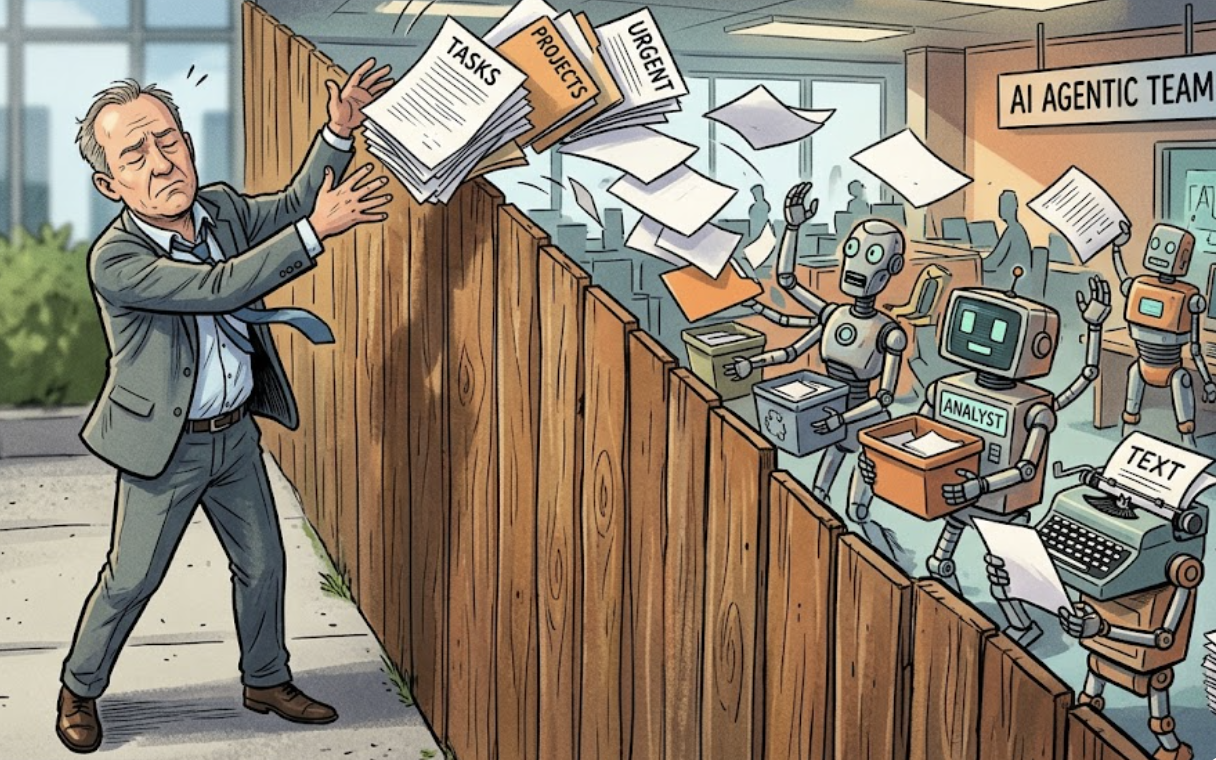
Just throw everything over the fence, the AI agent will delegate it.
This creates a curious parallel with a type of manager that many people in organizations will recognize: the 'throw-it-over-the-fence' manager. This is the manager who receives an assignment from above and then passes it on to the team as quickly as possible. Something is emailed, delegated, or brought up in a meeting, after which others are left to figure it out. In customer service, for example, you see this when a complex customer complaint is simply passed on to another team without anyone truly taking ownership. The manager saves time by doing so, but at the same time becomes increasingly detached from the real work. Ultimately, he barely knows anymore exactly what his team is doing, how decisions are made, and where the risks lie.
The less control, the smarter the system?
With agentic AI, we can make exactly the same mistake. We can build a system where we only enter orders at the top end and receive a result at the end. We outsource everything in between to agents. For example, a customer reports that their order has been delivered incorrectly for the third time. The lead agent sets various sub-agents to work, checks the history, reviews the compensation rules, has a response written, and perhaps automatically initiates a new shipment. In the end, we only see that the case has been resolved. That might seem like the ultimate proof of efficiency, but in fact, we risk becoming the digital equivalent of the box mover. We add less and less substantive value while simultaneously being completely dependent on a system we understand less and less.
A major misconception is that we primarily try to optimize the collaboration between humans and agents for time savings. Every human interaction is then quickly viewed as something that must eventually disappear. The less consultation, the better. The less control, the smarter the system. The more autonomy, the more mature the application. In customer service, this quickly translates into goals such as less human handling, fewer escalations, and the highest possible percentage of fully automated customer contacts.
A good manager does not try to eliminate every point of contact with his team.
But good management doesn't work that way in the human world either. A good manager doesn't try to eliminate every point of contact with their team. On the contrary, a good manager wants to understand what is going on, wants discussion, wants constructive criticism, wants to be able to evaluate choices, and wants to remain involved at crucial moments. Why should we suddenly assume that every form of interaction is inefficient when it comes to agents?
Why are we actually doing this?
The interesting question, therefore, is not how much work an officer can perform independently, but how much you, as a human being, keep in your own hands. And that brings me to a more uncomfortable question: why are we actually doing this?
I think the answer lies primarily within ourselves. After all, throwing it over the fence feels like management. It yields quick results, looks productive, and fits the zeitgeist perfectly: every executive is asked what they are doing with AI, and a lead agent with ten sub-agents is a wonderful answer. Moreover, understanding takes time, and time is precisely what we think we are saving with AI. In this way, not knowing is slowly becoming normal. After all, the result is usually correct.
How often do you, as a consumer, throw a question into ChatGPT without seriously thinking about it yourself first?
Anyone who recognizes this in managers can also recognize it in themselves. How often do you, as a consumer, throw a question into ChatGPT without seriously thinking about it yourself first? Half a thought in, an answer out, and often we copy it without reading it properly. It is the same movement on a small scale: the question goes over the fence, the answer comes back, and no one feels truly responsible for it anymore. That is fine for a recipe or a birthday email. It becomes problematic when we take that same reflex to work, to clients, and to decisions that matter.
Rebuilding a culture of disinterest
This raises a cultural question that is at least as important: what are you actually saying as a manager to your human team when you choose to pass the buck yourself? People watch closely what their manager does, and especially what he neglects. Anyone who passes a complaint on to an agent without seeing it shows that the customer doesn't really concern him. Anyone who delegates blindly shows that checking is not part of the job. That behavior doesn't stay with you. The team adopts it—towards colleagues, towards customers, and ultimately towards the agents as well. How you deal with AI is therefore not a technical choice, but a cultural one. An organization where everyone takes ownership achieves that same in their dealings with agents. An organization where problems always go to the next desk simply replicates that attitude in software.
Treat an AI agent as a new colleague, not as a mailbox.
So what is my advice? Treat an AI agent like a new colleague, not a mailbox. Give a good briefing, ask not only for the result but also for the reasoning behind it, and monitor the process frequently in the beginning. As trust grows, you can loosen the reins, but never let go completely. Furthermore, consciously decide which decisions and which clients you will never fully hand over, and regularly read a few cases from start to finish—not because you have to, but because it allows you to see what is really happening. A simple test for this: can I explain why this client received this answer if he calls me tomorrow?
With your customer service on autopilot, you no longer have any idea what is happening.
After all, you can have an impressive digital team, with a lead agent coordinating everything and dozens of sub-agents working for you day and night. But if you yourself only occasionally toss a task over the fence and then wait for the result, your schedule is empty and your customer service is on autopilot, and you no longer know what is happening. You could, after all, be a soulless manager of robots.
(Ziptone/Job van den Berg)


Also interesting
-

"2026 will be, I hope, the year in which we discover what we can really do with AI. Optimizing with AI…"
-

I was watching—with amazement—am watching, among other things, a conversation that starts with 'how things are going' and…
-

The consumer is going to build a complete agent team for the household themselves.