
 Hype or no hype, many customer service departments are undergoing transformations under the influence of GenAI. During the tenth annual Conversational Conference, it became clear that voice routing is often the starting point. In this first installment of Ziptone's impressions: how AS Watson and Delta Fiber are shaping their conversational strategy – including the lessons learned. And: CX is ready for a renaissance.
In brief:
- New conversational initiatives often start with voice routing
- AI initiatives that started a year and a half ago are already a legacy
- Involving employees in AI implementations? Not yet a given
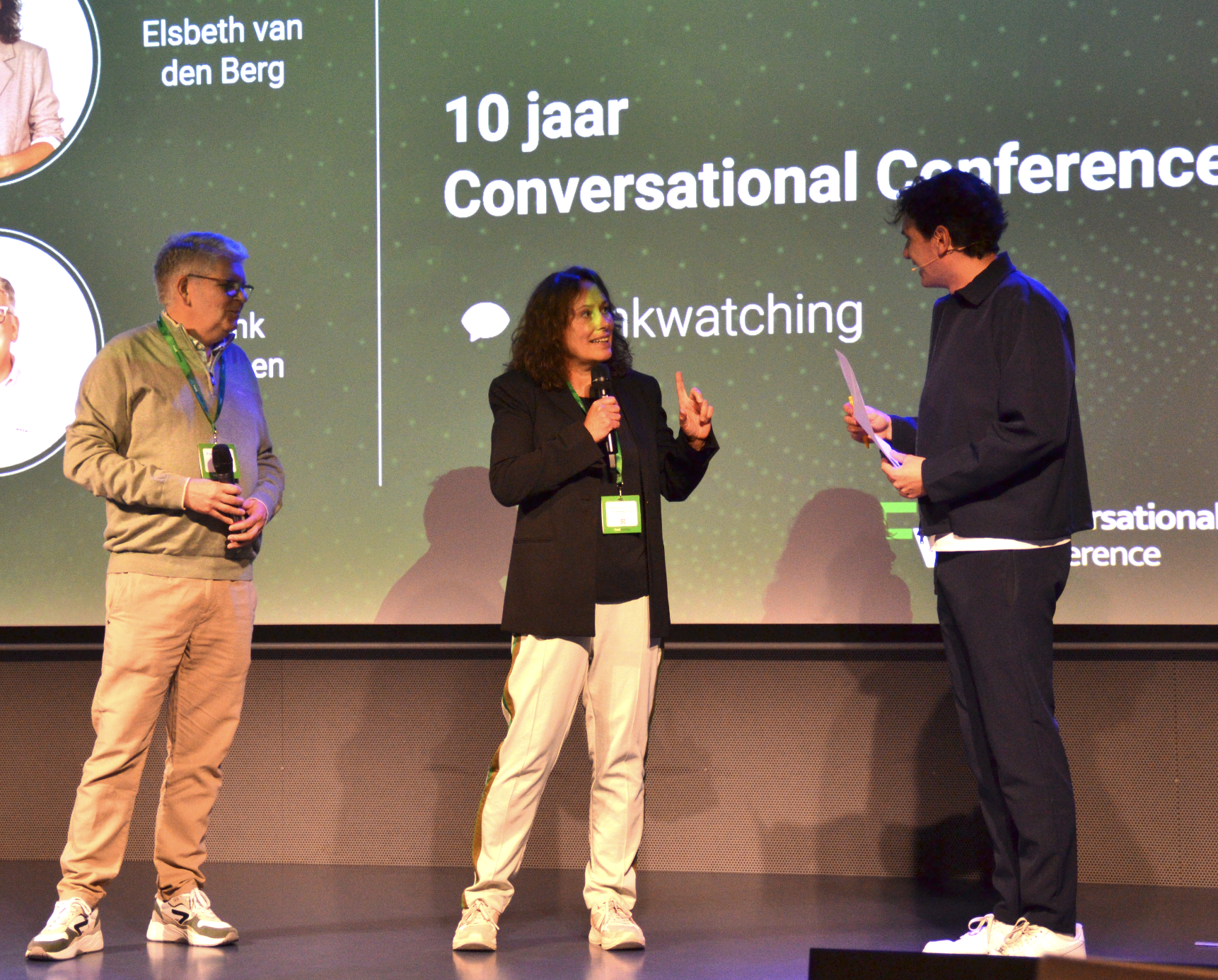
No confetti on stage at the Conversational Conference, but a brief look back at the nine previous editions with Frankwatching founder Frank Janssen and Elsbeth van den Berg. Incidentally, the first editions were held under different names, because instead of digital or AI, the focus was primarily on social media.
"Conversational" has carved out a niche for itself in the customer contact sector, characterized by its space for honest storytelling (including failures and lessons learned): stories of successes become considerably more meaningful. Some failures are classic management practices, such as insufficient upfront investment in support for the implementation of new technology. This was especially true of AS Watson's opening keynote. In this first installment, we'll also cover Delta's keynote; part 2 of our impressions of the Conversational Conference will follow tomorrow.
AS Watson gets started in speech routing
 Lisanne van Ingen (Content Coordinator at AS Watson Benelux) knows how demanding customer contact can be – she started ten years ago wearing a headset at AS Watson, the company behind ICI PARIS XL, Kruidvat, and Trekpleister, which operates 1.750 stores in the Benelux. The AS Watson customer service team averages 80 people, operates in two languages, and uses five contact channels. Towards Black Friday, volume increases by more than 300%. Agents need ten screens to do their work: the legacy of multiple brands and systems running side by side. This legacy also existed in the old, rules-based chatbot applications: seven variants, labor-intensive to manage.
The new platform implemented by AS Watson is based on GenAI and uses the knowledge base of approximately 3.000 articles as the foundation for both the internal bot (real-time agent assistance) and the customer-facing bot. AS Watson was fortunate that this knowledge base had already been updated earlier.
Agentic AI can help solve legacy obstacles
Just how limiting legacy can be was demonstrated by a good example given by Van den Berg. Tickets generated from live chat, for example, couldn't simply be captured in the SAP CRM system. Therefore, AS Watson, in collaboration with supplier CM.com, built a ticket creation agent. The drugstore chain also uses applications such as automated summarization and an improved search function so employees can more quickly find the right information about its more than 1.750 stores.
When they went live, three days before Black Friday, ticket creation was successful in half of all cases; now that's over 80%. The AI assistants are called upon an average of 20.000 times a week – "You can imagine the time savings if you can shave half a minute or a whole minute off each call." HALO, the platform on which the three bots from the three brands run, now recognizes 75% of employee and customer queries.
Employee to chatbot: “What don’t you understand?!”
Then there was the question of support. "You can read, can't you?" and "What don't you understand?" were reactions from frustrated employees when the bots' output was disappointing. Van den Berg's team concluded that it's not wise for management to remain in their AI bubble. They subsequently invested in additional training. Also not a smart move: quickly launching seemingly innocuous new features ("before lunch") without thorough testing.
At AS Watson, contact center management wants to be able to talk to reports
In the coming period, AS Watson plans to continue implementing voicebots. The demo showed some latency, but it looked promising for basic questions. This voicebot, with voices that align well with the three brands, should also provide more in-depth advice on nutrition, medications, fragrances, makeup (including dupes), and gift suggestions.
The AS Watson customer service team also wants to be able to "talk" to the reporting process via GenAI, according to Van den Berg. The time savings achieved by AI should allow them to spend more time with customers. When asked about checking AI output, the answer was "thorough testing beforehand."
Delta Fiber also cannot avoid digitalization
 The Delta Fiber case showed how large the differences can be between companies. Until recently, Delta encouraged customers to primarily make phone calls, according to Wendy Persoon (digital strategy lead Delta Fiber, photo) and Koen Spoonbill (AssistYou) – "We don't hide the number." But Delta also can't avoid digitalization and increased self-service.
One of the goals was to rationalize the application landscape. Before the migration from the on-premises version to the cloud version of Genesys, there were separate vendors for the IVR (Telecats), chatbot (Seamly and CM.com), live chat (Liveperson), voice (Genesys), email (Verint), outbound (Teleknowledge), WFM (Verint), and QM (Bumicom). In the new setup, much of this functionality could be extracted from Genesys Cloud.
However, the IVR, voicebot, and chatbot remained areas of concern: for example, Genesys allegedly wasn't developing voice routing quickly enough, leading to a solution from AssistYou. Besides dealing with a multitude of phone numbers, Delta therefore started with rationalization and voice routing. As a result, the conversational aspect of the presentation faded somewhat into the background; on the other hand, the case study demonstrated how you first need to build a foundation before you can start working with AI agents, voicebots, and the like.
Red light
Voice routing also forces you to consider your knowledge management, if only to ensure proper intent management. When should you ask follow-up questions if someone asks about "red light" or "box for second TV"? Smart routing also involves customer recognition (based on CLI), which in turn lays the foundation for more personalized service (e.g., "I see you've called before"). The routing project resulted in a 33% reduction in call forwards and significantly improved insight into the reasons for calls.
Future plans at Delta include becoming more proactive, implementing a voice bot, increasing deflection towards the service app or my environment, and deploying routing during busy periods by referring callers to chat.
Endless scrolling on Booking.com? That's so 2024.
 Conversational Conference was closed by Steven van Belleghem, who predicts a CX renaissance. In a particularly valuable closing remark, he touched on several sensitive points. For example, AI initiatives are often focused on internal issues – by extension, you could say "they are focused on costs instead of customers."
Endlessly scrolling across multiple platforms to make a choice? That's outdated, says Steven van Belleghem.
Anyone who isn't paying attention might overlook the fact that consumers and customers are also using AI—they no longer visit your website to search and compare, but order via an AI agent, selecting suggestion number one from an AI-provided list. The second sore spot: the advantage currently offered by e-commerce platforms—think of Booking.com, which only displays photos of a double bed, according to Van Belleghem—is quickly fading into the background, becoming clumsy and outdated.
Platform players like Booking.com or Bol.com run the risk of becoming a commodity; the question is how they become relevant again. There's no other option than to use AI to further enhance convenience and create new added value, says Van Belleghem. Companies will need to develop a new narrative to attract customers. The last tip is also the most challenging: when AI becomes a key player in sales and service processes, companies will need to establish a solid foundation of trust.
(Ziptone/Erik Bouwer)


Also interesting
-
Should you let your GenAI bot interact with customers, or should you opt for agent assist and other less risky uses first?
-

During the last General Meeting of the WFC in December 2024, the appointment of Bob Mols was unanimously approved.
-

Clients do not have to expect any fines in 2025 and may continue to use existing model agreements for self-employed persons.