

Image: Ziptone/AI
In the customer contact sector, the prevailing narrative is that the deployment of GenAI quickly leads to cost savings, for example through a shorter average call duration. It is less clear what costs offset this. After all, every time an AI tool does something, a cash register rings somewhere. Ziptone spoke with both suppliers and end users to gain insight into AI costs in practice.
In this article:
- Insight into the costs of AI is often limited.
- many different types of AI costs are involved;
- The AI market is immature when it comes to pricing.
A while ago it sounded Gartner sounds the alarmThe costs of AI would eventually skyrocket. The underlying rationale was that the massive investments in AI could only be recouped if the rates of LLM providers increased. Gartner predicted that a call handled by AI would become even more expensive than the hourly rate of a human agent from a low-wage country.
Savings often clear
Opposite the clear benefits of AI in customer contact (a shorter average call duration, or fewer calls) stand the implementation costs and the consumption costs for tokens, the unit by which AI applications draw on CPUs. The crucial question is: how high is the monthly AI bill, and what determines it?
We can imagine that the contact center manager wants to know in advance, or at the end of the year: what does this application cost per interaction? Which costs are related to licensing, usage, and management? Which costs are fixed and which are variable? Who monitors usage, quality, and compliance? And what is the payback period per use case?
Insight into the costs is limited

Image: Ziptone/AI
Ziptone therefore conducted an investigation. A survey by Ziptone reveals that it is not so much the costs themselves that are a sensitive issue, but rather the lack of insight into them. Users do not have a good understanding of both the structure and the magnitude of the costs of AI applications. Consequently, most experts Ziptone spoke with were only willing to contribute to this article on an anonymous basis.
Gartner's warning about rising costs was heard here and there skeptical received, but the concerns about unexpectedly high costs for new technology do not come out of the blue given that lack of insight. Grip on cloud costs is still a challenge for many CIOs.
Include all different types of costs
Experts Ziptone spoke with advocate for a clear distinction between development costs on the one hand and usage costs on the other. Development and build costs encompass a wide range of items: from consultancy to fine-tuning and training. These costs are not always included in the business case. Furthermore, the breakdown of usage costs for AI-based applications is rarely transparent and therefore not always known. While the implementation of AI may be a software project (according to some experts), different demands are placed on AI during the run that can drive up costs. The experts also pointed out the lack of insight into revenue loss (churn) attributable to the use of AI. Regarding costs, in many cases, invoices arrive at a central level—for example, the IT organization.
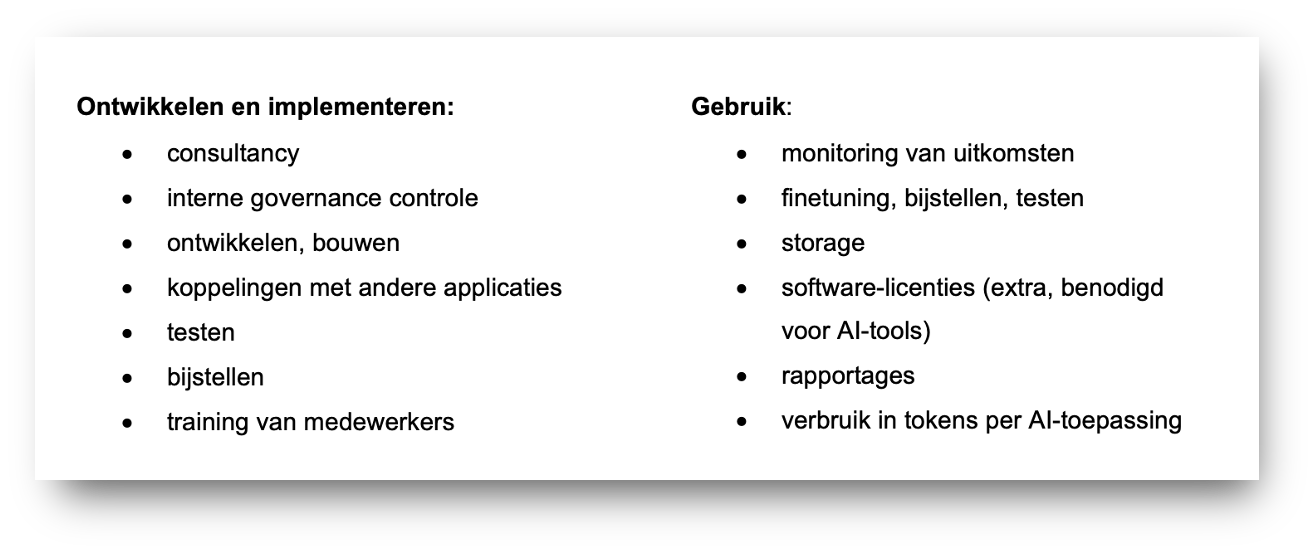
When calculating implementation costs, managers must take into account integrations with the contact center platform, CRM, and knowledge base, cleaning and preparing content for retrieval or prompting, testing in various scenarios, security and privacy checks, prompt development, training of team leaders and agents, and the establishment of escalation paths.
These implementation costs can add up, particularly for chatbot and voicebot applications, because not only the technology but also the customer journey, tone of voice, and error handling must be properly configured. Introducing automated summaries and automated QM is easier to implement and can therefore be a more logical starting point.
The costs for the 'run' are more than just the token or model costs. Costs for monitoring, retraining or adjustment of prompts, maintenance of knowledge resources, evaluation of output quality, support from IT or operations, and any additional licensing costs from vendors are also added.
For applications involving direct customer contact, such as self-service bots or agent assist, these costs can escalate faster than anticipated: these types of applications must be constantly adapted to new customer requests, processes, and product changes.
Governance costs relate to monitoring the quality of the output of AI applications. Who recognizes when a use case becomes less favorable than planned? Who assesses whether summaries, response suggestions, or classifications are still sufficiently accurate? And who intervenes if compliance, tone of voice, or customer experience are no longer appropriate? Low costs per interaction can be offset by costs for rework and escalations. Good governance requires periodic evaluation, validation, and adjustment. This may also mean that development teams have to go back to the drawing board.
AI costs: various costs stacked
You can also view the costs of AI as an accumulation of different types of costs.
The costs of AI start with the cost price charged by parties such as Google, OpenAI, Anthropic, and Mistral. These players use different types of rates, almost always based on a price per number of tokens.
The second 'cost layer' is determined by the resellers and providers of AI applications. They often apply their own rates (for example, cost price plus a markup) and use their own terminology and billing models based on tokens, conversations, transactions, bundles, and so on. This makes comparison difficult. For example, Genesys refers to 'experience tokens' (expressed in minutes), which is different from an LLM token, whereas certain AI applications are actually included by default in Genesys packages.
Other players price their AI based on 'solved cases', so regardless of the duration of the interaction. Rates may also be linked to specific licensing models. For example, the cost of AI might depend on the number of seats purchased from a CCaaS provider. Fair use policies are likely to apply to included services. And yet other players only provide pricing for AI usage based on a quotation.
The final consumption costs
The third layer of costs arises when various functionalities are used within AI applications. Consider automated summarizing, which requires both speech recognition and LLMs, but often also additional services. For example, to write the created summary to a CRM solution, or to ensure guardrails and PII removal—necessary to remove sensitive information if there is no legitimate purpose for storing it.
There are differences in cost structure and level in this regard. For summarizing and transcribing, the costs per interaction are low; with real-time agent assist, variable costs increase because usage can be continuous during a conversation; the deployment of a voicebot is relatively expensive due to speech, real-time processing, and sometimes more complex orchestration; when deploying agentic AI, one must account for additional costs for governance, validation, and risk controls.
Image: Ziptone/AI
A story from real-life practice: an insurer – One of the experts (name known to the editors) Ziptone spoke with works at an insurer where the use of AI impacts matters such as staffing and savings targets. Consciously managing costs is one of the most important ways for the insurer to control premiums. Therefore, savings targets are formulated annually at this company; a portion of these is aimed at increasing efficiency in customer contact.
Prior to implementation, testing is first carried out on a small scale with a PoC, which also serves as the basis for a business case including costs and revenues. If savings become visible within the pilot group, the application is scaled up.
The deployment of various AI applications in different phases and components of the interaction between customer and employee results in a reduction in call duration and after-call work time. This involves, among other things, recognizing customer intent, providing the most relevant knowledge articles during the conversation, and automated summarizing. This yields a total saving of five to seven percent on the total call duration. At the insurer, it is precisely known what every second of AHT reduction yields: the revenue side is transparent.
However, on the cost side, it is more complicated. For the various AI applications (a search in the knowledge base; recording, transcribing, summarizing a conversation), the rough token count is known. The moment an AI application is scaled up, the absolute costs increase, but the average cost per token decreases; suppliers work with tiered pricing.
The insurer purchases the tokens in a bundle, and there is no exact insight into how they are deployed per AI application. However, there are levers that can be adjusted to control costs. For instance, the frequency with which the agent assist solution accesses the knowledge base can be reduced. It can also be decided to have the AI application, rather than the existing knowledge management solution, perform the 'knowledge' work (searching company documentation).
To optimize savings, scaling up the use of AI – currently optional for employees – is essential. This scaling up is also considered a necessary step to implement agentic AI in the future. When 'autonomous agents' start working – think of independently processing changes – new processes will emerge that must apply to all customer contacts and all customers.
At the insurer, the total costs associated with AI are being examined in increasingly detailed fashion. For instance, it is clear that the deployment of AI also requires the involvement of various internal specialists in the fields of cybersecurity and privacy. The storage of conversations (audio) and transcripts also costs money. As AI applications evolve further towards agentic AI, these roles, like those of risk management and model validation, will become even more important.
Alongside an increasingly clear picture of costs, there is also a better understanding of (broader) returns, such as a faster and higher first-time fix rate. An agent who does not need to consult a colleague but knows the correct answer immediately contributes to trust and a good customer experience. Furthermore, a shorter total call duration reduces the strain the organization places on a tight labor market.

Immature market
 According to Jeroen Kromme (Head of Products & Data, QuandaGo) believes the AI market is still immature in terms of costs. “I notice that even when resellers and providers of AI services do their best to be transparent about AI pricing, there are still a great many ifs and buts that complicate matters and make them opaque again.” As a result, it is difficult to estimate how many tokens you need. Different models consume different amounts of tokens: think of API calls, reasoning tokens, and tokens needed for the operation of model context protocols.
In addition, new models are constantly being released, which are, incidentally, continuously benchmarked. Even with these benchmarks, it is not always clear how the cost comparisons work. For example, some new models are often more efficient in token consumption, but the tokens are more expensive per unit.”
Restaurant menu
“At QuandaGo, we receive an invoice from LLM providers for all our token consumption. Using so-called metering software, we can allocate all types of costs to specific applications – down to the level of speech-to-text. Our customers are not billed based on 'cost plus markup,' but on an all-in rate for the consumption of a specific application. This prevents cost fluctuations from leading to price changes and ensures that customers do not have to monitor cost rates themselves, which is virtually impossible. We consider fluctuations in cost price to be an entrepreneurial risk. At QuandaGo, we bring all our AI products down to a single price per conversation. Take, for example, the automated generation of a conversation summary, which costs us 15 cents.”
This model is best compared to a restaurant menu: the prices are all-inclusive, but the cost price of a kilo of pizza flour is not reflected in it. However, it does make it highly predictable and manageable for our customers.
That immaturity in terms of pricing also has to do with the immaturity of the technology, Kromme argues. “The existing models are still being improved, but that improvement levels off at some point. In addition, providers are doing their utmost to gain market share. The moment generative AI can no longer really be substantially improved, it becomes a commodity, just like with the cloud, which virtually no one doubts works well anymore.”
(Ziptone/Erik Bouwer)
In part 2 of this article: how does token invoicing work? What are common rates per application? Which tools can you use to keep a grip on the AI invoice?


Also interesting
-

In this article, we take a specific look at the costs of AI in customer contact. What do you pay per application and…
-

AI applications differ significantly in terms of cost structures, durations, risks, and forms of value creation, according to the analysts.
-

The cost of tokens for software development will exceed the cost of a developer's average salary in 2028.