
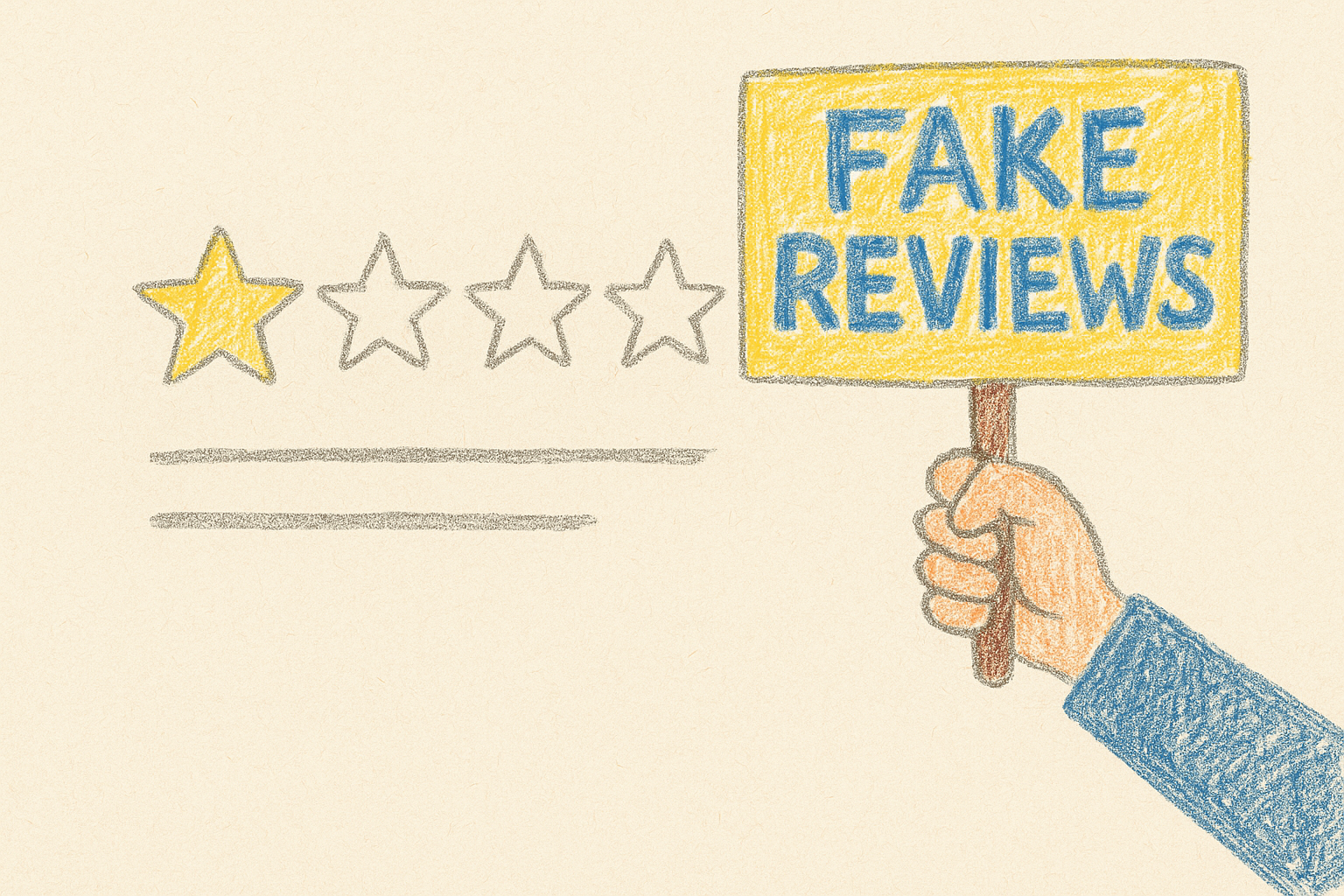
 No one appreciates a one-star review on Google or another review site, whether it's justified or not. Ideally, you want customers to contact you so you can try to alleviate their dissatisfaction or solve their problem.
Text: Charlotte Meindersma
They exist: customers who try to force certain solutions by threatening to leave a bad review. Their proposed solutions often go beyond what's reasonable. For example, because you would never offer that solution legally or out of goodwill: it's unreasonable or too expensive. This customer behavior can be a huge problem for small businesses.
Cybercriminals love to do that a little extraThey post one or more 1-star reviews and then contact us: pay, or we'll leave the reviews. If you don't pay, we'll post even more 1-star reviews.
Besides the fact that reporting these fake reviews and forms of blackmail to Google is a daily chore for businesses, Google often doesn't respond. Occasionally, a review is removed, but reporting a large number of automated 1-star reviews is impossible. Leaving comments under reviews yourself is also pointless. The review itself doesn't disappear, the average rating remains lower, and many (potential) customers rely on the average star rating – without reading the accompanying reviews.
DSA makes reporting easier
The Digital Services Act (DSA) should make it easier to report these kinds of reviews. It should also make it easier to contact a platform like Google. In practice, this is rather disappointing.
The ACM has been the Dutch authority since February 2025 supervisor for the DSABut the ACM hasn't gone much further than noting that many problems remain and launching a public campaign to make consumers aware of their rights.
Even if consumers weren't fully aware of their rights, they still wouldn't be able to take action. This costs time and money, and the products are often worth less than the costs involved in seeking justice.
Tackling fake reviews
Things aren't much better for businesses, especially freelancers and small businesses. They almost always lack the knowledge and resources to address DSA issues, such as fake reviews on Google and other platforms. If Google refuses to comply, the only option left is to engage a lawyer. They can write a letter to Google, urging them to take action. Google can respond (or not) or reject the request, but in the meantime, weeks have passed and the number of fake reviews has increased.
If Google fails to respond adequately or take sufficient action, the final option is summary proceedings. It usually takes six to eight weeks before your case is heard; after that, you have to wait another two to four weeks for a ruling. This is all very time-consuming and expensive – regardless of whether you can demonstrate that you are entitled to compensation for lost revenue due to the refusal to remove fake reviews.
Chances of winning
Not every fake review is clearly recognizable as fake. So you also have to be able to prove that it wasn't customers who criticized you. This usually works: the chance of winning is quite high.
The situation is different if the bad reviews are from genuine, but dissatisfied, customers. Even genuine customers can distort the facts or make the situation seem worse than it actually is. Where exactly do you draw the line at unlawfulness? Even unjustified negative reviews from genuine customers are damaging, but perhaps not worth pursuing.
Conclusion? Especially in the latter case, it's crucial to have many satisfied customers who are willing to post genuine reviews.
(Ziptone/Charlotte Meindersma)


Also interesting
-

A housing association talks about "Information Booklet" and "Consultation Hour." Is treating your clients like toddlers the solution if you...
-

Frans Reichardt is upset about the constant stream of LinkedIn requests with a commercial ulterior motive.
-

Frans Reichardt has an idea: KlantNet, an app for customer contact professionals that uses the voice of a customer to…