
Those looking for a new contact center platform have a wide choice of established enterprise providers and a huge influx of new SaaS providers. Dutch players are also active within this enormous range. One of the Dutch challengers in the market is Omnidesk, which originated in 2018 from the practice of KPN subsidiary Simyo.
 Year after year, Simyo scores high in rankings when it comes to the most customer-friendly mobile provider. The company has already been named the best mobile provider in the Netherlands 29 times by the Consumers' Association. The company scores a 9,7 on customer satisfaction. In addition, Simyo was the most customer-friendly telecom company in the Netherlands in 2016, 2017, 2019, 2020 and 2022.
But in addition to these excellent performances, there were also internal challenges, he said Thomas *), worked as an IT architect at Simyo until 2018 and was involved in the search for a new platform for the telecom company. The end result of that search was the development of Omnidesk.
Contact history
Thomas looks back: “At the time, Simyo used different systems for telephony, for social media, for subscription registration, for e-mail and a system for transferring customer cases that had to be sent from customer service to, for example, the back office. There was insufficient insight into customer data and customer contact history. The contact history was not visible in the form of a timeline.”
“This fragmentation in solutions presented several challenges. For example, the contact channels were literally divided over separate teams; employees were therefore also trained on a specific channel and the associated systems. This made the flexible deployment of employees difficult: it was difficult to get employees from one channel to another. Simyo had explicit views on this: the company wanted to give employees the information and autonomy to determine for themselves which tasks had the highest priority. The contact center platform in use did not provide good insight into the queues. In addition, the entry of contact history in the CRM system was not automated.”
Develop yourself
As part of the search for a new solution, Simyo asked various parties to give a demo. “One party came with a heavy delegation that did not fit in with Simyo's culture in terms of culture, another party could not offer what was asked for,” says Thomas. After the search had been halted for a while, he decided to develop a solution himself, based on the premise that customer contact employees would have a total overview and more autonomy for handling customer contact. Thomas mainly did the development work in the evenings, but during the development he also regularly literally sat next to the customer service employee.
The solution was initially tested internally at KPN at a number of smaller business lines. More than a year later and various optimizations further Omnidesk rolled out within Simyo. “Even at an early stage, I made agreements with my employer to be able to go further into the market with the solution myself. In 2018 I decided to leave KPN and join my own company, where Simyo was the 'launching customer'. That was important, because after that we mainly managed to get customers on board who are very explicitly concerned with customer satisfaction. Jeroen also came on board in 2018 – focused on sales.” In addition to Simyo, the company now also serves customers such as Greenchoice, Pathé and Intertoys.
Tasks and actions as a starting point
Omnidesk's solution is mainly aimed at the communication from a large customer service organization for the consumer market. Naturally, the solution arranges the routing of interactions that customers have with your company and Omnidesk provides a 360-degree customer view across all channels. While the routing of telephony (and other contact channels) is the starting point for many contact center solutions, Omnidesk has chosen a different approach route, namely that of the actions and tasks within the customer contact department.
Thomas explains: “With many solutions, the contact itself is leading. If something else needs to be done afterwards, the employee needs to go into the CRM system. With Omnidesk, the follow-up action is included as standard, a contact can be handled in one go, but then the employee specifically indicates this. If the employee does not indicate this, the contact will continue in a configured process until it is handled. We call that ticketing, but you can also call it a task or action that needs to be assigned to someone else. Think of the back office, another department, a colleague or another organization in the chain. You can also assign a priority to it. The idea is that the entire team can work on the case, with an overview of previous actions via the timeline, until the question is resolved.”
 Jeroen *) (manager customer experience & opportunities at Omnidesk) adds: “Some organizations have a relatively simple front office, but a large number of different underlying processes. Think of a municipality or province, where the front office does not perform all processes itself, in contrast to an e-commerce player where the flavors are clearer. But a ticket is also a tool to monitor the handling of tasks - think of a callback request. It contributes to achieving the objectives of a satisfied customer and NPS.”
Autonomy customer contact employee
A second difference with other solutions is the emphasis on employee autonomy. Thomas explains: “Employees can make their own decisions based on the real-time data they have in view – think of traffic or information from the BI tool – and can therefore also be freed within the agreements made by the team to join a specific queue or a specific team themselves: what is needed now?”
That autonomy – including the ability to influence processes yourself based on insight into real-time data – is becoming increasingly important in the eyes of Jeroen and Thomas. “The requests we receive often concern the phenomenon that customer contact employees have to retrieve their information from multiple systems. Increasing the overview is therefore an important element, and that also has a relationship with retaining your employees. They want to work with good tools.”
Everything in-house
And finally, Omnidesk is a Dutch company. Jeroen about this: “Even though you have a large contact center with more than 150 employees by Dutch standards, for large American suppliers of enterprise solutions you are not at the top of the priority list as a Dutch customer. We have often heard that during our pitches. The way of working together – think of short lines and direct contact with the development team – is an important factor for many companies.”
Thomas: “We arrange implementation, training and support completely ourselves. So we are very closely involved with our customers. In addition, our modest size allows us to respond very well to customer wishes, especially if expansions also yield something for other customers.”
Important choices
The future? Organic growth is the goal, according to Thomas: “We are mainly focusing on the further development of the solution. We are now also looking at chatbot functionality with intent recognition, although most of our customers work with solutions from major players, such as Google, which allow you to easily integrate with Omnidesk. Of course, we are also looking at ChatGPT. Last year, we added a knowledge base that provides employees with suggestions based on the content of a timeline. That fits in well with our solution, which is aimed at supporting the employee. From that philosophy, we also believe that WFM functionality, for example, does not have to be built into Omnidesk. Contact centers can easily search for the most suitable solution for this.”
Jeroen concludes: “For SaaS solutions like ours, it is important that the core functionality is suitable for as many organizations as possible.” (Ziptone/Erik Bouwer)
*) Corrections and additions – in an earlier version of this article, the full first and last names of Jeroen and Thomas were mentioned. This has been changed at the request of both for privacy reasons and limited to the first name only. The link to the LinkedIn profile of both has been retained for the first names.


Also interesting
-
On digital self-service channels, it is not always visible whether an action is performed by the customer themselves or by an AI agent…
-
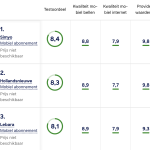
Mobile providers Simyo and Hollandsnieuwe score highly in the Consumers' Association's internet panel. Customer service, in particular, scores well.
-

The Customer Experience Battle of the Belgian industry association Customer Contact & CX Forum is now called the Customer Experience Challenge.