
 The debate regarding the impact of AI on jobs (and customer service jobs in particular) continues to stir emotions. The authoritative Economist is also joining the discourse on AI and the labor market, quoting Kristalina Georgieva, head of the IMF: “AI is hitting the labor market like a tsunami.” The only question is when that tsunami will come and who exactly will be affected.
To clarify the impact of AI, we looked The Economist, regarding developments in the American labor market influenced by technological changes. Naturally, automation has led to shifts, but the predictions from the 1980s that white-collar jobs would disappear have not come true. On the contrary, the number of management positions has grown rapidly. Automation has created very few jobs everything replaced, thus The Economist,Full replacement played a role among typists, for example. The IT revolution has primarily provided new impetus. Between 1980 and 2010, almost half of the growth in the number of jobs is attributable to entirely new jobs.
Tsunami on the labor market – Kristalina Georgieva, head of the IMF, foresees major shifts in the global labor market as a result of AI. In advanced economies, 60 percent of jobs will be eliminated or transformed. According to her, entry-level positions are particularly vulnerable in this regard, which could hinder young job seekers. She said this during the WEF in Davos in January of this year. The GuardianChristy Hoffman, Secretary General of the global trade union UNI, predicts that AI will primarily be deployed to increase productivity and reduce costs, “which amounts to cutting jobs.”
When it comes to AI, you cannot look back further than 2022. While AI is admittedly smarter than the digital technologies of yesteryear, the same logic of technological change seems to apply this time as well. To begin with, current artificial intelligence systems exhibit what AI researchers call “jagged intelligence”: uneven and inconsistent performance. Being good at 95% of a task is not enough when the remaining 5% revolves around important edge cases and judgment.
Analysis
To test the hypothesis about the limited impact of AI on various jobs, looked The Economist, based on job descriptions and task packages of four types of office jobs: technical specialists, managers and coordinators, healthcare workers, and back-office employees. For these groups, employment was examined from the end of 2022, using moving semi-annual averages.
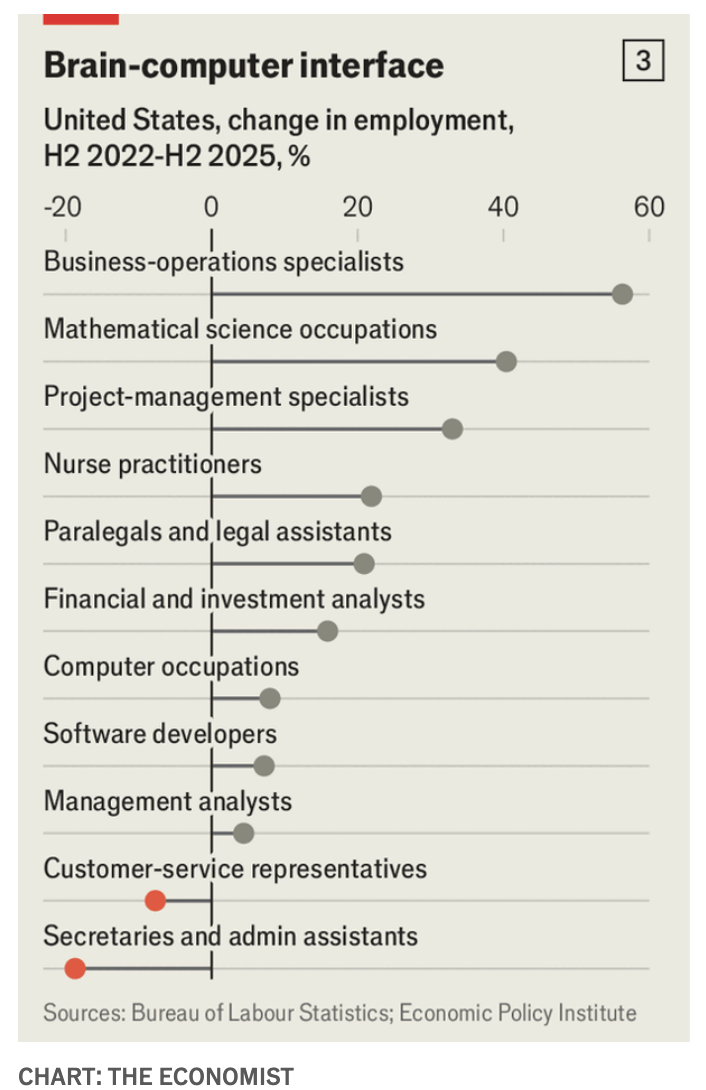 In three of the four job categories, employment has increased since 2022, often by tens of percent. Moreover, AI is also creating entirely new jobs; these involve new roles such as data specialists who prepare data for AI, specialists who guide companies in the implementation of AI, and Chief AI Officers. The number of jobs in the IT sector is also steadily increasing.
'Entry level jobs' under pressure
Only routine front-office and back-office work has shrunk, according to The Economist,Examples cited include American claims employees at insurers (down 13%) and secretaries and administrative assistants (down 20%). A decrease is also visible in customer service representatives – although it is unclear what the role of offshoring is in this regard. Additionally, it points The Economist, at the first signs of a declining number of entry-level jobs.
At the same time, it warns The Economist, for advancing technology. Every time new models are released, they are capable of more: better quality, higher output, more autonomy. This can cause a shift in specific professions, such as among software developers. But even then, it provides The Economist, no “labor market chaos” as some predict. “Combining human judgment with machine intelligence will yield more value than AI alone for the time being,” according to the magazine.
(Ziptone, The Economist)


Also interesting
-

The supermarket chain reportedly wants to implement changes to employment conditions that are detrimental to employees.
-

This book is about AI agents: software that can perform tasks independently. Will customer contact also have to deal with this? The answer…
-

Premature deployment of GenAI chatbots and virtual agents for customer contact will lead to increased consumer skepticism, according to Forrester.