
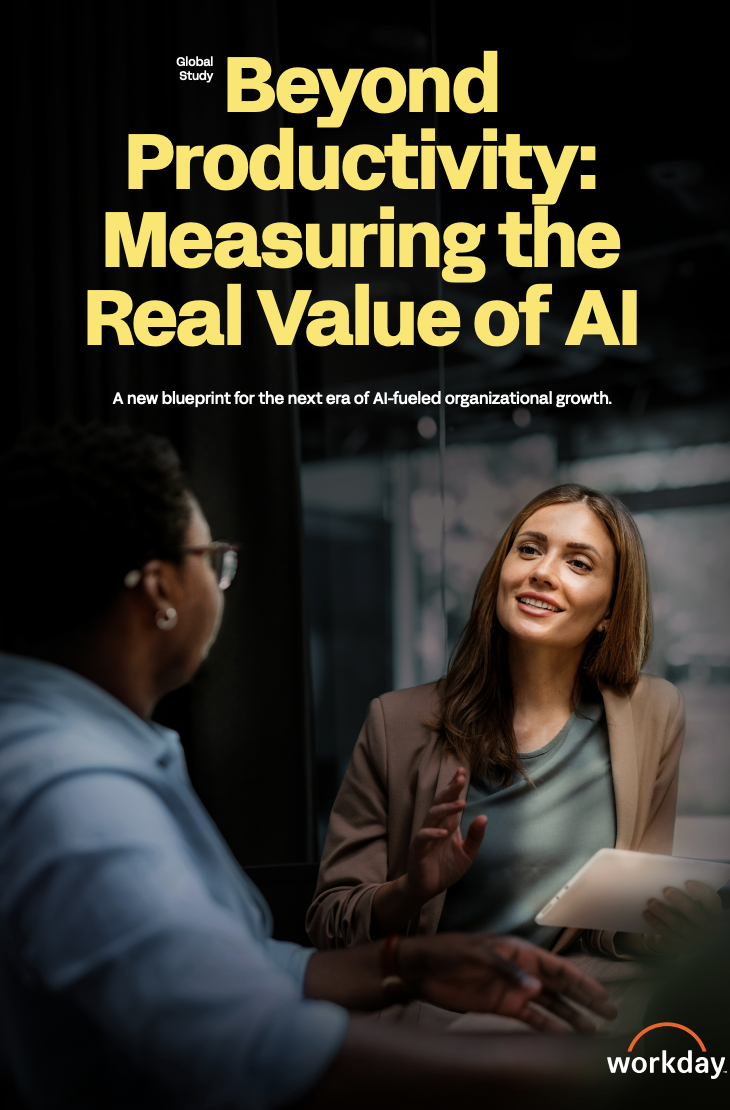
 While AI does deliver productivity gains, many organizations aren't fully leveraging its value. Time saved by AI is often negated by remedial work such as correcting errors, rewriting content, and double-checking results from generic tools, according to a new global study by Workday.
The report, “Beyond Productivity: Measuring the Real Value of AI", shows what separates leaders from laggards: the most successful organizations don't just implement AI; they reinvest the time savings in their employees. By developing skills, redesigning roles, and modernizing work, these organizations convert speed into lasting business impact.
“Too many AI tools push the difficult questions of trust, accuracy, and repeatability back onto the individual user,” said Gerrit Kazmaier, president of product and technology at Workday. “At Workday, we’ve been delivering AI for years in simple, human-centric solutions, not as pure technology, so customers don’t have to connect things and validate every outcome themselves. Our philosophy is that AI should do the complex work behind the scenes, freeing people to focus on judgment, creativity, and connection. That’s how organizations turn AI-driven speed into sustainable, human-centric advantage.”
Productivity paradox
AI saves a lot of time, but that speed doesn't always translate into better results. Although 85% of employees report saving one to seven hours per week by using AI, a large portion of that gain is negated by the remediation of low-quality AI-generated content. This creates a false sense of productivity and efficiency. AI increases capacity, but roles, skills, and processes often haven't evolved to structurally translate that extra capacity into better results.
“Younger employees spend most of their time checking and correcting AI output.”
According to Workday, the key findings are:
- Globally, nearly 40% of the time saved by AI is lost to remediation work, such as correcting errors, rewriting content, and verifying the output of standard AI tools. In the Benelux region, employees spend an average of 1 to 2 hours per week (37%) on remediation work, exacerbating the hidden burden on AI-driven productivity. As a result of this invisible barrier, only 14% of employees globally consistently achieve clear, positive net results with AI.
- Frequent users experience the most pressure: Employees who use AI daily are highly optimistic: over 90% believe AI will help them be more successful. At the same time, they bear the greatest burden: 77% review AI-generated work as thoroughly as, or even more thoroughly than, human work.
- Younger employees bear the greatest burden: Employees aged 25 to 34 make up nearly half (46%) of the group most affected by AI-related remediation work. Despite their reputation as the most tech-savvy, they spend the most time checking and correcting AI output.
- The training gap persists: Over half of Benelux executives (72%) say their organization prioritizes reinvesting AI-generated efficiency gains into skills training/learning and development, while less than half (48%) of Benelux employees have experienced increased organizational investment in new or expanded skills training/learning and development programs. This exposes a clear disconnect between leadership intent and employee experience.
- Jobs are lagging behind AI: In most organizations (89%), less than half of jobs have been adapted to AI capabilities. Employees are using 2025 tools within 2015 job models and are struggling to combine faster output with unchanged processes and systems.
Reinvest AI profits in your workforce
Most organizations agree that the benefits of AI should accrue to employees, but in practice, much of the investment is still being made elsewhere. Organizations are more likely to invest AI savings in technology (39%) than in employee development (30%). And instead of using the saved time to develop skills, many simply increase workloads (32%), leaving employees to figure out how to use AI effectively on their own.
But the organizations that actually see returns are making a different choice. Employees who achieve positive AI results are much more likely to use the time saved to increase the value of their work, for example, through deeper analysis, better decision-making, and strategic thinking (57%), rather than simply taking on more tasks. They are also much more likely to have received additional training in their skills (79%).
Organizations deriving the greatest value from AI view the time saved as a strategic resource. They invest in reskilling their teams, improving collaboration, and strengthening work that revolves around human judgment. The greatest opportunity lies in supporting employees in using AI effectively, particularly in areas that require judgment, creativity, and decision-making. The research makes one thing clear: investing in people is the fastest way to reduce rework, improve outcomes, and translate AI speed into lasting business value.
The study was commissioned by Workday, a provider of HR and finance software, and surveyed 3.200 respondents in North America, Asia Pacific (APAC), and Europe, the Middle East, and Africa (EMEA) in November 2025. Respondents were full-time employees at organizations with annual revenues of more than $100 million and were active users of AI technology.
(Workday)
Also interesting
-
Research from McKinsey shows that the impact of AI is expected to…
-

Two different studies show that the return on investment of using GenAI in…
-
Two-thirds of HR professionals believe that their own organization still makes too little use of…