
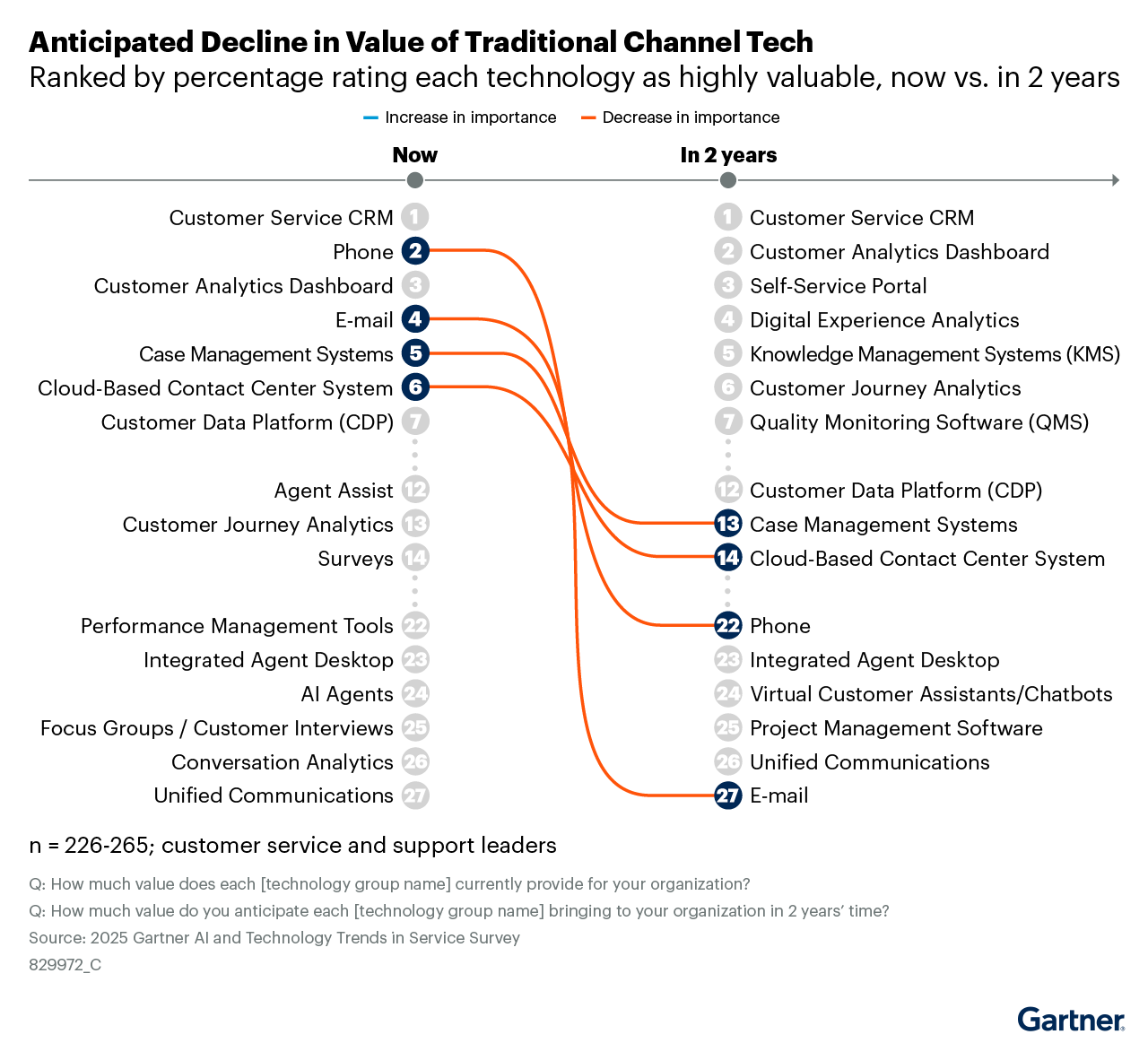
Digital channels will overtake traditional customer service channels like phone and email in the next two years, according to a Gartner study. AI agents (AI-based chatbots) will remain outside the top ten customer service technologies for the next two years.
This is evident from a survey of 265 leaders in the field of customer service and support, conducted in April and May 2025. According to Gartner, it is mainly technologies such as live chat, self-service portals and knowledge management systems that are seen as the most essential tools.
Also read it article about Future skills in customer contact. Ziptone spoke with several experts about what skills agents need now and in the coming years. The downsides of real-time agent assist solutions are also discussed.
As service becomes more complex, agent support will move into the top 10. Gartner predicts that by the end of 2025, 73% of customer service organizations will have implemented agent-assist functionality for their staff. This will primarily focus on support for more complex conversations. (text continues after image below)
Source: Gartner
While customer service leaders are enthusiastic about the potential of AI chatbots, the technology isn't among the top 10 most valuable technologies, neither now nor in two years. According to Gartner, this is because the technology is still developing. Some leaders also worry about "agent-washing," "where products are advertised as 'agentic' when in fact they are only rules-based," Gartner says.
Agent assist is higher on the agenda
Based on other research, it appears that customer service and CX leaders are more likely to focus on implementing agent-assist solutions than AI chatbots. A full three-quarters of companies plan to invest in real-time agent‑assist and copilots to be increased over the next two years, according to CMP. This also includes applications such as next best action.
The latest figures for the Dutch situation come from the KSF, a survey conducted in April 2024. It shows that 38% of organizations are already using AI in customer contact, while another 41% plan to do so within a year. The applications primarily deployed at that time were conversation reporting, summarization, and analysis of customer contact (68%), followed by smart chatbots and virtual assistants (57%).
Yields still modest
The impact of the underlying technology – LLMs – is being strongly downplayed. In any case, a transformative impact on the labor market remains to be seen, according to researchers from the University of Chicago and the University of CopenhagenDespite high adoption of GenAI tools in customer-facing roles, the effect on productivity, working hours, and employee compensation remains negligible. Frontline employees reported an average time gain of 2,8% per workday. In customer-facing roles where employers actively encouraged AI use, this was 6 to 7%.
(Gartner, Ziptone)
Also interesting
-

Two different studies show that the return on investment of using GenAI in…
-

The use of AI creates additional CO2 emissions – something companies must report on.…
-

Sudden fear that technology like AI will take your job? You may be suffering from…