
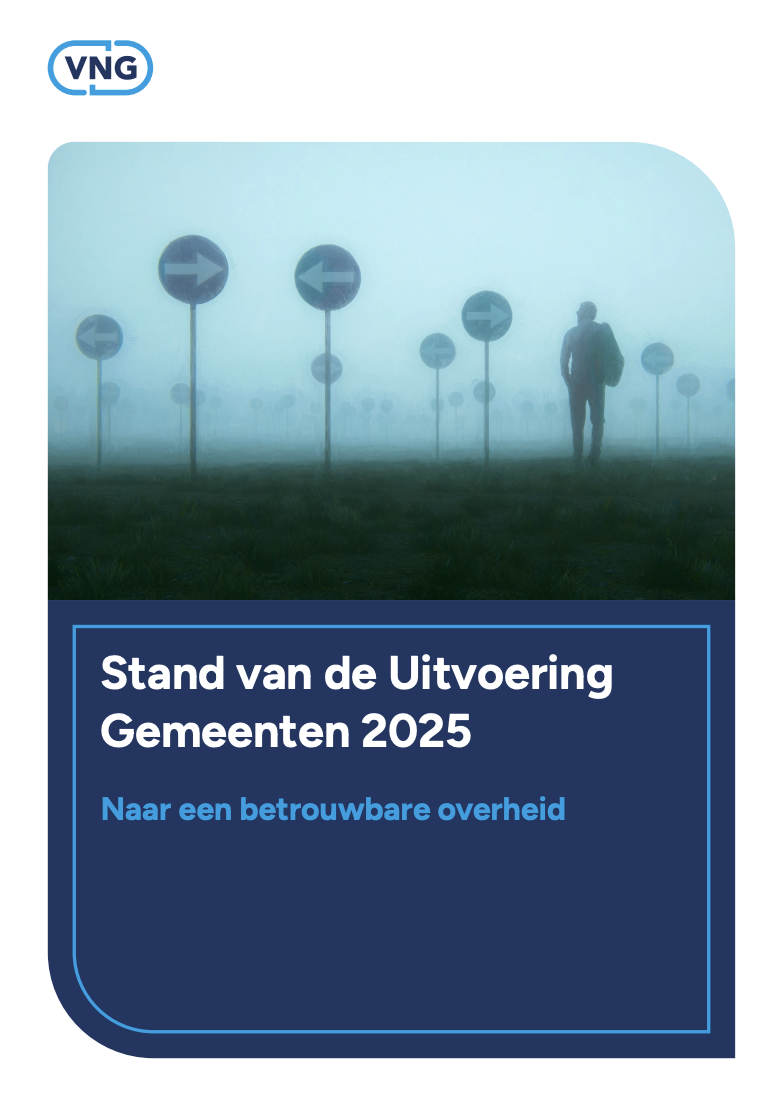
 Municipalities warn that major social challenges are being stalled by unpredictable policies, temporary funding, and conflicting rules from the national government.
This puts pressure on the implementation and confidence of residents in the government as a whole, as can be seen from the Status of Implementation 2025 of the Association of Dutch Municipalities (VNG).
"Municipalities are always pulling it off, but we can't keep mopping while the tap is running," says Roel Wever, chair of the Association of Netherlands Municipalities' (VNG) Board for Service Provision. Roel Wever presented the report to Senate Member Mary Fiers today.
According to the report, major challenges are becoming increasingly intertwined. Housing construction is at a standstill due to nitrogen restrictions and an overloaded electricity grid, causing young people to stay home longer and the outflow from shelters to stall. At the same time, the energy transition is stalling due to constantly changing regulations and subsidies.
Municipalities' efforts to support citizens and businesses are coming under increasing pressure. "Behind the scenes, professionals are working with erratic policies, conflicting regulations, and temporary funding," says Wever. "Then even the best implementation becomes vulnerable." The report shows that structural improvement is possible, provided the central government and municipalities collaborate more clearly and policy becomes more predictable. This is essential for a reliable government.
"Temporary solutions" don't always work out well. The report, for example, points to the Proactive Services Act, which is intended to reduce the non-utilization of income support programs. Various studies show that many residents who are entitled to national and local income programs don't actually use them. Under the Proactive Services Act, municipalities, the Employee Insurance Agency (UWV), and the Social Insurance Bank (SVB) can proactively approach these residents to inform them of their (potential) entitlement to programs. They can also assist residents with pre-filled forms and the submission of (combined) applications.
While the law's intentions are good, it ignores an underlying problem, according to the Association of Netherlands Municipalities (VNG) in the report. One of the reasons for the high non-utilization of regulations and facilities is that residents get lost in the jungle of regulations and facilities. Each of these regulations and facilities has its own unique conditions, criteria, and application procedures. Reducing this complexity is expected to significantly contribute to reducing non-utilization, as residents know what they are entitled to and what they need to do to access them.
The report identifies six conditions necessary for the government to function reliably again: clear choices, structural policies, enforceable rules, stable financing, good cooperation and data exchange, and investment in expertise.
"As long as rules keep changing and funding has to be fought for again and again, we can't keep our promises," says Wever. "This jeopardizes residents' trust in the government."
Read the Status of Implementation Municipalities 2025 (pdf, 13 MB)
(VNG)
Also interesting
-
The deployment of AI in municipal Customer Contact Centers primarily takes place via pilots; for the time being, little is…
-

The Dutch Digitalization Strategy has been relaunched.
-

A large proportion of Dutch government bodies do not yet comply with the associated basic obligations that…