
 The number of municipalities using a contact center for the early detection of debt has increased fifteenfold in three years. In 2023, only 1 percent of municipalities did this; now, that figure is 15 percent. This is reported by Divosa, the national association of managers in the social domain.
Municipalities are looking for new ways to reach more residents with payment arrears personally. This is evident from the report. Municipal approach to early detection 2026 Divosa Debt Early Warning Monitor. According to Divosa, the growth in contact center activities regarding early warning aligns with a broader trend: municipalities are focusing more on personal contact with residents with payment arrears. Almost seven out of ten municipalities have adjusted their early warning approach in the past six months or are in the process of doing so.
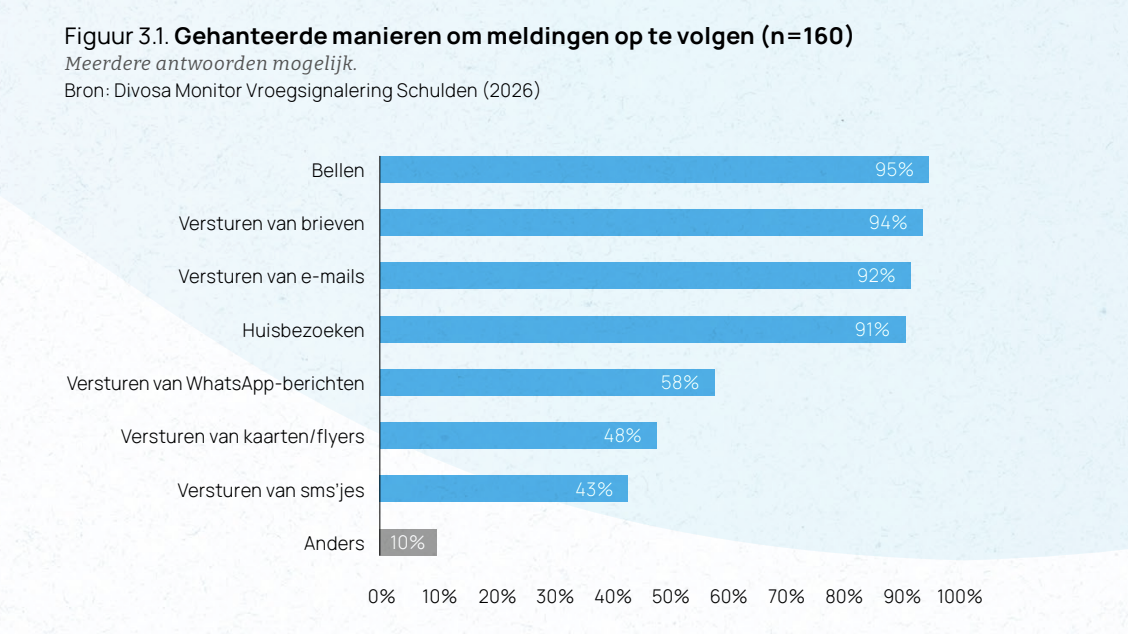
Municipalities receive signals from, for example, tenants, energy suppliers, and health insurers when residents are behind on payments. The goal is to reach residents early and offer assistance before debts escalate further. How they do this varies by municipality. Most municipalities combine different methods of contact, such as phone calls, home visits, letters, email, WhatsApp, and SMS. Seven out of ten municipalities use five or more contact methods.
Increasingly, a standard letter is not seen as the endpoint, but as one of the ways to establish contact. Written communication is being made more personal, and some municipalities are aligning their approach better with specific groups, such as young people. Increased reliance on telephone contact and the rise of call centers are part of this development.
In 13 percent of municipalities, all residents are contacted by telephone. In 2025, this was 11 percent. Municipalities indicating that they call in specific situations or in a different manner primarily cite the amount involved and the type of report as criteria. This concerns, for example, crisis reports and recidivism. Rental signals are also specifically mentioned a few times.
More than a third of the municipalities have no agreements regarding the maximum number of attempts to reach a resident by telephone. The minimum number of call attempts (n=34) is two on average. Of the municipalities that apply a maximum, half make a maximum of three call attempts. A quarter make a maximum of seven attempts.
Municipalities that use a call center – either outsourced or via their own customer contact center – often call single reports up to seven times. Under 'other', municipalities indicate that the number of call attempts varies by situation.
Many municipalities tailor the number of attempts to the nature of the signal. In the case of rent arrears, a high amount, or a recidivism, they try to establish contact more frequently than in the case of minor arrears.
Municipalities also regularly combine calling with other forms of contact – such as an SMS, email, WhatsApp message, or a home visit – when telephone contact is unsuccessful. For many municipalities, the starting point is not a fixed number of attempts, but actually reaching the resident.
Municipalities were also asked whether they apply a maximum to the number of telephone calls per inhabitant per month. This concerns the number of calls actually made, not the number of contact attempts. A large majority of 81 percent do not apply a maximum. Five percent do have a monthly maximum, and 3 percent do not know. One in ten municipalities answered 'other'. These municipalities indicate that they adjust the number of calls to the available capacity, which can vary from month to month. There are also municipalities that place a fixed number of reports on a call list and make calls for other reports in addition, for example prior to a home visit.
The results are based on a questionnaire survey among policy officers and early warning coordinators from 160 municipalities participating in the Divosa Debt Early Warning Monitor.
Also interesting
-

The deployment of AI in municipal Customer Contact Centers primarily takes place via pilots; for the time being, little is…
-

A large proportion of Dutch government bodies do not yet comply with the associated basic obligations that…
-

The Dutch Digitalization Strategy has been relaunched.