
Marieke Smidt's first hundred days as CEO EMEA of Transcom are well over. Ziptone spoke with her and Remko Gribling, VP Business Development, about Transcom's vision and strategy. People are still needed in customer contact, but technology is becoming increasingly important.
 Before joining Transcom, Marieke Smidt worked at TP for almost ten years; her last role was that of COO EMEA. After a reorganization she opted for a sabbatical and during that period the decision grew not to continue working in the BPO sector. But when a phone call came from CEO Brian Johnson, an interview followed despite an initial hesitant reaction. The decisive factor was her feeling that Transcom has a people-oriented culture. Or as she puts it: putting people in the right place so that they achieve more than they expected of themselves.
Moving to tech
Smidt initially joined Transcom as COO EMEA in August last year. There was still some harmonization to be done between different locations – think of systems and processes around IT, HR and communication. But less than six months later she became CEO EMEA at the company. Also Remko Gribling has been working at Transcom EMEA since the beginning of this year. He previously worked for software suppliers Verint and Salesforce, among others. “I did not know the BPO sector from the inside, but I did know that there was a transition towards a more technological role in the sector.” That appealed to him.
Moving up the value chain
That trend – moving up the value chain, becoming less dependent on selling seats – is unmistakable. Most facility contact centres are changing course, often on the axis of technology and process improvement. The Benelux is a good market for that, says Gribling. “The Netherlands and Belgium are leading positions when it comes to consumer adoption of ‘digital’. Companies increasingly expect ‘full service’ from service providers, so in addition to FTEs, also technology. Although the differences between outsourcers are large.”
“Although some outsourcers still primarily focus on FTEs,” Smidt adds, “we also see a broader need for expertise in Tech and AI. The combination of people, processes and technology is a crucial combination to really make an impact. Then you also don't have a discussion about where what responsibility lies. We do a lot of research with a large team into the right and best solutions for customers and then we offer them. If that technology is not available, we develop it ourselves.”
Skin in the game
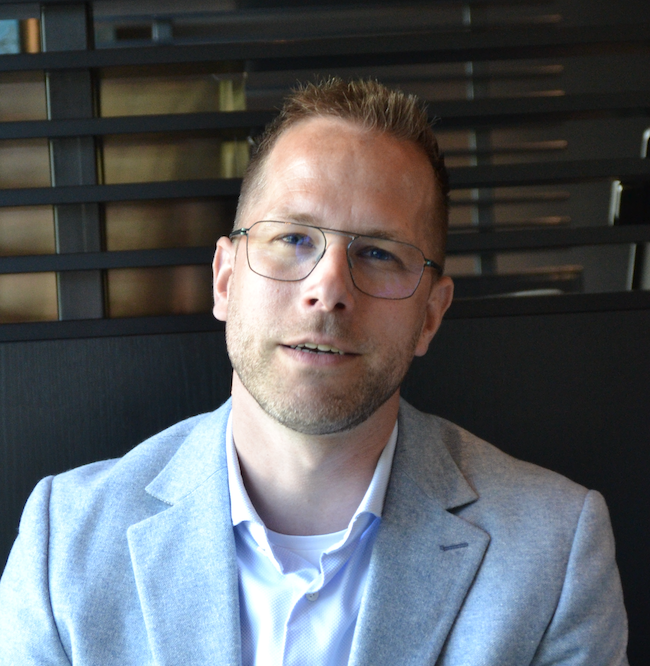 You can philosophize about whether facility contact centers can successfully move towards consulting and technology services. After all, the market is quite full there too. “The difference with technology suppliers is that we have 'skin in the game',” says Gribling. “We can not only show what works and what doesn't – because we have tested it together with other customers – but we are also involved in a different way. We ensure that it fits within the operational model. Technology suppliers leave after they have implemented. System integrators are never behind the buttons themselves.”
Real-time speech translation
From trying out new technology, it is only a small step to real-time speech translation. “That is very important for Transcom,” says Smidt. “In the Netherlands and Flanders, but also for the Nordics, it is difficult to find employees. Suriname can be successful for Dutch-speaking customer contact, but in my opinion that country is now reaching its limits. The future lies in real-time speech translation, so that you can work independently of language and focus on hiring people based on competencies, instead of language. It is very important for us to gain a lot of experience with that and to find customers who want to do that with us. At the moment we work for the Nordics and the Netherlands from Cairo, where there is a very good working population. But we also have a strong focus on India: there are many opportunities to expand there. If real-time speech translation breaks through, we have capacity in India and Egypt, but also in Tunisia and the Philippines, where we are already active. We also take the geopolitical situation into account when spreading the regions.”
Transcom worldwide – Transcom was founded in 1995 by a Swedish investment company. The company has grown rapidly in the first ten years to include the rest of Europe, the US, Canada and the Philippines. Transcom currently has 85 locations in 29 countries, employing approximately 35.000 people. In the Netherlands, Transcom employs approximately 350 FTEs; a similar team is employed in Spain. Transcom achieved a global turnover of approximately 745 million euros last year. The company is now owned by Altor Equity Partners, which acquired more than 2017% of Transcom's shares in 98 and delisted the company from the Stockholm stock exchange.
Innovation comes in waves
Transcom is completely convinced of real-time speech translation. How do you deal with skeptical contact center managers? “Technical development goes with peaks and troughs. Sometimes you stand still for a moment and it is tempting to shout: 'it doesn't work!' But that is precisely when you have to keep going, because then the next step follows,” Smidt believes.
That perspective requires clients who are willing to experiment together, she continues, which also means being transparent about all the pros and cons you encounter every day. “And as for the future, your partner must have faith in technology. Experimenting and learning, that has to be in your DNA.”
The ideal customer
That is also one of the core characteristics of our ideal customer, Smidt says later, especially in verticals such as e-commerce, travel and leisure, fintech. “There is a lot of innovative power there.” The reverse also happens: scaling down, cutting back with customers where there is little win-win to be seen.
“Traditionally, this market has indeed focused strongly on delivering FTEs,” Gribling explains. “However, we do not see innovation as something that cannibalizes, but as an essential part of the market evolution. This is why we started working with TUI early on rreal-time speech translation. While we knew that the first phase would yield lessons, we created a valuable opportunity to move forward. TUI is now one of the early adopters that is reaping the benefits on a larger scale.”
Short-term thinking does not help innovation
Experimenting takes time and money – does that mean that you as an outsourcer should not focus too much on the short term? “Perhaps for some companies, real-time translation is not yet seen as feasible. Even then, you can get started with the short term. There is enough low-hanging fruit that leads to savings. Think of solutions such as voicebots and co-pilots, to automate or support the employee. Innovation and cost reduction are increasingly going hand in hand,” says Smidt.
Gribling: “We now know that Klarna comes back on the idea of 'replacing people with AI'. But we do see AI as an opportunity. Transcom decided a few years ago to invest heavily in that. We do that throughout the organization, so there is also an AI literacy program for all employees. Because how else can we sell AI applications if we don't use it internally? In this market, I notice, there is still a lot of fear of AI.”
Cannibalization
“We don’t mind giving up something in terms of topline if something else takes its place,” Smidt adds. “At one of our customers, we reduced the AHT by 40 seconds in the last two months. We notice that in our turnover. But if we don’t innovate, someone else will. In any case, it can lead to a better EBIT,” says Smidt.
On the one hand, conversations can be shorter through smart solutions, but on the other hand, the average conversation duration increases on balance because the remaining conversations are more complex in nature. In addition, the threshold for making contact is becoming lower and lower. However, neither Gribling nor Smidt sees that the number of agents is already decreasing. In certain cases, according to Gribling, it is even very useful to connect the customer with an employee - think of up- and cross-selling. "Anyone who has airplane seats assigned automatically misses opportunities to upgrade someone to an empty seat in business class for 100 euros."
Fluff
Also agentic AI and the agentless contact center are coming. Thinkable? Feasible?
“There is a lot of fluff in these concepts,” says Gribling. “An agentless contact center is not realistic to expect in the short term. And as mentioned before, you have to ask yourself whether human customer contact does not add value to customer loyalty and ultimately revenue and profit. Agentic AI is certainly the future to automate certain customer contact efficiently and customer-friendly. But that will not apply to every customer contact in the future.”
Gribling continues: “Klarna also thought they could automate everything. They concluded that human employees are important for customer intimacy, but Klarna has not said much about churn or NPS. Their drive for automation has undoubtedly had an impact.”
Smidt: “Of course we keep a close eye on the market and are constantly looking at new technologies. That is how we came into contact with Cognigy and Parloa and, for example, we started testing Parloa's technology at an early stage with TUI.”
Culture and progress
Transcom has a people-oriented culture, Smidt said at the start of the conversation. How difficult is it to maintain a people-oriented culture if employees have only been with you for one or two years? “One of our employee value propositions is lifelong learning,” says Smidt. “All changes happen very quickly. You have to keep immersing yourself in those changes. But it is indeed not easy if people have been with you for a relatively short time. It definitely makes sense to invest, even if someone only stays for a year. In that year, they can add a lot of value to the company. We therefore try to offer our employees as much as possible. Both offline and with e-learning. Furthermore, AI also helps to shorten the onboarding time in the training phase. So people are ready for a good conversation with the customer sooner.”
“Making the connection is really easier if you are not so enormous”
“And conversely, it is essential that employees feel part of the bigger picture. I do a lot of town hall meetings,” says Smidt. “The turnout is sometimes as high as 90%. I provide insight into where we are and where we are going, as a company, as a region and as a branch. The feedback from such a session is also valuable to me. In that respect, our size really does have advantages. We call that 'big enough to matter, small enough to care'. Making connections is really easier if you are not so enormous. That is why we have also set a kind of limit to our size.”
Gribling adds: “Of course we also want to grow. But only supplying FTEs is not something we are happy with.”
binden
“In the coming period, we want to tell our story louder, not only in the Netherlands. That means investing more,” Smidt concludes. “The Netherlands is indeed an important market. That is why Remko is also on board. Furthermore, the culture is very important to me. That we can bind people, motivate them, that they are inspired when they work for us, so that they can also do more than they think they can do. Connecting is essential, also internally. Making it clear what everyone contributes. But also being transparent and honest. With us, you must be able to be who you really are.”
The request can also be different
Finally, Gribling wants to say that part of the market is holding itself in a stranglehold. He explains: “When requesting information, many parties primarily focus on cost savings. Of course, we can save costs for our customers very well, but we want to show that we can really offer added value over the long term of the collaboration. Strangely enough, there is little focus on this in RFPs and tenders. For example, people do ask about culture and development opportunities, but no score is given. That is a shame, because that means you actually get what you don't want as a customer.”
“There is so much potential,” says Smidt. “The future of customer contact requires courage, people and technology. And we choose all three every day.”
(Ziptone/Erik Bouwer)


Also interesting
-
Facilities contact center Transcom is ceasing operations from the Groningen branch. This also brings an end to activities from…
-

Transcom Egypt won bronze, gold, and silver for "Best Customer Service in Europe" with TUI and Samsung, respectively.
-
BPO player Transcom has improved margins in 2025 and is focusing on AI and offshore growth, particularly in India…