
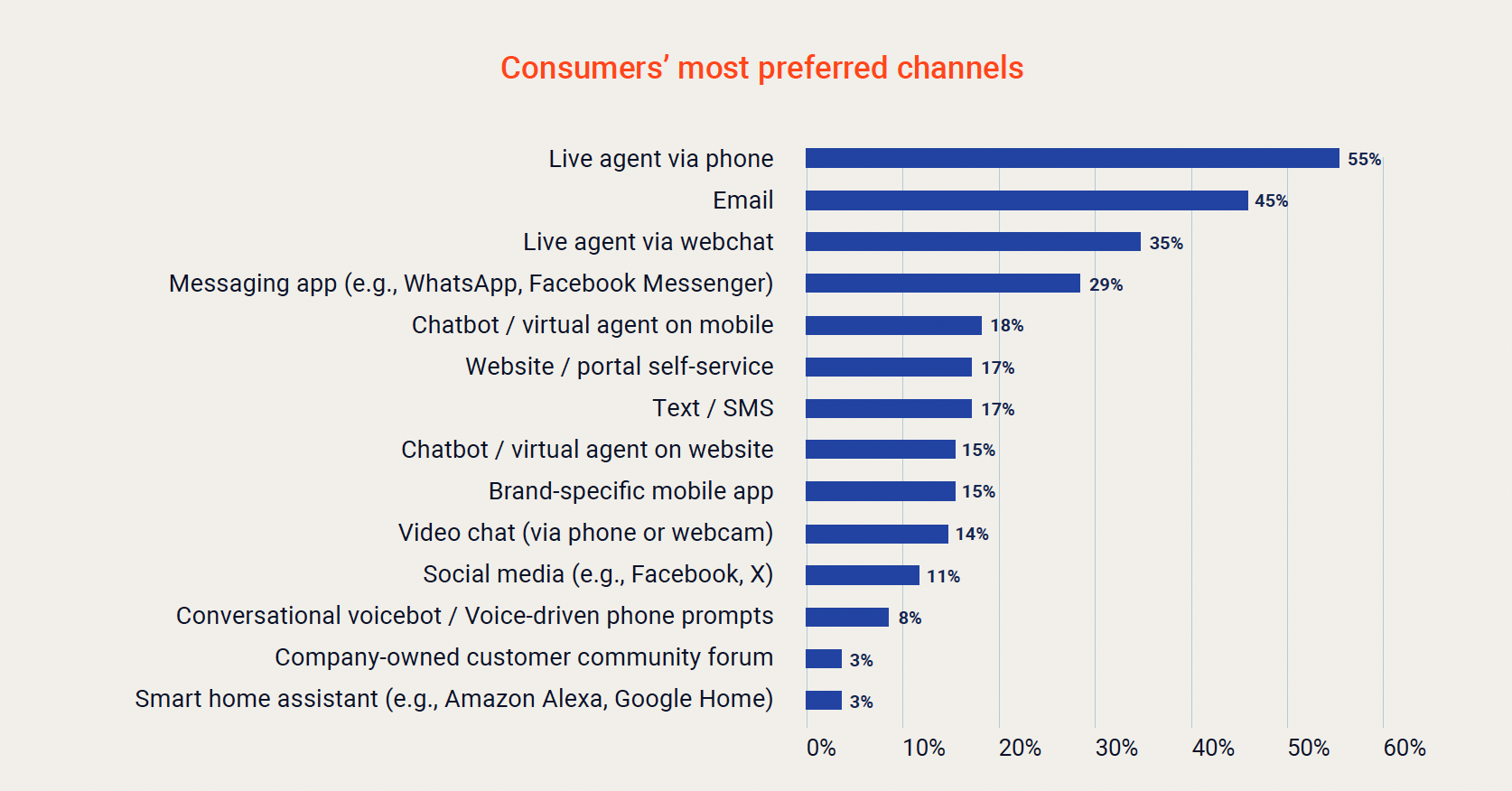
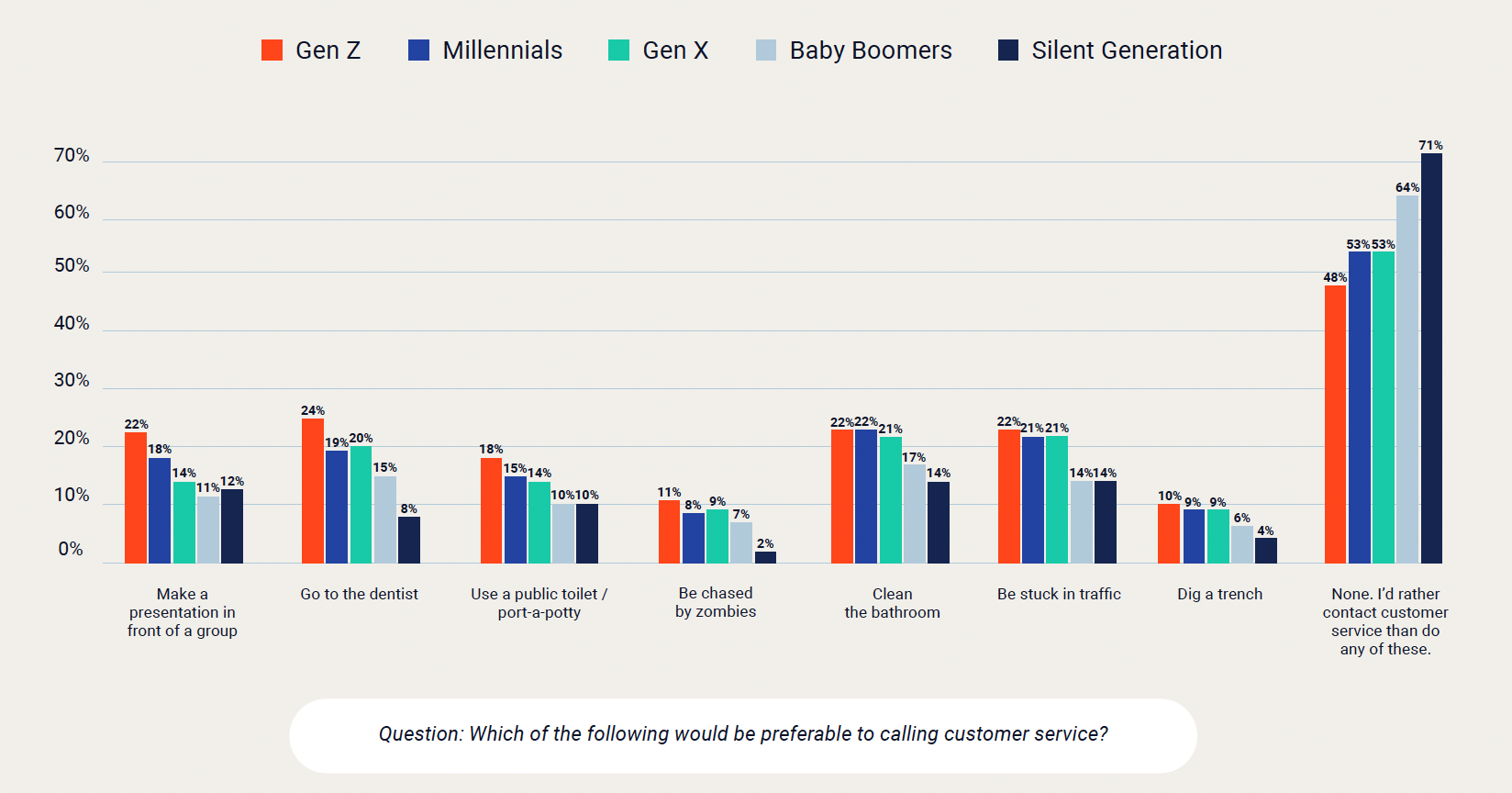
Chatbots are the least valued channel, and yet companies are willing to invest heavily in them. That’s one of the many findings from the latest research report “The State of Customer Experience 2025” from CCaaS provider Genesys among consumers and CX leaders. 22% of Gen Z consumers would rather clean the toilet than call customer service.
41% of CX leaders surveyed see “keeping up with rising consumer expectations” as their biggest challenge. At the same time, the same percentage of companies currently have a chatbot online, with 27% planning to have one in place within six months (16% within a year). About a third of companies plan to launch a voicebot in the foreseeable future, the report found.
It is precisely that voicebot and chatbot that dangle together at the bottom of the list when it comes to the general satisfaction of consumers about the contact channels they use. At the same time, 16% of consumers indicate that the lack of a chatbot available on the website actually leads to dissatisfaction with the brand. Are companies and consumers driving each other crazy by introducing new channels that ultimately do not meet expectations?
Crying or screaming
More than half (53%) of consumers surveyed say they prefer to speak with a human agent to resolve their questions and issues. They want to be able to reach an agent quickly and easily when an agent-led interaction is their preference, including through channels other than the phone, Genesys points out.
Forty percent of consumers find it “really frustrating” when they can’t seamlessly go from a chatbot to an agent. And 40% say it’s so annoying that they want to cry, scream, or never do business with the company again. Thirty-seven percent of consumers say they’ve been unable to reach an agent at all in the past year. Highlighting the impact that not providing access to a human agent can have, 26% of consumers say it “really frustrates me” when there’s no way to reach a live agent; 37% say it makes them want to cry or scream; and 16% say it makes them “so angry that I vow never to use that company again.”
Channel usage and preferences
Source: Genesys. Click to enlarge
Genesys also asked about consumer usage and preferences when it comes to channels. Respondents could indicate their top three in both cases. (image 2). Genesys divided the answers that came back over 14 channels. Interpreting channel preferences and usage remains debatable. First of all, consumers do business with a variety of organizations, which means that there is a good chance that they will come into contact with all channels in a year, while most organizations will only offer a small portion of those fourteen channels.
In addition, consumers choose the channel within the range of channels that best suits the circumstances and the possibilities. Those who are in the car will generally not send e-mail and in case of urgency, the telephone or chat will be more appropriate than a user forum. The usefulness of listing the most used channels and the preferred channels is therefore relative. This also applies to the channel preferences of different generations that Genesys mapped out.
The new National Voice Monitor, an initiative of Y.digital, among others, will be released on March 18. The National Voice Monitor provides insight into the experiences of the Dutch consumer with digital assistants and insight into the experiences of organizations with the use of generative AI in customer contact. Ziptone will pay attention to this after March 18.
Regardless of channel, 86% of consumers surveyed expect to be connected to an agent within one to 10 minutes. Unfortunately, more than 60% say they’ve waited 15 to 60 minutes in the past year. Organizations are underestimating the problem, according to Genesys. CX leaders surveyed believe long wait times (10 minutes or more) occur only 10% of the time. Genesys calls this a “perception-reality gap”: organizations may not be fully aware of the daily customer experience and the frustrations that long waits cause. It begs the question: Are CX leaders giving socially desirable answers, or are they lacking key performance indicators (KPIs)?
Personalized service by agents
The research also looks at first call resolution, personalization combined with the “privacy paradox,” and omnichannel. In terms of personalization, nearly 50% of consumers surveyed want agents to have access to their data to improve personalization, while nearly 70% say they become irritated or frustrated when this doesn’t happen. The question is what will happen to these numbers in the future as agents increasingly make way for AI. Consumers are fairly confident in AI right now. Nearly two-thirds (64%) of consumers surveyed believe AI will improve the quality and speed of the customer experience in the next two to three years.
CX leaders also see AI’s potential to transform the way their organizations engage with customers as a top priority, with 42% of CX leaders citing increasing the use of AI to improve experiences as a top priority. Nearly half (46%) of CX leaders surveyed are investing in AI solutions like copilots and real-time coaching that can help improve the employee experience, which 26% of CX leaders say is critical to achieving their strategic CX goals.
Migration to the cloud
About a third of organizations have moved their CX technology to the cloud. Of those that have not yet fully moved their CX capabilities to the cloud, 56% of CX leaders surveyed plan to do so within the next two years, partly because they see it as an essential step in enabling AI-driven personalization at scale.
Since the data collection for this study was done in the period before Trump took office (September and October 2024), new risks related to the use of (American) cloud solutions have not been included.
Cleaning the toilet and turnover figures
What would you rather be doing than calling customer service? Click to enlarge. Source: Genesys.
There are some interesting afterburners at the end of the very extensive report, including what people would rather do than call customer service and what the average annual staff turnover is. This ranges from 27 to 51 percent, but the outliers are above 70%.
GenZ comes out on top when asked what you would rather do than call customer service. 24% would rather go to the dentist, and 22% would rather be stuck in traffic or clean the toilet. For baby boomers and seniors between 80 and 100, those numbers are roughly half as low.
For research , Genesys partnered with an independent research firm to survey 5.157 consumers and 1.181 CX decision makers in more than 16 countries. More than 1000 consumers from Europe participated, along with 290 CX leaders. (Ziptone/Editorial)


Also interesting
-

The KSF is getting to work on a national chatbot improvement plan. Ziptone is launching the research into chatbot performance one last time…
-
Dutch consumers spend an average of eight hours annually on customer service: waiting, calling back, problems that are not resolved.
-
If no one answers, customers get – even if unintentionally – the impression that the company or brand…