
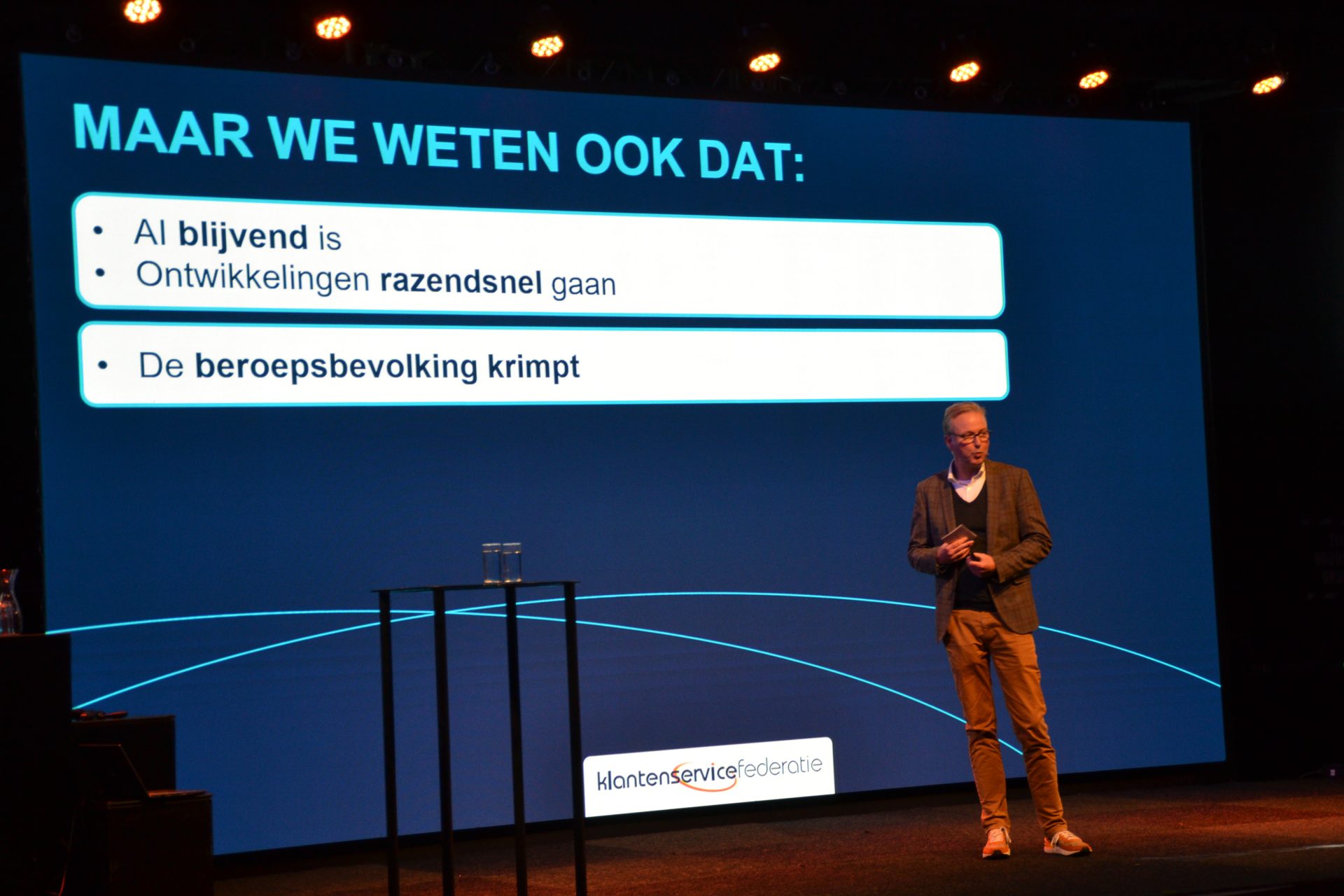
 Before you know it, they'll take your job away, said KSF director Roel Masselink at the opening, after the virtual assistant 'Ava', specially created for the conference, had given the foreword. However, the industry association is not yet at the point where a clear link is made between customer contact, costs, offshoring and AI.
At his kick-off, Masselink once again pointed out the AI vision document that the KSF has drawn up. In it, the industry association gives its vision on AI and the impact of AI on customer contact. According to Masselink, there is a lot of attention for the negative impact ('AI will cost jobs', 'is only focused on cost savings') but there is too little attention for other aspects. Such as that AI is here to stay, that it is developing rapidly and that the working population is shrinking while the volume of interactions is increasing and the need for personal customer contact remains.
Also read: KSF membership growth “not progressing”
The influx of new members satgnates. In addition, according to KSF chairman Ramón Delima, customer service must also be careful that the AI domain is not hijacked by marketing or sales. Read the article
The KSF believes that AI is a valuable tool to ensure the affordability and quality of customer contact in the future, but human supervision remains necessary. Yes, AI will cause jobs to disappear and change and new jobs to be created, according to Masselink.
These three movements are of course difficult to predict (in terms of speed and size). The recommendations of the KSF are therefore not about anticipating possible shock waves, but are mainly focused on the importance of experimenting, education and training, and taking a governing role within the organization. The KSF is still working on the ethical side of AI.
AI Crash Course
 Nancy Rademaker addressed the question of how to strike the balance between 'hi tech' and 'hi touch'. Building on older messages about the exponential nature of technological developments and our linear thinking pattern, Rademaker listed five i's. We have more information than we can process, we are more individual than ever, and impatience, intuition and influence are (in short) the reason why consumers have become skeptical.
Rademaker shows at high speed what AI can do at the moment: predict, recognize, work preventively, assess opportunities and risks, create content, recognize emotions and navigate through the traffic of San Francisco. Anyone who attends other events besides the KSF Annual Congress is very likely to be presented with a similar crash course in AI. It becomes more interesting when the very, very latest applications are shared. Judging from the reactions, the zero click option in the app of pizza chain Domino's new for some of the KSF audience, but the solution dates back to 2016 and was also mentioned by Rademakers five years ago.
More valuable were the advices that Rademakers concluded with. AI is not a choice, but if you start with it, use your brain. Look around you, look for examples, experiment, ensure a basic level of knowledge by training employees and enter into discussions with suppliers. The KSF Annual Congress is of course a good opportunity for the latter. And also: it is not only about learning new things, but also about unlearning old things. As a kicker, Rademakers gave an interesting reference: TAAFT.com, where TAAFT is an acronym for 'There's An AI For That'.
The KSF Annual Congress offered two rounds of parallel sessions with space for Zendesk, Orion, WEngage, Calabrio, Contact Center Live, the KSF Trend Monitor, ING, TB Auctions and Concentrix. The question arises why suppliers prefer to be on stage themselves than their customers.
click to enlarge
AI at ING: not fast, but impactful
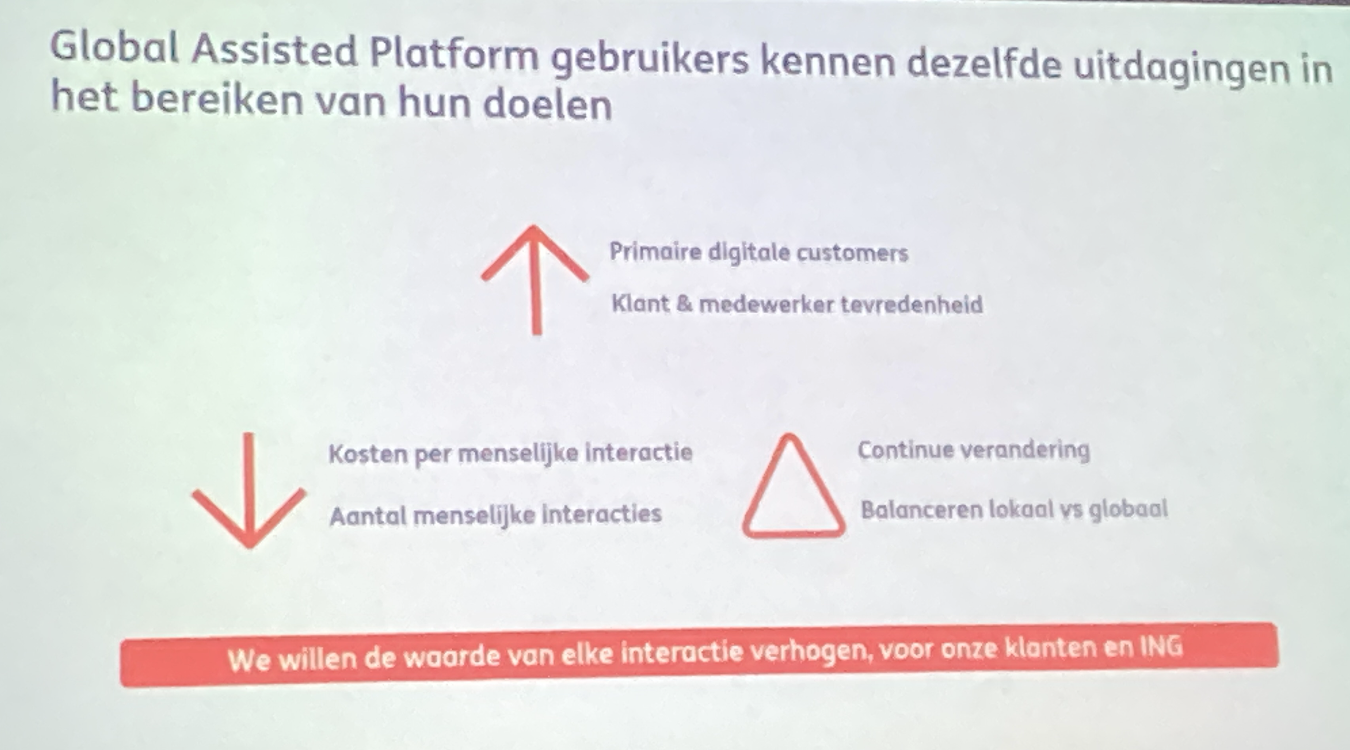
Ziptone attended the ING session (hosted by Calabrio, which did not participate in the presentation). René Bostelaar, Product Lead at ING, talked about scaling AI. The major bank (37 million customers in 40 countries, 60.000 employees) wants to improve customer service, but later in the presentation Bostelaar also stated that the bank wants as many interactions as possible without human intervention (chatbot deflection), that the costs per interaction must be reduced and that the number of interactions must also be reduced.
The average customer is on the ING app 365 times a year and has real contact with the bank once a year. Scaling up AI is something that has to be done across multiple countries at the same time. To increase the pace a bit, 'making the difference' has been replaced by the motto 'growing the difference'. The bank therefore allows countries to design their own standard processes and have them land on the international platform. This already contains 1 processes such as 'replace bank card'. A solution such as 'check your conversation' - recently launched, also by ABN AMRO – has already led to 50% fewer fraud cases. The bank has chat sessions with customers translated and settled in Manila in real time. The justified question from the audience 'can't you better automate those simple questions via chat instead of offshoring' was answered: we want to, but we're not there yet.
From high volume factory to value boutique
That answer makes a lot clear about the path that ING has taken and still wants to take. First, the contact center was in-house at ING, then it was outsourced, then offshored and now it is being automated. Or as Bostelaar stated: the contact center is now set up for high volumes and is focused on service and we want to move towards low volumes and focused on value. In other words: the factory is becoming a boutique and we always need people for that, but they can be anywhere.
Are things moving fast at ING? Ida, the ING Digital Assistant, can now handle half of the digital interactions, based on ING's internal knowledge base alone (i.e. the website). At the same time, ING has not yet reached the point where agent assist, for example, is fully operational in the contact center. The bank is still working on pilots. Bostelaar: working in IT at ING is like renovating an old building in Rome: complex and challenging.
Unbelievably broke
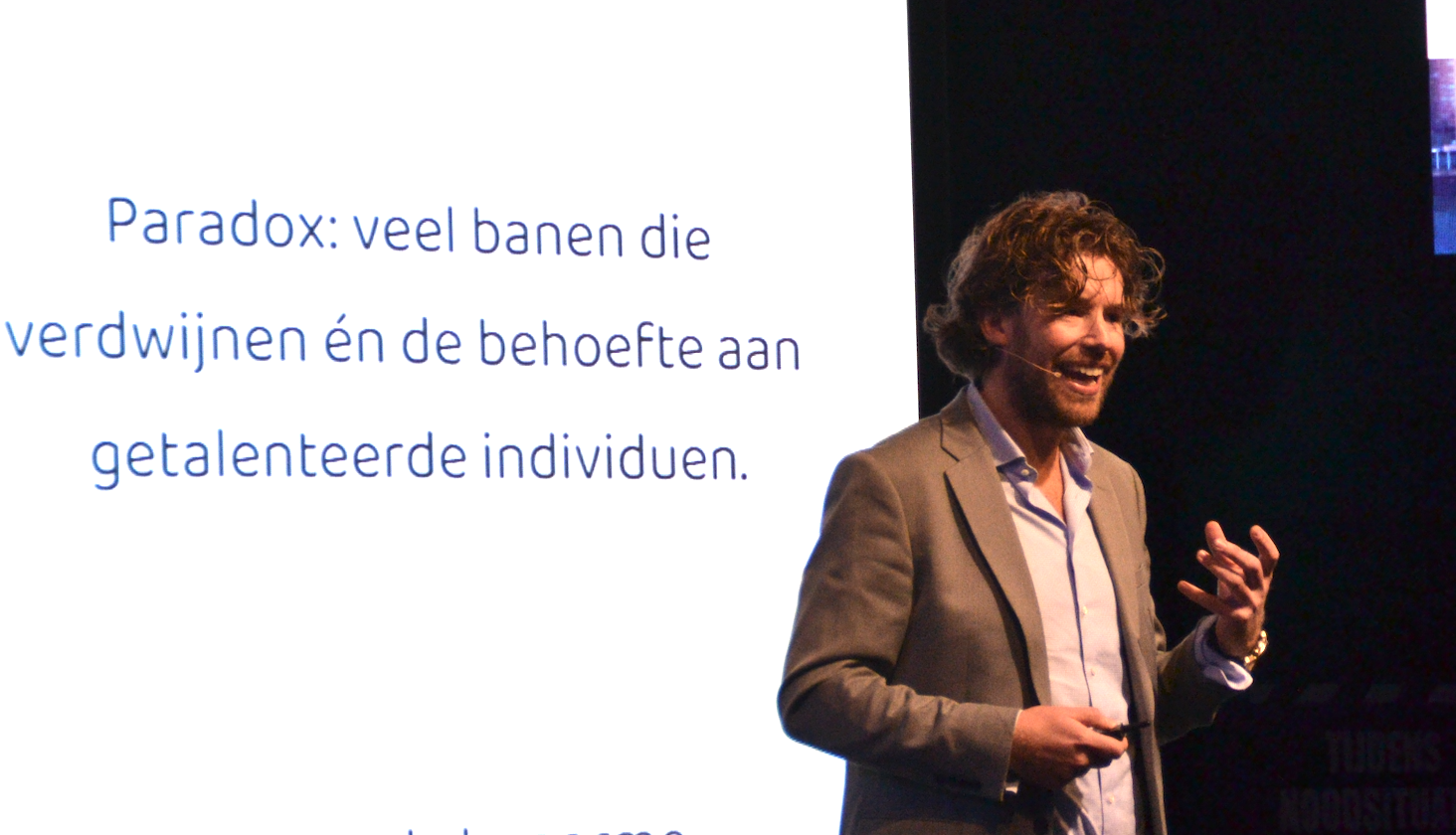 The second keynote had the right (high) energy level in terms of timing. Job van den Berg is a data specialist and co-founder of ai.nl and The Automation Group. His message was a bit like Rademakers': there is a lot of talk about AI, it is a bit overhyped, but it is also underused in business processes.
Van den Berg is convinced that AI agents are about to transform every office job: they will also take over parts of customer service processes. At the same time, he called the data foundation of Dutch companies “incredibly broken”. The data quality is often poor, not least because organizations add synthetic data to the mash they already have in-house. Van den Berg did not really get specific on this point: there were no examples showing that organizations are getting stuck with their AI plans. Examples that did come up are the well-known blunders of Air Canada and DPD. However, this is not about data quality, but about poor prompts and guardrails.
RAG
It was very good that Van den Berg put the spotlight on Retrieval Augmented Generation (RAG). Think of the LLMs as the engine block of generative AI – good at producing new text, images and sound based on existing material. But think of RAG as the exploratory phase before GenAI gets to work. RAG looks at relationships and connections between concepts in a so-called vector database. That first step is part of 'slow AI' and therefore a good counterpart to the original version of ChatGPT that could produce both sense and nonsense in no time.
Agentic AI
Van den Berg also discussed the concept Agentic AI, where multiple specialized agents work together. What does that remind us of? Exactly: the classic chatbot is only successful if it focuses on a very specifically defined question or task. Agentic AI is an effective way to have complex tasks performed. A striking example from Van den Berg: picking up a breakdown report by the ANWB. This requires information about the location, the time, the vehicle, the problem, the customer, the situation or circumstances, possible solutions for similar breakdowns, previous contacts with the customer.
Finding all that together is still human work; Agentic AI can do it faster and better. A similar example where large amounts of data from different types of sources and systems have to be combined: writing tender documents for a large contractor.
At the end of his story-at-top-speed, Van den Berg came up with tips. AI is not a magic box. But do include it in your annual plan and get started with it. If necessary with fictitious data. Not immediately to double your business results, but to learn from it. Innovate when you can, not when you have to, according to Van den Berg.
Suriname and AI
Forrester says that there are more jobs that will change because of AI than there are jobs that will disappear, says Van den Berg, and the CEO of chipmaker Nvidia also uses words to that effect. So AI has an impact on people in the organization.
The KSF could map out the extent to which the customer contact sector will change in the next edition of the AI vision: which jobs will disappear, which jobs will change? Is that a complicated question? KPN said a while ago that the company would use automated QM less coaches needed. ING has been answering chats from Manila for a while now as part of its app-first strategy, but the next step, automated handling of online customer contact, will not help more Filipinos find work. Offshoring to Suriname and AI will naturally come together.
(Ziptone/Erik Bouwer)


Also interesting
-

According to Chinese astrology, 2024 is the year of the Dragon. Or did someone make a math error? Because it is…
-

The future-oriented vision should contribute to KSF and KSF members being well prepared for the impact of AI.
-
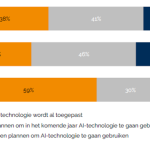
Currently, 38% of organizations are applying AI in customer contact, while another 41% plan to do so within…