
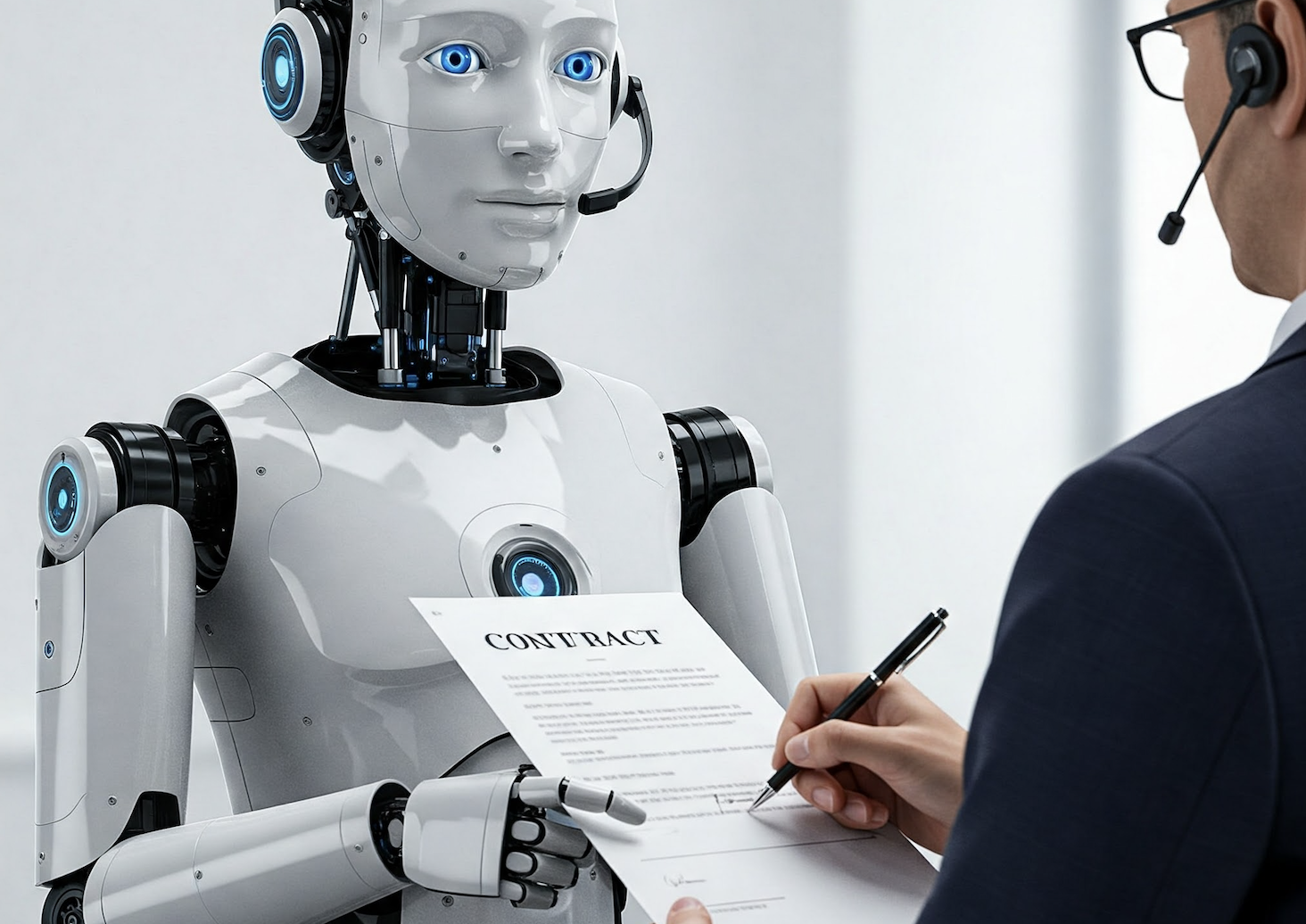
 Recently, Italian unions reached a temporary deal with facility contact center Konecta Italia. They have agreed on conditions for the use of AI in customer contact. The agreement raises questions.
Developments in AI are raising concerns about working conditions, job security and human agency among workers, says UNI Global Union, the global federation of trade unions. Local unions are responding by negotiating agreements that put workers at the heart of AI adoption. With agreements, unions aim to ensure that technology serves workers’ interests, rather than undermines them, UNI Global Union says.
One such agreement was signed in March 2025 between BPO service provider Konecta Italia (with over 8.000 employees in Italy) and local unions SLC-CGIL, FISTel-CISL, UILCom-UIL and UGL Telecomunicazioni. Konecta's works councils also signed. The agreement: agreements on the 'trial of agent assist'.
Guarantees: “not replacing people, but supporting them”
Key goals of the agreement include establishing a ban on “remote surveillance” and ensuring that AI will augment rather than replace human work. The signatories also agreed to train workers on the operation and use of AI. They also agreed to jointly monitor through a commission during a 12-month pilot phase. In short, the use of AI is a hotbed of union leaders.
In Konnecta Agreement (pdf) the operation of (Gen)AI is defined. For example, it is stated that 'agent assist' supports employees in daily tasks by real-time transcription and analysis of interactions between employee and customer. "The aim is to provide real-time operational suggestions, show a summary of handled calls, to reduce manual work; and to improve the quality and efficiency of work processes," the document states.
Training vendor AI models
Other notable points from the agreement are that the suppliers with whom Konecta works declare that employee data will not be used to train AI models. It is unclear whether this concerns their part of the dialogue with the customer. The use of agent assist is also discussed in advance with the trade associations per project and per location. And when there are new functionalities or broader applications of AI, new discussions are necessary. Finally, employees receive clear information about operation, data collection and data processing, in line with Article 13 of the GDPR.
It is also unclear when there is a question of replacing employees or jobs through the use of AI. When AI is used with efficiency as one of the goals, it is possible that the same work can be done by fewer people.
Similar agreement between federations and Italiaonline
This last facet – not unimportant – is also noticeable in an agreement concluded by local unions with a digital service provider Italyonline (pdf) was concluded. It literally states: “AI will be used as a tool, to support employees, and not as a replacement for human labor.”
There are several examples of the use of automated summarization that lead to a minimum ten percent reduction in FTE. The question is also what will be decisive after 12 months or the next step: when is the agreement a success or when not? And finally, it is striking that the customer perspective is not part of the agreement.
Digitization
UNI Global Union reports that other organizations are also establishing agreements focused on the use of AI. In Ireland, for example, the Financial Services Union (FSU) has signed a first-of-its-kind comprehensive AI agreement for the retail banking sector with Bank of Ireland. The agreement sets out principles for transparency, employee consultation and ethical standards for the use of AI tools. UNI calls it a groundbreaking agreement that will serve as a crucial model for “future negotiations on digitalization in the financial sector.”
(UNI Global Union, Ziptone)


Also interesting
-

Local unions are continuing to conclude agreements with TP. The company does not want to renew a global agreement.
-

Konecta currently has 109.000 employees working in more than 28 countries and accounts for an annual turnover of…
-

TP reported earlier this year that social dialogue with employees is being conducted differently, namely via…