
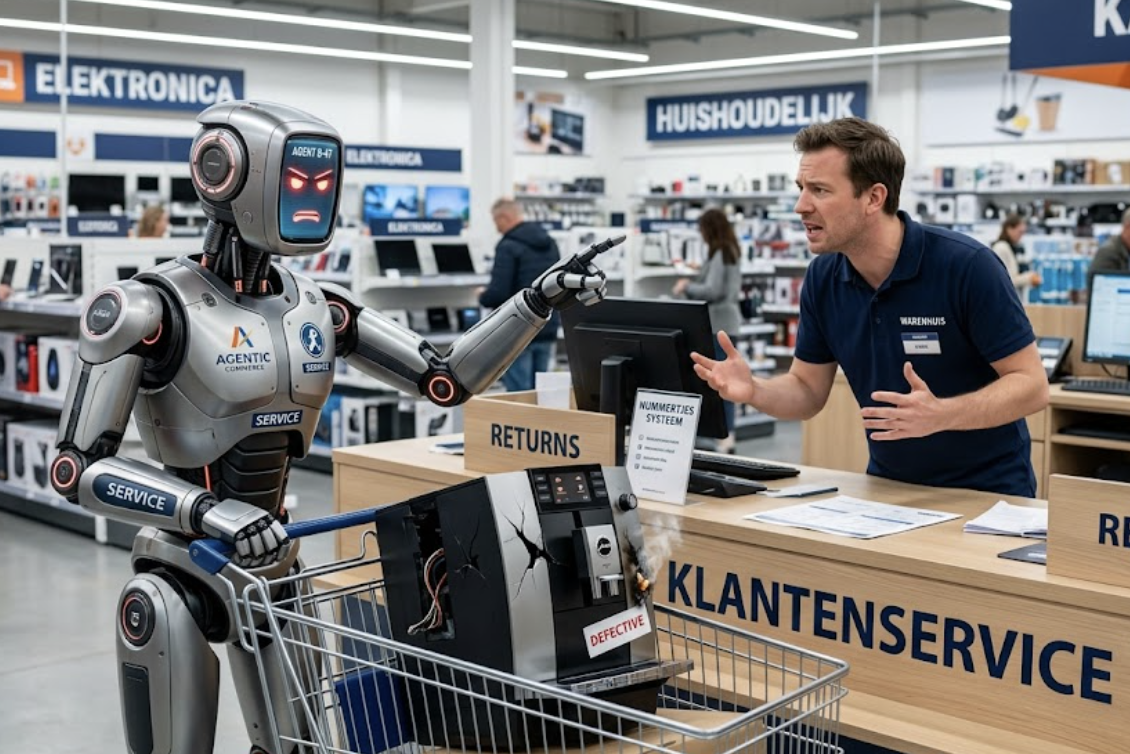
Image: Ziptone/AI
Agentic commerce is the hot topic in e-commerce. At every conference, in every boardroom, it is the subject: soon, an AI agent will make the decisions and handle the purchases. Consequently, companies are investing massively in product data, feeds, and content, hoping that the agent of the future will choose them. Understandable. But there is a blind spot in this entire conversation, and it lies exactly where almost no one looks: in customer service.
Almost everyone thinks about agentic commerce from the company's perspective: how do I become visible to 'the agent'? But the consumer is going to build a complete agent team for the household themselves. An agent for groceries, an agent for gifts, an agent for the calendar, and the agent almost no one talks about: an agent for customer service management. That agent also manages contact with customer service on behalf of that household. Now, you have to be a bit 'techy' to build this yourself using, for example, OpenClaw, Claude Code, or Hermes, but – watch out – in a year this will be as simple as sending an email, and then this shift will happen quickly.
What does that agent do? He monitors delivery times, files claims if a package is late, arranges returns, applies for warranties, and escalates if a company fails to respond. Tirelessly, without hesitation, and with a perfect memory. Where a person gives up after being put on hold three times, the agent simply keeps going. And more importantly: he remembers it. Forever. Which webshop keeps its promises and which doesn't—it is all recorded.
That customer service agent does not operate in isolation. He continuously feeds the other agents in the household with data. The grocery agent and the gift agent are told: at webshop A, returns took three weeks and required four emails; at webshop B, the money was refunded within two days.
And agents make decisions differently than we do. A human is susceptible to discounts, scarcity, and attractive banners. An agent looks at data: availability, reliability, reviews, delivery terms, and therefore also proven service quality. A product that is two euros cheaper from a party with a poor service track record loses out to a slightly more expensive provider who has their affairs in order. For a human, that is a vague gut feeling (“I once had trouble with them”). For an agent, it is hard data.
Price becomes a threshold; service becomes the deciding factor.
Customer service thereby transforms from a cost center into a ranking factor. Every handled complaint, every delivery time, every return becomes a data point that weighs in on every subsequent purchase by that household. Not just once, but structurally. Price becomes a threshold; service becomes the deciding factor.
The big mistake companies are making now is that they view agentic commerce only from their own perspective: how do I become attractive to the agent? A better question is: what does my client's agent workflow look like, and how do I perform on all the points by which that workflow evaluates me?
So be sure to invest in findability and rich, consistent data – there are now tools available to make your products AI-ready. But don't stop there. Take an equally critical look at your entire service chain: delivery times, return processes, warranty handling, and accessibility. Because in a world where the consumer has their own customer service agent, there is nowhere left to hide. Every broken promise is recorded, shared among agents, and factored into the next purchase.
The winners of agentic commerce will soon not be the companies with the sharpest price or the most beautiful banner. They will be the companies that understand that on the other side of the table there is no longer a human being to seduce, but an agent who remembers everything and only looks at what you actually deliver.
(Ziptone/Job van den Berg)


Also interesting
-
Worldline and ING, together with Mastercard, have successfully completed the first end-to-end agentic payment transaction in production in Europe.
-

Consumers are increasingly having to engage in conversation with chatbots first and overcome other hurdles. Is something growing wrong...
-

High turnover? Shaky knowledge management? No chain responsibility? Whatever it is, for now, AI is trailing 1-0.