
More than half of the employees of the Social Insurance Bank (SVB) have customer contact. That work is often complex; a legacy from SVB's past, but politics does not make it any easier. Ziptone spoke with Bert van Laar and Theo Bolhuis from SVB about the change agenda for SVB's customer contact. One thing is certain: move forward in small steps.

Bert van Laar – Image: SVB
'Complexity' can easily be used as an excuse for faltering innovation. If you want to understand the complexity of the SVB's processes, it is best to listen to examples. Bert van Laar is strategy manager at the SVB's law and communications strategy department. He leads the management advisors who advise the Board of Directors and is responsible for the relationship with the Ministry of Social Affairs and Employment.
Van Laar explains that the number of living arrangements has grown from two (married/not married) to now 1957 since the introduction of the state pension in 21. One of these is 'permanently separated life'. The idea behind this lifestyle is that you can increase your state pension if your partner is permanently in a nursing home. But whether such a decision works out well for you financially depends on your own contribution and your right to benefits. Van Laar also mentions the incident/regulation reflex: something happens and politicians come up with additional legislation. This must be translated into the SVB's operations and ultimately falls on the employee, who must speak to the citizen and make well-founded decisions about rights to benefits.
Internationalization has an impact on customer contact
Internationalization also contributes to growing complexity. Van Laar: “The SVB is also responsible for determining insurance: in which country do you pay your premiums and what rights do you have to social security? A huge pile of rules apply within a family that lives, works and receives education in a border region. This often leads to uncertainty for citizens, but it is sometimes difficult for us to explain.”
The SVB is the public service provider with the most customers abroad: about ten percent, says Van Laar. “That also requires a lot in terms of customer contact. The website is available in seven languages. We have our own translation service and we can always contact an employee of that translation service for a conversation. In addition, there are teams for cross-border workers in Belgium and Germany who answer questions about living, working, social security and education across the border. We work closely with Netherlands Worldwide of the Ministry of Foreign Affairs and, for example, we have attaché posts abroad, which inform people about social security, but are also a point of contact for matters related to regulations from UWV, CAK and the Tax Authorities.”
More errors, more repairs
The impact of complex schemes full of dependencies that are constantly changing and increasing internationalization is that the timeliness of benefits can be compromised, the sensitivity to errors increases, more mistakes are made and more recovery actions are required, according to Van Laar. That requires extra capacity, a challenge in a tight labor market. The fact that the SVB workforce is aging does not help, nor does the long training time for new employees: it takes two years before someone is fully employable. “Our message to The Hague is that increasing complexity cannot be solved with 'more people'. We need to work towards greater simplicity,” Van Laar concludes.
2.500 employees perform front and back office tasks

Theo Bolhuis – Image: SVB
At the SVB, Theo Bolhuis is responsible for the customer communication domain, including customer contact, the website, the mySVB environment, letters and social media channels. The SVB has almost 2.500 service team employees, who perform front and back office work. This combination is a conscious choice, Theo Bolhuis explains: “The customer who calls us must immediately get someone on the line who can help. You cannot properly help our customer in the front office if you do not know the back office process well. In the past we did have a contact center, but that led to a lot of callbacks and transfers.” The SVB service team employees therefore have the mandate to handle files and make decisions. Where necessary – and mandatory in specific situations – coordination is made with colleagues. There are also 'custom workshops' where complicated matters are given a place.
Happy flow
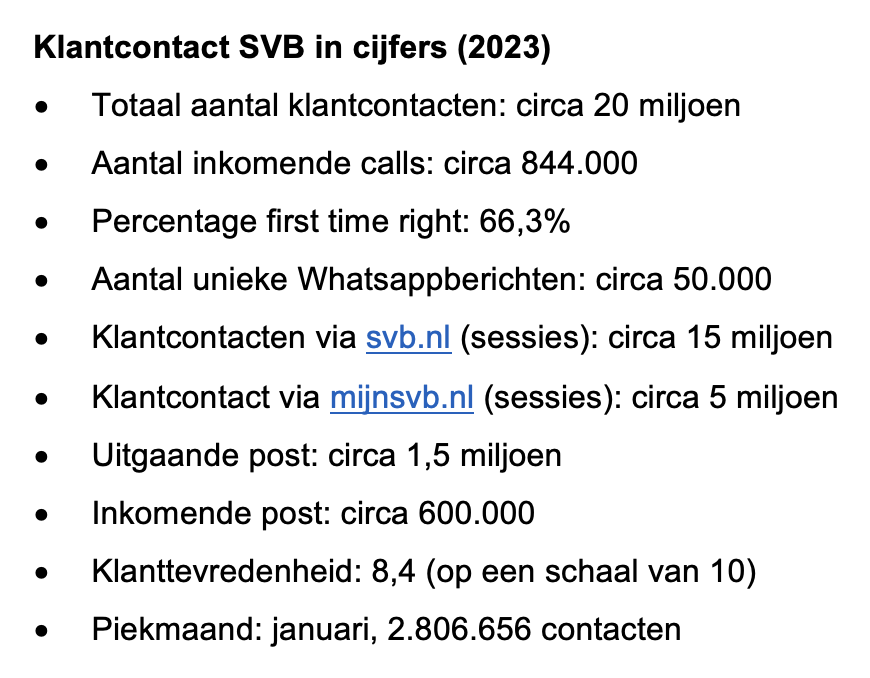 Despite all the complexity and customization, there are major investments in the happy flow. At the SVB, this now comprises 97% of interactions, says Bolhuis. “We had 844.000 calls last year, but we're down to two million.” This reduction is partly due to the rigorous implementation of simple and clear communication - preferably at language level B1, sometimes at A2 - and to a well-functioning self-service portal. The vast majority can get by just fine there, says Bolhuis. “Telephony at the SVB now only accounts for 4.25 percent of all interactions. But we have to take into account people who are not digitally skilled or who come from abroad.”
Planning and routing are the biggest issues
The SVB's customer contact issue is mainly about routing. There are currently separate telephone numbers for the various schemes that the SVB implements, which also differ per region. And in addition, the service team employees who combine customer contact with administrative work are also divided over eleven regional offices. Callers now reach a service team employee directly without further routing criteria.
Bolhuis: “Usually within twenty seconds, but as far as we are concerned the limit is really one minute. We want to move towards skills-based routing, so that depending on the question, language and complexity, you are directly connected to a specialized employee who can help you immediately. Managers schedule employees based on forecasting. If the offer on the telephone is too large, we ask additional service team employees to join the call. This process is currently manual and based on Excel, but we obviously want to automate this.”
Change step by step
The SVB now uses overflows so that the locations can distribute the pressure. Ultimately, the plan is a national number and a national division of work. That has only been a realistic option for some time now, because previously a service team employee in Groningen did not have access to the file of a citizen in Roermond. That is now possible. The routing will probably take place based on speech recognition, but the SVB does not have a master plan for the customer contact organization. Bolhuis: “We will go step by step, see what customers and employees think.”
Rate of change
Van Laar emphasizes: “A lot of change is coming to the service team employees. Due to the Benefits Affair, among other things, all kinds of adjustments have to be made to the enforcement policy. The new rules coming from The Hague must be translated into clear work instructions for employees. This should create more room for employees to apply tailor-made solutions. They like that, but they do need criteria.”
Not all service team employees enjoy customer contact equally or are equally good at it, says Bolhuis. “Some employees experience customer contact as an interruption of their actual work. With more automation it will become easier to differentiate in that area. You want the people who enjoy customer contact, are good at it and get energy from it, to be most concerned with customer contact. People who don't like it, only join when it is very busy.”
Service guarantees and service promises – Special are the commitments that SVB makes with regard to its own services. For example, the SVB talks about service guarantees and service promises and clear response times are indicated. The SVB promises to respond to messages via WhatsApp or Facebook within one hour on working days; Email via the contact form will be answered within 24 hours. For responses to letter mail, on the other hand, there is a period of ten working days. The SVB has continued to work on it training employees in recognizing suicidal thoughts in customers. This training was designed in collaboration with the 113 Suicide Prevention Foundation. The SVB also participated in a pilot for anonymous transfers to 113.
Experience with large IT projects
This choice for an iterative approach is also inspired by the SVB's experiences with previous IT projects. In the period 2006-2014, Capgemini worked on developing a new payout system (costing at least 47 million euros), but that project failed. The IT service provider later had to repay 21 million euros to the SVB. Another ongoing IT challenge is the SVB's General Administration system, which regulates, among other things, the administration of AOW and child benefit. That system suffers from overdue maintenance; the modernization of this system (the source code is drawn up in Cobol) is difficult, new functionality is not sufficient and test programs are not well organized, according to ICT watchdog AcICT.
A new customer contact platform

One of SVB's 2.500 service team employees – Image: SVB
One of the first iterative steps has already been taken: a migration of the eleven local, on-premise Avaya platforms to one central storm platform from Content Guru, started in September 2023. That platform has brought all kinds of possibilities within reach, but here too the customer and employee experience remains leading, says Bolhuis. “We are going to explore new possibilities in importing step by step. We spent two years on that. For example, having eleven locations makes it possible to set up an experiment in one location and compare the effects.”
The consequence of this iterative approach is that the SVB cannot immediately take full advantage of all the new possibilities that the new platform offers. However, the new solution is much more stable and the audio quality is much better, says Bolhuis. In addition, the SVB has been freed from the management issue of eleven on-premise installations.
First the quick wins
What is first on the customer contact agenda? “We want to start with quick wins. One of them is queue management. We answer relatively quickly, but if it takes a little longer, the customer will not hear anything. Also on the list: the integration of social media channels in storm. This is currently still done via separate applications. The introduction of a national number is also planned,” says Bolhuis.
Despite the ongoing tornado of change, customer satisfaction is generally higher than an 8. “People are surprised that we answer quickly and that you immediately have someone on the phone who can help you.” Although that 8,4 is a more than excellent figure (“a compliment to our employees”), Bolhuis wants to go from 'average good' to 'good for everyone'. “You can also improve on failing grades. We do not want to act bureaucratically. Make proactive calls more often. If necessary, we will visit you.”
Professional stomach ache
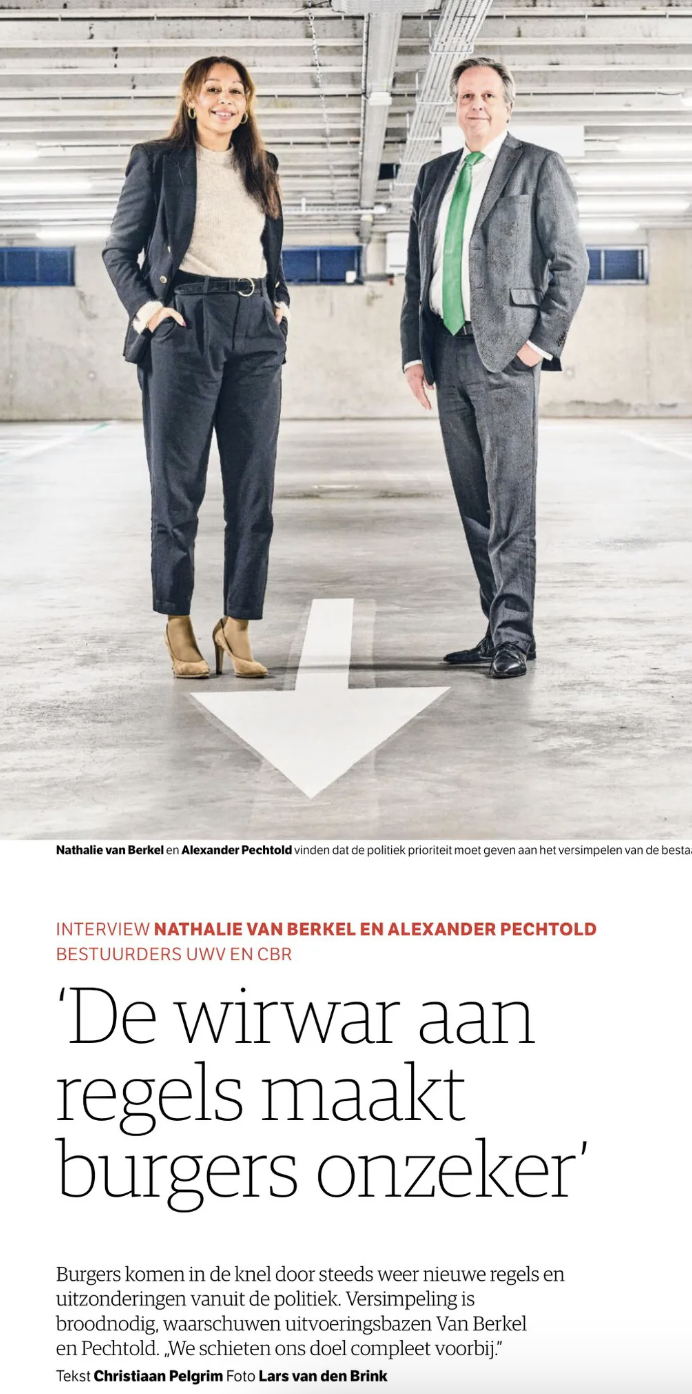 Feedback – or pushback – from implementation towards politics has become increasingly intensive since the Benefits Affair. The 'State of Execution' is an example of this and also speaking directors of executive institutions manifests itself more and more often. To what extent does the customer contact organization play a role in this?
Van Laar: “We introduced intentional thinking a few years ago, for those issues that employees professional stomach ache and that can be addressed by multidisciplinary teams. From these teams there are lines to the so-called bottleneck letters that implementation institutions periodically draw up and address to politicians. That circle towards politics is now complete. The complexity created around lifestyles is now being investigated: it must be simpler. Or consider a scheme for children in intensive care, who receive double child benefit. Partly in response to a bottleneck letter, parents with children who already have a Wlz indication will soon no longer have to submit a separate application, but will automatically receive double the child benefit. This intentional thinking has already led to quite a few simplifications.”
An 8,4 from everyone
To innovate, the SVB has an innovation lab: a team outside the SVB. And only if essential knowledge is lacking does the SVB hire an advisor for a few months. “After that we should be able to do it ourselves,” says Bolhuis. “The Content Guru team also thinks along with us, but that was part of the package of requirements in the European tender. It is up to us to decide what we will do and when; Together we arrive at a backlog.”
Will SVB's customer contact look completely different in two years' time? Bolhuis: “That does not necessarily depend on the technology. I will only be satisfied if that 8,4 applies to everyone.”
About the SVB– As an independent administrative body, the Social Insurance Bank (SVB) is responsible for the implementation of 18 different laws and regulations in the field of social security, including the AOW pension and child benefit. Approximately 5,7 million people in the Netherlands and rights holders abroad have to deal with the SVB. More than 50 billion euros are paid out every year. The SVB emerged from the National Insurance Bank, founded in 1901 to implement the Accident Act (intended for employees). In 1957, the AOW (as the first national insurance) was added, and in 1963 the General Child Benefit Act (AKW). Every year the SVB publishes a list of the most popular children's names. The SVB employs approximately 4.770 employees.
(Ziptone/Erik Bouwer)


Also interesting
-

Voice training for agents is often neglected, while their performance can only be heard thanks to the use of their voice.
-

As customer contact professionals, let us primarily focus on eliminating contact reasons. AI will soon be able to pick up the complex conversations.
-

André Vermaat starts working at the SVB. He recently worked as an expert in large-scale customer contact at…