
 App first is the credo for many banks. The app is not only 'always on' and always in your pocket, but is also the perfect starting platform for customer contact – you know who the customer is. And the app is the ideal landing place for marketing activities and for new functionality. Ziptone spoke with Thom Kokhuis from Rabobank about the (digital) customer contact strategy.
While all customers (9 million) must be able to arrange as much as possible via the Rabo app, within Rabobank all 16.000 Rabobank customer advisors are connected to the same platform. This consists of several components. The core is formed by Genesys Cloud for routing to customer advisors, where part of the routing is done by Pega's rules engine based on various parameters. Microsoft Co-Pilot Studio is used for the chat and voice bots. Another pillar of the customer contact platform consists of Oracle's Siebel – a solution that will soon be replaced.
 Thom Kokhuis has been working for Rabobank for four years. As Head of Conversational Banking and CRM, he is responsible for 350 IT professionals who work daily for the 'run' and 'change' within the bank for all customer contact channels and the CRM system. The basis of customer contact lies in customer recognition, demand recognition and optimal routing.
Kokhuis: “In many cases we recognize our customers based on the 06 number. You will then arrive at the voicebot of our Co-Pilot Studio for determining customer demand. After identifying the customer, we ask why someone is contacting us via the voicebot. The reason for calling also influences the routing and prioritization based on the Pega rules engine: it forwards the call to Genesys, after which the customer is referred to the right advisor. We included Pega because our business rules change regularly and we want to be able to route advanced based on customer demand and customer data. If identification is successful, we can call up the customer image and start a conversation. The fact that employees do not have to ask for bank account numbers or a zip code saves conversation time.”
Personalisation
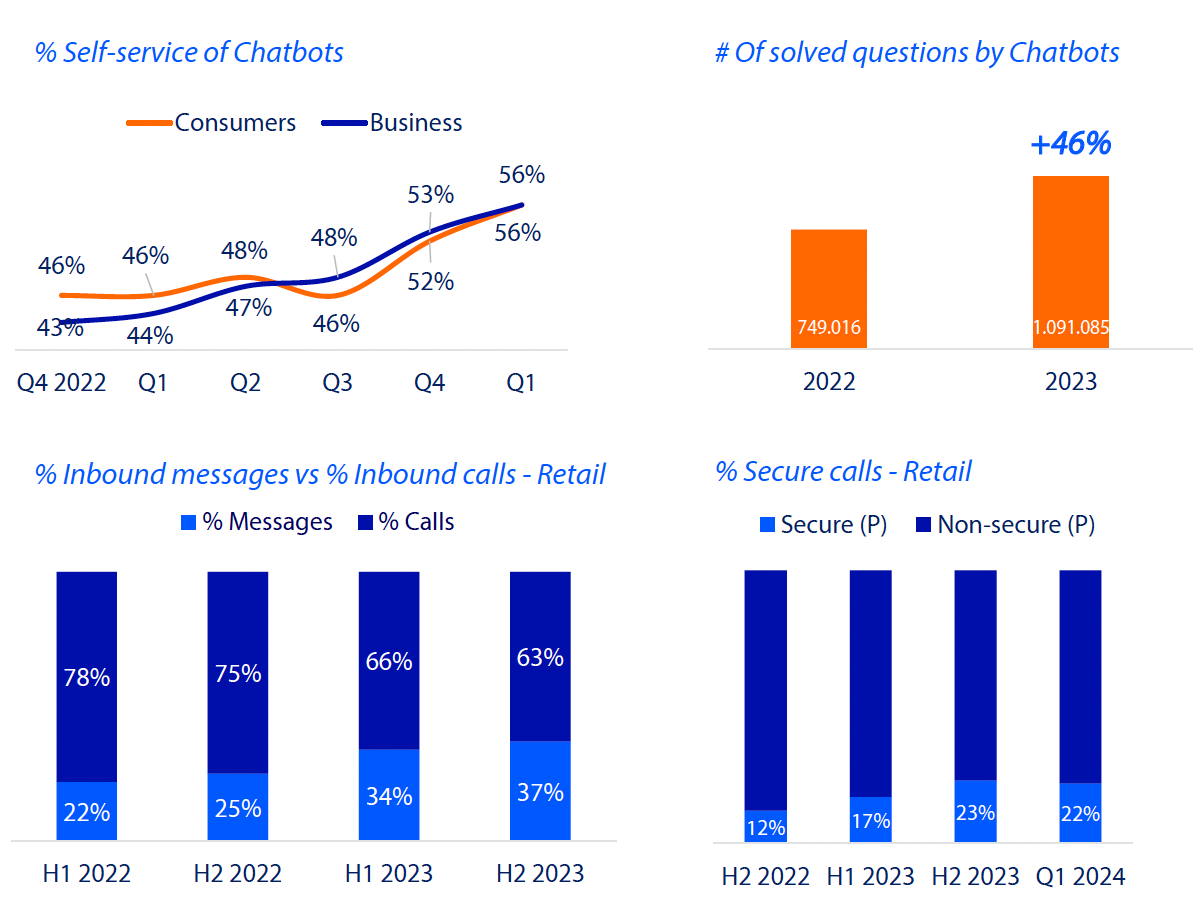
This IT landscape enables Rabobank to increasingly focus on service differentiation, says Kokhuis. This involves looking at all kinds of characteristics that determine the customer journey. The bank wants to focus more and more on customer journeys and life events: you turn 18 or you buy a house. The bank wants to be present at those times with relevant advice. Customers can do their daily banking affairs digitally as much as possible, according to Kokhuis. This is working out quite well: the bank has 1,9 billion digital interactions per year, 92% of which take place via the Rabobank app. This concerns interactions and transactions, from transfers to next best actions that the bank serves to customers via PegaMarketing. “But offline contact remains as important and relevant: 6 million calls and more than 2 million chats per year. The ratio is changing: the ratio between telephony and chat was 2022/80 in 20 and is now 60/40.”
Take care
 It is clear that the bank is moving full speed ahead with digitalisation. In June 2023, the bank stated through Bart Leurs (then chief information & technology officer Rabobank) that the bank wanted to “take a pause” in innovating on the axis of AI.
Kokhuis responds: “Yes, we have indeed taken a step back. Rabobank first wanted to understand what the risks were, where data would go and whether we could guarantee the privacy and security of our customers. We have now properly identified the risks and drawn up a standard working method for dealing with AI and we will now experiment with GenAI step by step per use case. We first do this internally within customer service and operations because we can simplify a lot of administrative work for our advisors there. The starting point for the time being is 'human in the loop',” says Kokhuis.
The automated summary has been rolled out as a pilot to 4000 daily banking advisors and will be further scaled up this quarter. Having AI make suggestions for written messages is also going well, according to Kokhuis, it saves a third of the time required to type messages; the result is that advisors can do more chats simultaneously than before and are helped in providing optimal customer contact. Auto wrap up is used in its own Azure environment and with humans in the loop.
Personalized call flows
Personalization has already been implemented in the call flow: someone with a private banking account does not go through the voicebot, but immediately reaches an employee. This also applies to people over 80 years old: if recognized, they will not be confronted with a voicebot at the start of customer contact. And if it is known that someone is looking for contact from the surviving relatives environment within the website or app, then someone will go directly to the surviving relatives desk.
“We were initially able to help four out of ten customers with our bots, now that number is six out of ten customers. So we have a resolving power of about 60%. We invest heavily in backend integrations so that our bots can perform actions,” says Kokhuis. He therefore expects that the voice and chatbot will eventually be able to use information from databases.
Rabo App
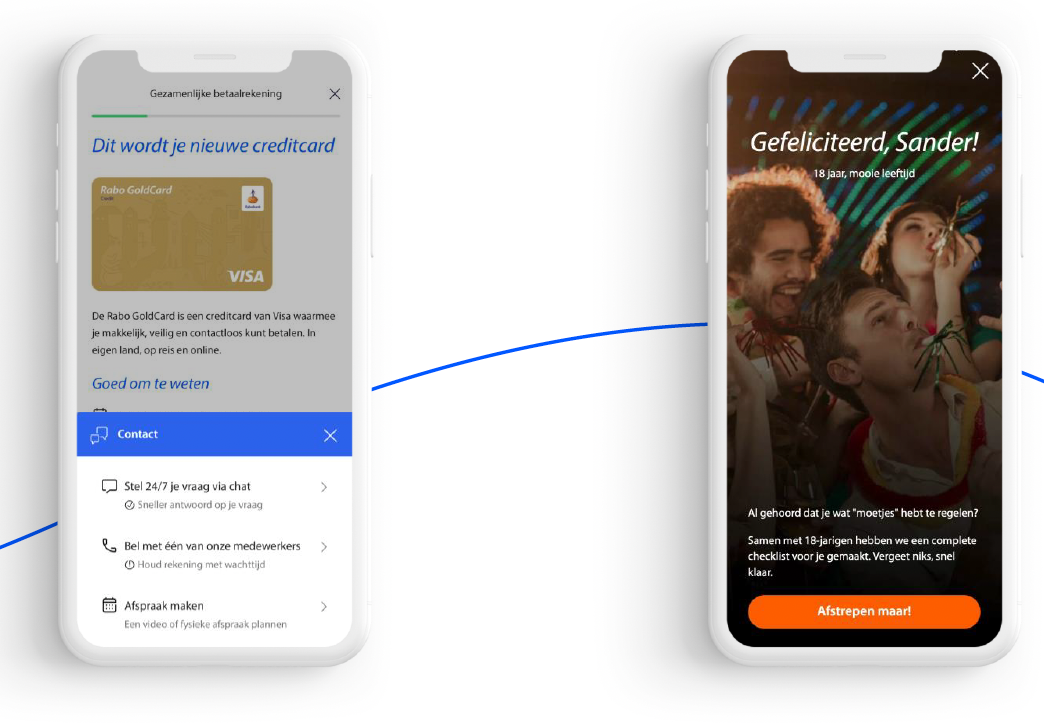 Furthermore, the Rabo app obviously plays an essential role in the further development of services. Before the app-first strategy, the bank had to catch up, says Kokhuis. “In 2015, the Rabo App had a low app rating, but strong investments have been made since 2018. The emphasis is also on further personalization in the further development of the app. At the moment, all Rabobank customers have the same app, but a private banking customer has different needs than a student.” To ensure all innovations run smoothly, Rabo Labs is available to 10.000 of the bank's customers. This is a pilot environment where customers can become acquainted with new functionalities. They are expected to actively provide feedback on this.”
Video calls from the app and voice biometrics
The digitalization agenda for 2024 also includes the introduction of video calls from the app and the bank will also start with Rabo Voice ID, in which voice biometrics are used to combat fraud. “Privacy legislation reduces the number of opportunities to ask privacy-sensitive questions,” says Kokhuis, who therefore sees room for voice biometrics applications.
“And finally: we also want to make the Rabo app available to customers who only have a mortgage or insurance. There are approximately 1 million customers who purchase products from us but unfortunately do not yet have access to our app. This will be implemented step by step in the coming months for these groups of customers and for customers with insurance through Rabobank.”
Customer experience is decisive
Ziptone has also recently presented a dilemma to other banks: an app first strategy may mean that your bank primarily becomes an app on the phone. Then it is just a small step to the bank as a commodity.
As far as Rabobank is concerned, the answer to that statement is that the bank wants to make a distinction with customer experience: “That everything works seamlessly and feels as if the bank knows you as a customer. Just like in the past, when you, as an entrepreneur, walk into your local Rabobank office, you are recognized. Our digital channels must become warm and personal,” Kokhuis explains. “Anyone who has a birthday will receive a login screen with confetti. When someone turns 18, they are allowed to bank independently. However, we will send a letter well before then: you will soon be 18, prepare yourself for independent banking. On the day that someone actually turns 18, we make it more festive.”
More or less people?
Source: Rabobank
With an app that offers more and more functionality and better access to information, you would expect that the number of customer advisors could gradually decrease. Kokhuis's first answer is that the size of the operation remains unchanged, because more and more employees are deployed in a different way - such as the know your customer programs. “Employees start in the contact center and then move on to the role of KYC analyst. Customers only call once a year on average. So when they call, we really have to serve them in a different way than before. This also means, for example, taking more time for conversation.”
But Kokhuis acknowledges that longer conversations do not lead to more advisors, on the contrary. “Ultimately, this may decrease over time. We mainly see that we have less inflow due to natural attrition.” (Ziptone/Erik Bouwer)


Also interesting
-

Voice training for agents is often neglected, while their performance can only be heard thanks to the use of their voice.
-
Zaturdag will work at Customer Contact.nu as a consultant for customer contact professions.
-
DigiToegankelijk will provide an update at least once a year on developments in the field of digital accessibility at…