
Robots are advancing and taking over our jobs? There is little truth to these clichés. Nevertheless, professor Jenny van Doorn warns us to remain vigilant. Physical robots and chatbots can lighten the workload of professionals, but can also make that work less attractive. This also applies to customer contact. “A coach may still be accepted. But what happens when employees have to deal with an AI manager?”
Jenny van Doorn has been working on the use of robot technology in service provision for about ten years. This is an extremely relevant issue, because our labour market shortage will only increase until 2040. “The phenomenon of service provision is broad: it ranges from hospitality to healthcare. And with robots, I am not so much concerned with their physical appearance or their capabilities, but mainly with their interaction with people. How do people react to robots, how do you ensure that service provision remains pleasant, both for the employee and the customer?”
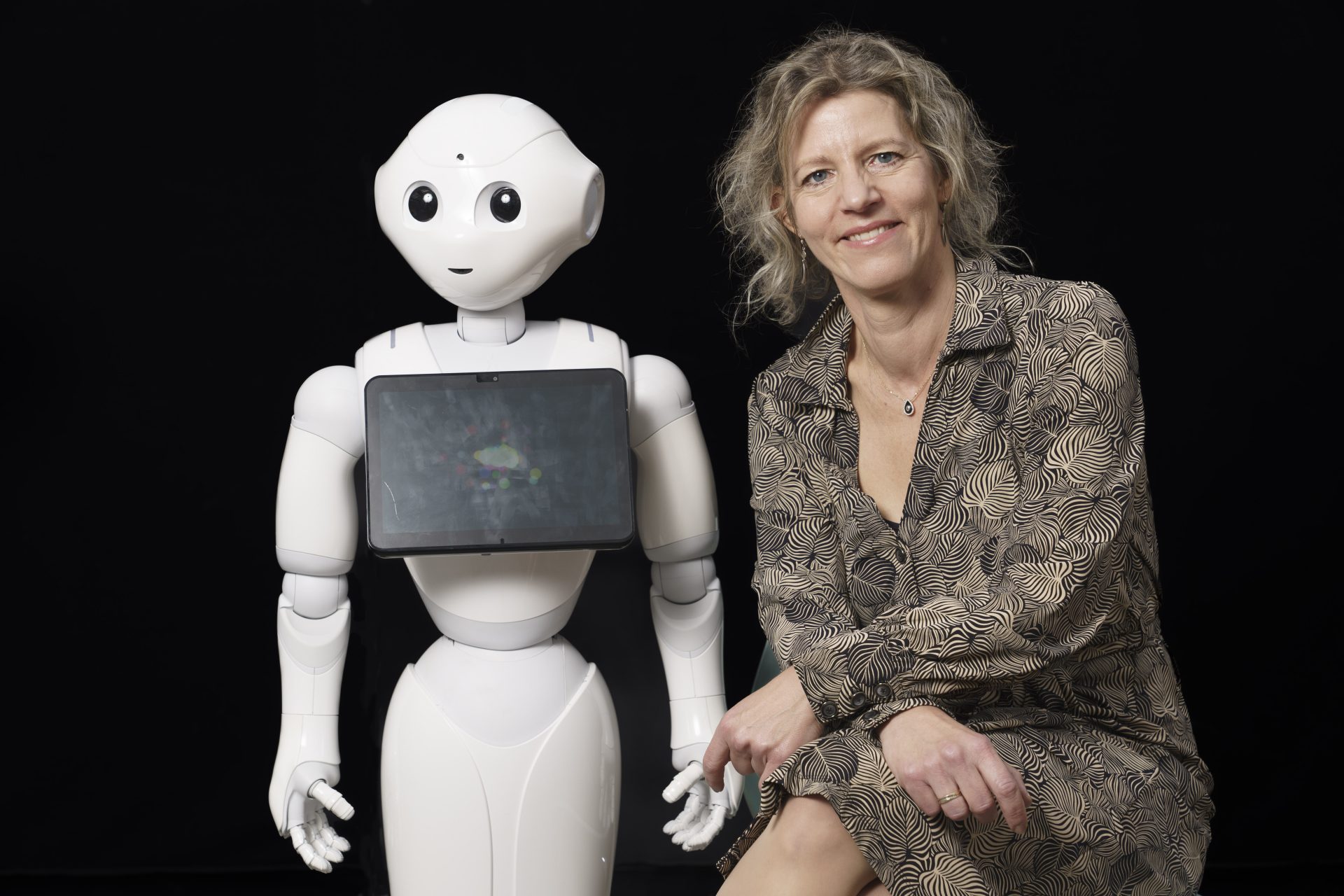
Jenny van Doorn is a professor of services marketing at the Faculty of Economics and Business of the University of Groningen. She studies how consumers and other stakeholders respond to social robots in services. She has published in Journal of Marketing, Journal of Marketing Research, Journal of the Academy of Marketing Science, Journal of Service Research and International Journal of Information Management.
Here and there a robot is the replacement, in other cases an assistant of the employee. What are the most striking developments at the moment?
“The chatbot is advancing in customer service; partly due to solutions such as ChatGPT. Physical robots cannot keep up with that speed, although they are on the rise in restaurants, hotels and healthcare. In healthcare, social robots are developing faster than robots with physical tasks. But that also has a downside: that social aspect is precisely the part that healthcare workers like. So we have to be careful of the situation in which healthcare workers only do physical tasks and all social components are transferred to technology.”
In those care areas where the labor shortage is greatest – home care, care for the disabled – the risk of work erosion is also greatest, Van Doorn summarizes. “On the other hand: there are clients in care who have not had any visitors for years; then a companion robot perhaps better than nothing.”
Voicebot more effective in combination with physical robot
At the end of the continuum are lifting robots and automated showers, but these are applications that are sometimes difficult to fit into existing housing. That is already an obstacle, according to Van Doorn. On the other hand, there are small robots that help clients with proactive notifications: the employee will come in ten minutes to dress you, have you already prepared some clothes?
In the hospitality industry, they can dispose of dirty plates, in healthcare, the physical appearance is particularly important because of the voice-based interaction with patients, says Van Doorn. “If physical robots ask something via voice, people are more likely to follow it than if it is a text message via an app or a screen. The physical form also contributes to perception; if you were to choose a loudspeaker, people would sooner ignore that message. But the physical form of a robot is not always necessary.”
Back to service. Sometimes you come across a robot with a display at a bank. Or think of a registration column at a counter. When can we speak of robots?
“The distinction is clear: you can ask yourself whether the system is autonomous or not. A registration column usually is not. Autonomous systems can respond to input from the environment and are therefore different from a menu structure that you go through.”
“If you look at how chatbots are valued at the moment, the common denominator is that it doesn’t work that well. My latest experiences have been more positive. We have made greater progress in recent times than we anticipated two or three years ago.”
But according to Van Doorn, disappointing results can also be related to legal regulations and the goals of organizations - she also points out the EU AI Act which, for example, sets limits on the use of sentiment analysis.
From 'what is possible' to 'what do we want to do with it'
Van Doorn: “I think that the discussion will increasingly shift from 'what is technically possible' to 'what do we actually want with AI'. That goes beyond the use of data and the risks surrounding privacy. Which part of the customer journey can you do perfectly well with a chatbot and in which cases do you use an employee?”
“How are we going to shape the collaboration between human employees and chatbots? How and when do you organize a handover? But also: what does the use of chatbots mean for that employee? It is often said that the employee can then focus on the complex tasks. But is that also the reality? If you, as a customer contact employee, have to deal with people for eight hours a day who have already been working with chatbots for half an hour, that may not be so good for your own job satisfaction. You have to actively manage that collaboration. What is pleasant for the customer and what is the impact on the employee? And sometimes it may also be pleasant for employees to do tasks in between that are less complex.”
In the hospitality industry, this collaboration is perhaps better organised. There, a serving robot can do the carrying, while the human can focus on the interaction with the customer, says Van Doorn.
 That robot is only here to stay if he or she doesn't drop everything - but in customer contact, quite a few shards fall with clumsy or even dysfunctional chatbots that customers have been burdened with for a few years. Why is that accepted in customer contact and not in the hospitality industry?
“Costs maybe? It’s hard for me to judge. What will definitely play a role is the trade-off between availability and costs – 24×7 service comes at a price. And perhaps customer contact is too large-scale to create a system that always works.”
This also applies to virtual assistants who will advise customers – they will offer a selection from a number of options, which is different from the endless options that people can find on their computer screen via Google. “With voicebots, that number of options is reduced even further – a robot will not read everything out. This poses challenges for companies: how do you become easy to find for AI bots? "
What can scientists add to bridging the gap between available technology and customer adoption?
“We can provide insight into situations or moments in which it is or is not a good idea to use robot technology. It would be nice if we could draw up generic rules, but that may be too ambitious. Products that make consumers feel ashamed are better purchased via a robot. If you want an honest answer to questions, technology is sometimes not a bad idea, because less social pressure is felt. It is also important to find out in which cases it is better not to use technology, even if we are dealing with shortages. It is not only about customers, but also about the perspective of employees. There is also a task for researchers in that discussion, also on an ethical level. I am concerned about the possibility that it will become a question of money. The risk of that is that people with a good income still get human service and people who cannot afford it have to figure it out with a chatbot.”
Speaking of inclusivity, Sanas’ accent-distortion software improves communication between customers and employees, but it doesn’t address the root cause of employee incomprehension and puts pressure on acceptance of accent differences.
“These are interesting issues, especially because there is software that can create synthetic voices with certain accents, so that it becomes more authentic. It is really an advantage if communication is easy, especially if you can remove hiccups with technology. But you also have to be careful that we do not end up with only one way in which people are allowed to speak. Such an accent application reminds me a bit of the filters on Instagram, which make everyone look the same.”
Finally, what are the pressing issues that remain to be explored when it comes to technology-employee collaboration?
“Based on GenAI as a supporting tool for customer contact employees: when will the moment come that GenAI becomes your boss? Is that acceptable? I am thinking of Uber drivers, who are literally controlled by an app based on an algorithm. We have done research into the use of robots as team leaders. That is something that people really do not want, while at Uber it is in fact the situation. How are we going to determine in this area what is and is not accepted?
In the past, a floorwalker would walk around the contact center, now you have an agent assist tool that provides answers based on a knowledge base. Coaching employees is also increasingly automated. The workload is also offered by systems. Does this make the contact center look like Uber?
“Yes, and what do employees think about that? What issues really need to be addressed by human managers? Where do we draw the line? A coach might still be accepted. But what happens when employees are confronted with a kind of AI manager?”
(Ziptone/Erik Bouwer)


Also interesting
-

Sudden fear that technology like AI will take your job? You might be suffering from Kasparov syndrome. The good news:…
-

According to Chinese astrology, 2024 is the year of the Dragon. Or did someone make a math error? Because it is…
-
Two-thirds of HR professionals believe that their own organization still makes insufficient use of HR technology for onboarding.