
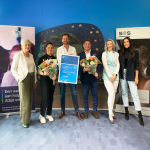
Kalff, an established name in donor and fundraising, achieved ISO 18295 certification at the end of last year. Jerry Smit, co-owner of Kalff, looks back on the process. “If someone says 'I already have a stable organization' then my answer is 'I do too'. It can always be better.”
“Before corona, everyone worked entirely from our office. During the corona pandemic, we also switched to working entirely from home, which went well. But after the corona pandemic, we ended up with a hybrid model,” says Jerry Smit, co-owner of Kalff. “And that is also the reason why we opted for an ISO 18295 certificate.”
Kalff, based in Almere, generates the vast majority of its turnover from fundraising and donors for charities. The company also conducts market research. Kalff does not engage in cold calling; the company believes it is important that there is always some kind of relationship. It is a conscious choice to work exclusively for charities – which can also be arts and cultural institutions. For Kalff, this choice means “that we are somewhat limited in terms of size and growth. We will not grow to 15.000 seats, for example,” says Smit.
After the corona pandemic, Kalff came to the conclusion that working from home and working from the office each led to different processes in the operation. Smit explains: “Things like selection, onboarding, training and education, guidance and coaching look different. In the online model, you miss a lot of information about how someone is doing, what energy someone has. In addition, the onboarding process with us is a long process. You start with a very small amount of calling while a coach sits next to you, who mainly calls a lot. That ratio gradually changes, until you are able to call independently. In the online situation, you no longer sit next to someone as a coach. That requires different work instructions.”
Cut up or rethink
“We saw that process adjustments were needed in many areas, including compliance and regulations. Are you going to divide your organization into a home-working and office-working variant? We decided to examine all work processes and reorganize them where necessary. Most of our processes were already documented and we have extensive policies in various areas. In short, Kalff had an excellent foundation, but we lacked a standard that we could adhere to. We have always been audited regularly by various of our clients. Auditors then asked us: according to which system do you work? That was our own system.”
Best fit and most feasible
“ISO 18295 came up in one of the KSF mailings. Together with operational director Sylvia Schilder we asked ourselves: isn’t this exactly what we should be doing? What does it involve and are we ready for it? We didn’t look at alternatives – think of COPC or ISO 27001 – but very consciously chose 18295. After attending an information meeting at the KSF, this felt like the most suitable and the most feasible.”
“We have been well supported from the very beginning, including by Naomi Verheij. He gave good tips, such as carefully and gradually involving all employees in this process, also before the start. Why do we want this? What do we want to achieve? ISO 18295 is quite a paper tiger, so I understood the reactions of some of our departments. Continuing to explain well and consistently why we want to introduce more structure into processes gave the team the insight that certification leads to something. If you don't involve your people in advance, there's little point. It's not about the piece of paper. And in retrospect, I'm very proud - also of the journey we've made with everyone - and the certificate is definitely hanging on our wall."
Objective and approach
“What is the higher goal for us? We want stability and predictability. Everyone needs to know what to do in which situation. If roles or handover moments are not well thought out and documented, then you increase the chance of errors. In the period that we started working hybrid, we really had to adjust. There were management changes, we had to work much harder to keep processes at the right level.”
“We started by mapping out what is needed, what we have in-house and what its status is. Is it up-to-date and correct? Is something missing? So it is mainly a clean-up operation with a lot of research. Our foundation turned out to be solid. But there was also contamination in the documentation. Not everything was up-to-date. If you want people to work in processes, it must also be clear whether process A or process B is the right one.”
“The change component is also there. You can document everything, but of course it is about making people work according to processes. That does not happen automatically, but it is an important part of the work of Sylvia, our operational director. After obtaining the certificate you are not finished, on the contrary.”
Pre-audit and audit
“We started in the spring of 2024 and chose to have a pre-audit carried out in July. This provides insight into your chances of successful certification. The pre-audit also helps to get an idea of what the final audit involves. That official audit took place in October last year and Kalff was 'successful'. ”
“Such an audit takes two days. Everything is turned inside out. You have to provide a lot of data about processes and provide evidence to show that these processes are also followed and executed. Where is the process description? Where are the ticked checklists, which show that processes have been checked by people? It is a paper tiger, but it is about the application in daily work. Each department is forced to check its own work and work process. That results in better quality in all processes and more stability and continuity for the whole.”
Describe the process and burden of proof
“A good example of burden of proof is the guidance of agents and data security. The ISO 18295 process makes it clear what you can and should do in that area – think of instructing employees better and more consistently and recording that process. Another example: access to CVs of applicants was well organised at Kalff, but there were still quite a few CVs stored of people who were no longer employed or had never been employed. That is about professionalism towards your employees and candidates, privacy, data security.”
“We did not choose to free up someone for this certification process. However, the plan to go for ISO 18295 was included in the search and appointment of our operational director. For her, this was part of her job description. That also immediately increases the support base. Her approach was: I am responsible for the operation and the processes and I am going to help you make the work easier. That is different from appointing a dedicated staff member who is going to bother everyone with complicated questions. So in our case you cannot speak of 'it cost us 1 FTE'.”
Discussion points
“From my commercial role, I also looked at the impact of various decisions around certification on our clients. That led to some discussion during the audit process. For example, about things we do differently, or about things that are not necessary for our organization.”
“A good example of this is our complaints process. We do not do inbound and do not build up cases or files of customers. We only call outside. Of course, we do everything necessary to recognize, handle, investigate, discuss with the complainant, resolve and learn from any complaints about our work, record and close them. We can listen to all conversations. But according to ISO 18295, you must also set up a structure that ensures that you meet periodically with your clients to discuss all complaints and then adjust your policy. You must be able to provide a report of this process – part of the complaints management section.”
“But we don't want to subject our clients to such a process. As far as we're concerned, it can't be the case that something is included in ISO 18295 and that you absolutely have to set it up to be able to meet the standard. Fortunately, such a difference of opinion is allowed to exist and then it remains a 'point of attention' in the audit.”
Recommended
“My advice regarding ISO 18295? Definitely do it. It not only provides stability and structure, but it also offers insight into your company and your own blind spots. If someone says 'I already have a stable organization', my answer is 'I do too'. It can always be better - and you only know that when you have gone through all your processes in a structured way.”
“During the very first briefing at the KSF in Doorn – together with about ten other interested organisations – it became clear to me during a round that Kalff was relatively far along when it comes to recording processes. The rest of our 'class' is currently still working on certification. The investments will differ per organisation. But I would recommend it to everyone, even if it takes you two years.”
There are currently nine customer contact organizations in the Netherlands that are ISO 18295 certified: WEngage, LAVG, Bos Incasso, Sidekix, Your Voice, Patch Marketing, 2contact, RDW and Kalff. Contact4You was also certified, but that company was taken over by ContactCare. Abroad, various in-house and facility contact centers have obtained ISO certification. There is no central register available of all certified organizations. The documentation on the (Dutch) standard can be found purchased from NEN.
(Ziptone/Erik Bouwer)


Also interesting
-

ContactCare's customer contact centers in Suriname and the Netherlands have been recertified for ISO 27001 and ISO 9001.
-
The PSO certifies organizations on their results in social entrepreneurship, aimed at the labor participation of vulnerable groups in the labor market.
-

ISO 9001, 27001 or 18295? Whichever ISO certification you choose for your contact center: it affects the entire organization.