
 “The kitchen is still closed,” says the young waiter. He looks away from me, uninterested, and across the square.
“Do you perhaps have a toasted sandwich?” I ask the back of my head.
The head turns. “No, because the kitchen is still closed,” it says with unconcealed irritation at so much stupidity.
Out of necessity, we stick to coffee.
It is the late eighties, a sunny spring Sunday on a terrace in the heart of Amsterdam. My girlfriend and I have decided to have brunch in the city. We choose Thorbeckeplein, around the corner from Rembrandtplein. It is almost noon and an antique market is in full swing. It is not busy; Amsterdam is sleeping in, and at that time the city was not yet overrun by tourists.
The cookie with the coffee feels like a welcome extra. We drink our coffee, pay, leave a modest tip out of politeness (we do!), and decide not to wait until the kitchen opens. We will never come back here.
The perfect terrace
This incident came to mind when one of the speakers at an event on customer experience referred to the story by Hans Sibbel ('Lebbis') about the perfect terraceIt is a classic, albeit a bit overused by now, and the fact that so many recognize his story proves that we in the Netherlands really do know how to please our customers.
Yet something strange happens.
When I am abroad, I am always curious about how they do things differently there than we do. Perhaps even better than us. In a way that can inspire us in the Netherlands and from which we can learn.
When I share my experiences abroad back in the Netherlands, they are rarely met with curiosity, but mostly with skepticism.
I'll give you an example.
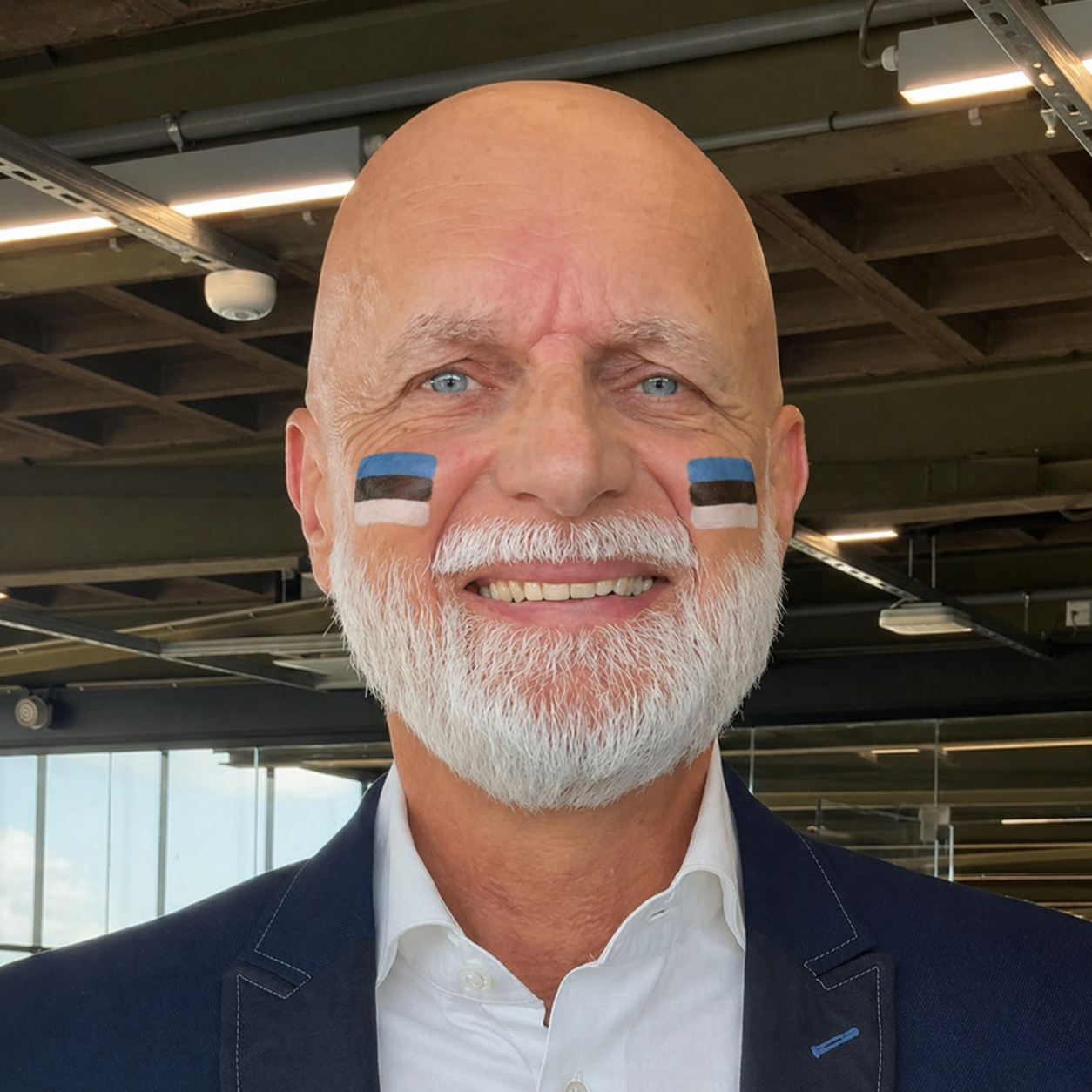
This spring, I had the opportunity to travel to Estonia for a lecture. This country has been at the forefront of digitalization for years. In the Jetten cabinet's coalition agreement, it is even cited as an example for the Netherlands.
I flew with Airbaltic to Tallinn, the capital of Estonia, and when I told someone that Airbaltic was the first airline in Europe with high-speed internet on board, the response I got was: “Oh, but that is nothing special. All airlines have that.”
When I mentioned that I noticed in Tallinn that I had access to open Wi-Fi everywhere, and I mean absolutely everywhere, the response was “you have that everywhere here too”. Apparently, I end up in different places.
Yes, but….
In another conversation, I talked about my experiences with public transport in Tallinn. Public transport is free for residents of Tallinn. This has a huge impact on car ownership and use in the city. On the bus or tram, you only need to check in, not check out. That has a few advantages: you can't forget to check out (duh), you can get off faster, and others can get on sooner. That saves time. Travel time too, because the tram or bus can move on faster. Very efficient and pleasant for the customer.
“Yes, but then as a traveler you pay just as much for a ride as someone who gets off a few stops further on,” was the answer I received. That is correct, just as you pay the same amount as that traveler who rides a few stops fewer than you. This cancels each other out, and the convenience is there for everyone.
During an inspiration session about the art of surprising your customers, I talked about my visit to Restaurant Noah, one of the outstanding restaurants in Tallinn. When we received the menu, it turned out that one of the guests in our party had forgotten his reading glasses. Without being asked, the alert waiter placed a small tray on the table with reading glasses of various strengths.
When I said this, a voice from the audience asked: “Do you ever visit Rotterdam?”
“Absolutely,” I replied. There are few cities I enjoy more than Rotterdam.
Every restaurant does that there.
The skepticism among the Dutch regarding positive customer experiences abroad is not an isolated incident.
It is possible, of course, but I haven't noticed it before. Moreover, it misses the essence of the example. At its core, the questions are: 'What do I do for my client at moments when I can be helpful?' and 'How can I provide my client with surprising service in a way that goes beyond our primary product or service?'
The skepticism among the Dutch regarding positive customer experiences abroad is not an isolated incident. It is a pattern. It happened to me too after visits to Dubai, Palestine, New York, and Las Vegas.
The reactions are predictable.
When I tell people after a visit to the United States how customer-friendly I was treated there, the reaction is invariably: “Yes, but that is always faked. Do you know why they do that? For the tip!”
The indignation about that escapes me, because as a customer I think it is a great trade: you take good care of me and I reward you with a little extra.
As a customer, I would rather be served well by someone who is artificially customer-friendly than be served poorly by someone who is genuinely uninterested. Like that back of the head on Thorbeckeplein.
(Ziptone/Frans Reichardt)


Also interesting
-

How can you make your customers wait endlessly when it is abundantly clear that they don't have all the time in the world?
-

Frans Reichardt imagines what would happen if a company treated its customers the way political parties treat their voters.
-

The digital assistant can handle natural language – but exclusively in Dutch, so not in French…