
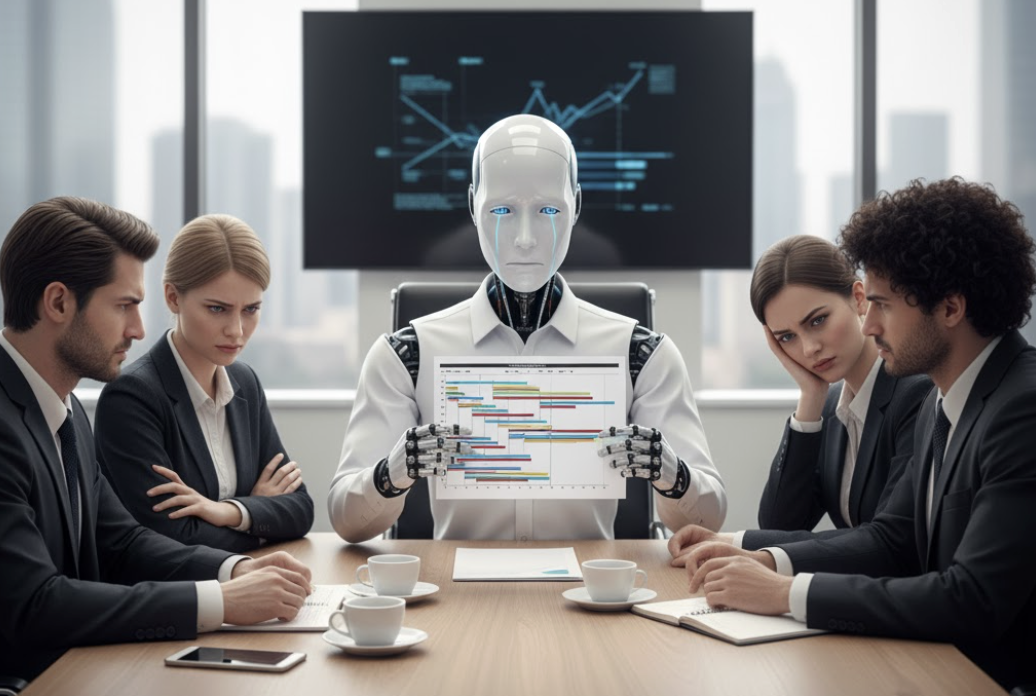
 There they stood, neatly lined up, their judgment ready, like a hungry firing squad. Waiting, eager to see who would strike first. Opposite them, against the proverbial wall, stood Artificial Intelligence. It's become a familiar presence by now. Because AI has been here before.
This time the charge was that unrest had arisen among the staff of public transport companies GVB and HTMThe newly introduced scheduling system could automate scheduling and thus replace human schedulers. In addition, employees reportedly experience increased workloads with the new schedules and feel that leave requests are not always handled properly.
The country's planning experts were falling over themselves: automation is good, but WFM must remain truly human-driven. Without AI, the unrest and dissatisfaction among employees would never have arisen.
A long time ago….
Without AI, this would never have happened, would it really? A long time ago, I was a student working in a contact center.
In the early years, we had Erik Jan as our planner. A perpetual student who used two KPIs for his schedule. First, the schedule had to be comprehensive. Second, he didn't want to go to the pub alone at the end of the workday and didn't feel like waiting until 21:30 PM for beer. Therefore, he assigned employees who enjoyed going to the pub the afternoon shifts. In practice, this led to division among the staff. Erik Jan was accused of being unsympathetic by the employees who had to work every evening.
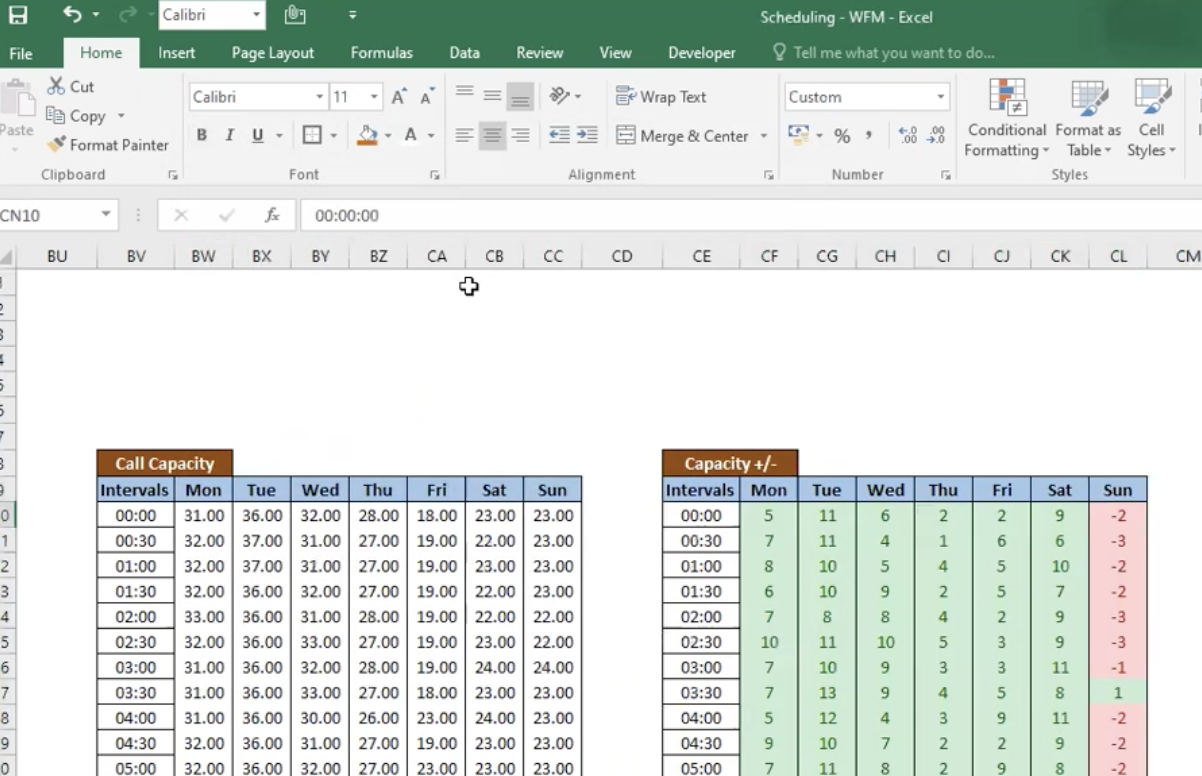 Management took drastic measures. The Excel schedule had to make way for a state-of-the-art WFM package. A package that would facilitate higher employee engagement and satisfaction. It was intended to ensure a more equal distribution of work among staff and a feeling of reduced workload. Finally, the WFM solution would also make Erik Jan's job easier. According to management, this would free up more time for analysis. Erik Jan himself felt that this would allow him to go to the pub earlier, or start later—or perhaps both.
The tool was launched with great fanfare. Even our management was present at the go-live. Along with the suppliers' big bosses, they toasted with champagne. This leap forward for the company and its employees would go down in history with their names. And oh well, that little bit of friction is just part of it.
The managers did indeed make it into the history books. They're just listed in the "Failed Implementations" section, on the third page, in paragraph 8.
Process in order
It doesn't matter which process you want to transfer, or who you want to transfer it to. First, ensure the process is in order and optimized. Only then can you hand it over to a colleague or start automating it.
So first, create a solid scheduling policy so everyone knows the rules for who works when. Then you'll have something better to fall back on than Erik Jan's whims.
The scheduling policy outlines the organization's framework, agreements, and rules regarding planning and scheduling. It translates the organization's vision and strategy into operations and scheduling. Scheduling policy helps the organization achieve its goals. It addresses all relevant scheduling themes: the vision for planning, the scheduling objectives, tasks/responsibilities, and agreements regarding capacity planning, flexibility, scheduling methodology, and healthy scheduling.
Sour apple
You could say that scheduling policy gives substance to the organization's vision and translates it into daily practice. It provides clarity for everyone, creates uniformity across departments, and ensures that employee deployment aligns with the organization's objectives. Policy is inextricably linked to a solid foundation. This applies to WFM, but also to quality management, e-learning, knowledge bases, chatbots, routing systems. Basically, to everything.
Let's stop believing that automation on the fly is the solution. No, don't get your hopes up either. Just get things in order first. Bite the bullet. As senior management, you've already opened your wallet. If you really make things right now, you'll end up in the chapter on successful implementations. Chapter one, paragraph one.
Finally, I see many parallels between GVB, HTM, and Erik Jan. Yes, I have to say, Erik Jan was as flexible as a tram. There was only one right direction, and that was his. Little understanding, arbitrary leave requests, and a heavy workload. But with Erik Jan, it was all human work.
(Ziptone/Mark Elschot)


Also interesting
-

Sudden fear that technology like AI will take your job? You might be suffering from Kasparov syndrome. The good news:…
-
This book is about AI agents: software that can perform tasks independently. Will customer contact also have to deal with this? The answer…
-

According to Chinese astrology, 2024 is the year of the Dragon. Or did someone make a math error? Because it is…