
Starting an ISO certification process is no small matter, say Naomi Verheij (ElevateCX) and Kim Vermue (Quality Contacts). Both made their own choice. But whichever ISO certification you choose for your contact center: it affects the entire organization.
 Take a walk through customer contact country and you will come across all kinds of quality certificates and quality marks. Well known are ISO 9001 and ISO 27001 and of course there is the specific contact center standard ISO 18295. With regard to the latter standard, Naomi Verheij (ElevateCX) “Expert by experience”: as an operational manager, she supervised the certification at facility contact center Contact4You.
The motive for opting for ISO 18925 was twofold at the time, Verheij said in a KSF podcast: Contact4You wanted to map out its own processes properly; and the company wanted to be able to show proof of quality to existing and potential clients.
After obtaining the certificate, Verheij entered into discussions with the KSF, because the trade association was curious about the journey that had been made. And the KSF was looking for ways to support organizations in obtaining the certificate.
Verheij is now also a member of the Supervisory Board of ISO 18295 (within the Customer Service Federation). This supervision is extra important because there is currently only one institution in the Netherlands (namely LQRA) who can perform the official audit necessary to obtain the ISO 18295 certificate.
A standard for customer contact
We start with the question of why a separate standard is needed for contact centers.
“ISO 27001 is mainly focused on data management, ISO 9001 is focused on the quality process. Both aspects are included in ISO 18295,” says Verheij. “This standard pays a lot of attention to the way in which you measure and register quality in customer contact and what you do to continue to deliver quality. The ISO 18295 standard is a process standard, not a performance standard. Those who achieve the standard actually deliver high-quality customer contact in which the processes are in order, both towards the customer and towards clients, with the aim of helping the end customer as best as possible. With ISO 18295, you also look at other aspects of the organization of customer contact: for example HR, IT systems and your customers, but also at reporting and process formation. It provides targeted insight into your entire contact center; more than with the separate quality and data management certifications. From a contact center perspective, I would no longer opt for 27001 and 9001.”
No performance standard for the customer
However, the ISO 18295 certificate does not offer the end customer any certainty that they will never be on hold for more than five minutes, for example. What you want to establish as a standard for your accessibility, according to Verheij, depends greatly on your client, your customer, the market in which you operate and the channels that you offer. But the standards that you use yourself are safeguarded and all stakeholders are aware of those standards.
ISO 18295 has not been widely welcomed by customer contact organisations since its launch in 2017. Verheij has several explanations for this. “Firstly, ISO 27001 and ISO 9001 have been marketed much better: a lot more marketing budget has been thrown at them.” And secondly, Verheij thinks, the low adoption of ISO 18295 may also be caused by the lack of clarity and familiarity: there is a lack of experience stories. Reason for the KSF to put more energy into increasing familiarity and lowering the threshold for getting to know it in recent years.
ISO 18295 in the Netherlands: often in combination with 27001 – The Customer Service Federation maintains the Netherlands register of ISO 18295 certified organizations at. The list now contains the names of nine organisations. One of them (Contact4you) has been taken over by a non-certified party; the KSF indicates that it will not take any action on this. “This will be addressed during the recertification,” according to the trade association. Anyone who wants to retain the ISO 18295 certificate must be recertified by means of an audit within the validity period of two years. The certification date of all organisations in the KSF register is older than two years; most organisations have already been recertified, according to the KSF, which promised to update the data. If the certificate is not renewed within two years, the organisation will be removed from the register, according to the KSF.
South Africa is the initiator of ISO 18295. The predecessor of ISO 18295 was the European Call Center Standard, ECCS, set up in 2006 and the European contribution to ISO 18295 that was first published in 2017. It is currently estimated that there are more than a hundred organizations with an ISO 18295 certificate. The 2017 version was reviewed and re-approved in 2023.
The number of organizations with an ISO 27001 certificate runs into the tens of thousands worldwide. In the Netherlands, according to the most recent research from ISO Over 1.700 certificates for ISO 27001 have been awarded and over 9.750 for ISO 9001. For the specialized ISO 18295, this number is much lower worldwide – an estimated over a hundred; exact figures are not kept.

Self-assessment as a baseline measurement
The KSF offers organizations that are interested in ISO 18295 certification the opportunity to perform a kind of baseline measurement by means of a concise self-assessment. “That shows how far you have come and what is still needed to obtain the certificate,” says Verheij. “That self-assessment does not always lead to certification. There are parties that have performed the self-assessment and have dropped out. Or that have decided to continue the certification process at a later time. And it is also possible that companies have already obtained ISO 27001 and ISO 9001 and do not see the added value of an additional certificate. But if you do not yet have 9001 and 27001 in-house, there is all the more reason to look at the contact center standard 18295.”
What is involved in ISO 18295 certification?
During her certification process, Verheij encountered the fact that she did not know anyone in her network who had experience with implementing ISO 18295. But she now has a good idea of what certification entails. “For every contact center – and in fact for every organization that starts with certification – certification is an addition to everything you already do,” she says. She is referring mainly to the daily workload: “We ended up working on it for a year – during the same period, for example, we were busy with a rebranding.”
Anyone who wants to start certification must have sufficient time and capacity available, that is the most important advice Verheij can give. “For small and large facilities, certification can be extra complicated: all your processes can differ per client,” says Verheij, “Even if you have probably clustered clients in categories such as e-commerce or government. You will have to investigate, describe and adjust processes where necessary. It also raises questions: why do we actually do it this way? These processes concern different facets or pillars: operations, think of the relationship with your client, your quality monitoring and management. If you have done a zero measurement via the KSF, you then have to get to work on what is not yet in order.”
Start with what is not yet in order
The latter varies greatly per organization and that is why it is difficult to give reliable indications of the required investment in time and money, says Verheij. “Some processes are ready in an hour. Others are complex and require one or two weeks.” The size of the investment also depends on the size of your contact center, the number of customers/projects, the number of branches, etc. Audit executor LRQA gives a cost indication of 10400 euros for an organization with 200 employees at 1 location, including the audit. Not all costs are included; after two years, recertification follows if desired. “If all goes well, you will have completed the PDCA cycle in the meantime, which makes it relatively easy to obtain recertification.”
Making implicit knowledge explicit – “In contact centers, agents or team leaders regularly grow into another function. There is a lot of information in people's heads. If that person leaves, the knowledge is also gone. Most organizations have many undocumented processes. Or process descriptions are recorded, but outdated or incomplete. A recognizable example is making work agreements with a client. In the beginning, everything is recorded properly, because it is relevant to the contract and the start-up. As the collaboration continues, there is more and more room for informal coordination. That can have an impact on other work agreements that are still properly documented.”
What can I expect?
Verheij is convinced that the investment in ISO 18295 always pays off: “Every contact center still has work to do. It is mainly insights that you do not get so quickly if you are only busy with the madness of the day. Where are we now? What are we doing now? How do we do that? What can be improved? What can be done differently? Financial effects were also visible for us: for example, by choosing to add certain forms of service provision – this involved blending activities – to the portfolio. That led to a saving of 20 hours per week on one project.”
Of course, there are all sorts of other investments that need to be made and that everyone expects to pay off. There are no certainties in this area, Verheij acknowledges.
Verheij also points to the trend of outsourcing customer contact to Suriname, South Africa or the Philippines. “Then it is even more important to have your quality in order. Outsourcers only move customer contact to another country if they are certain that the cost savings will not be offset by a loss of quality.”
ISO 9001 and 27001 instead of ISO 18295
 Kim Vermue, business manager sales and marketing at facility contact center Quality Contacts, did not end up with ISO 18295, but with the traditional certifications ISO 9001 and 27001. “Our choice to go for ISO certification was not directly our own initiative,” she tells Ziptone. “We participated in a tender that requested ISO 27001 and ISO 9001. We presented this to the outsourcing organization: we are not certified now, but we can start with this immediately. Is that a dealbreaker? Because we were already working according to similar quality requirements, this was agreed. We were awarded the tender and the agreement was made that we would have obtained both certifications within ten months.”
ISO certificate makes acquisition easier
Vermue wonders how many contact centers are intrinsically motivated from all departments to maintain ISO certification. “I think that for many companies, ISO certification helps to attract certain types of clients. Anyone who can state that ISO 27001 and ISO 9001 have been achieved has a significant advantage; the ISO standard has meaning. Even though in practice it is of course no guarantee that, for example, no data leak can occur. In tenders, it is often a knock-out criterion. There are not many players of our size who have 27001 and 9001 in-house, so that is an additional advantage.”
“Certification affects all employees”
Certification takes an incredible amount of time, says Vermue, who suspects that the time investment required is easily underestimated. “Certification affects all employees – in our case, some 250 people in one location – and all departments. And while you are busy with certification, things happen in a contact center every day that were not predicted or known. What made a difference in our case was that we already had a colleague within Quality Contacts who was very keen to take this on. She became the driving force behind this certification. Partly because of her, and the fact that the certification process was fully supported by the MT, we can look back on a successful and fast certification.”
Certification results in “a big paper tiger” that everyone needs to know about and work with, says Vermue. “For example, it involves serving all your stakeholders well, making risk analyses, adhering to retention periods for conversations, performing checks. ISO stipulates, among other things, that changes in collaborations are recorded in writing for both parties, but that there is also an accompanying written agreement from both parties. In small organizations, such matters are quickly done verbally.”
Ending informal coordination
That informal way of mutual and continuous coordination is something that you have to do away with almost completely, Vermue explains. “In the period before certification, data that could be traced back to a customer was sometimes put on a piece of paper for a colleague or a team leader. Screens were not always locked by everyone when leaving the workplace. Our challenge was that after ten months we would get an auditor who would also check these kinds of details. By that time, everything has to be internalized; as an organization, you can no longer turn a blind eye.”
Explain, repeat, check, rename and address
Making your own organization compliant may be even harder work than explicitly recording your processes. Learning new behavior is a matter of explaining, repeating, checking, renaming, and addressing. “That process takes a lot more time than we had estimated. And it also causes team leaders to shift their focus for a longer period of time, which means that other matters receive less attention. Managers also have to set the right example in everything.”
To keep it all fun and top of mind, various initiatives are continuously organised, including a Kahoot quiz. “What is the maximum retention period for voice logs: three or six months? That way, you can make something that is somewhat dusty a bit more fun again. E-learnings are also an important tool – we have developed six e-learnings specifically for ISO that must be repeated regularly by all employees,” Vermue lists. Even after implementation, ISO requires continuous attention in all kinds of ways. In short, ISO certification is a serious matter, according to Vermue.
“After the initial certification, you are then checked every year, do we still comply? Once every three years this is a full check, and in the other two years it is a limited check. In addition, an ISO standard can be revised at an international level. This results in new rules that must be followed.”
Added value and costs
Vermue finds ISO 18295 difficult to assess when she compares it to 9001 and 27001. “The 18295 standard is fine for small contact centers that need structure, and where 9001 and 27001 are too heavy. At the same time, it is an objection that ISO 18295 is not requested anywhere. It is not yet embedded in the sector. As far as I am concerned, this makes it a certification that you mainly do for yourself.”
It is difficult to list the total costs of ISO certification, says Vermue. This is mainly due to the fact that you have to include a lot of indirect costs – think of training, briefings, consultations with all kinds of colleagues and teams. “These types of consultations often result in action points that you also have to follow up on. In addition, the costs will depend on the size of your organization, including the number of employees, the number of locations, the maturity of your organization, etc.” She estimates the fixed costs for ISO 9001 and 27001 at a minimum of 15.000 euros; in addition, you need a quality specialist for about a year, for approximately 24 hours per week. With recertification, the direct costs are lower: 7.000 euros and 15 hours per week for a whole year.
“ISO certification makes your entire organization more mature”
Looking back, Vermue says yes wholeheartedly when asked about the usefulness and necessity. “ISO certification makes your entire organization more mature. It provides a lot of structure and stability: everything you do is described in processes and you have the resources to monitor them. It reduces the dependency on employees who have a lot of implicit knowledge in their heads to zero. This makes you less vulnerable to departing employees, even in essential positions. My tip for those who want to get started? Make sure you have sufficient time and capacity available, because you really need it. You can't do it with just a consultant and a project team.”
ISO 9001: general form that prescribes what a quality system should look like
ISO 27001: standard for information security
ISO 18295: standard for contact centers, partly derived from ECCS
ISO 14001: standard for environmental management system
ISO 45001: standard for occupational safety and health
ISO 27701: extension to ISO 27001, provides guidelines for privacy protection
ISO 26000: standard for corporate social responsibility
The Golden Ear: a testing framework for a listening, customer-sensitive and learning organization, 16 organizations or organizational units with one or more stars
ITO: quality mark for customer service, 7 certified organizations
(Ziptone/Erik Bouwer)


Also interesting
-
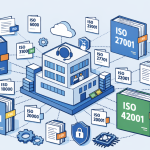
ISO standards can help to organize and improve the quality of customer contact. Which ISO standards are available and from which…
-
ISO 42001 is an international standard for setting up, implementing, maintaining and improving an Artificial Intelligence Management System.
-

Calabrio has certified its AI management according to ISO 42001, a global standard for artificial intelligence management.