
Following the ruling of the court of The Hague in a dispute between Teleperformance and an employee about login time and (paid) working time, Ziptone made a tour of customer contact land. How do other contact centers deal with the preparation and login time?
 First back to basics. The contact center almost always works with clearly defined services – necessary from the WFM-driven production model. However, the contact center is not unique in this: we also have tight schedules in other sectors. A pilot must be on time to do flight preparations prior to a flight – for example, reading weather and traffic reports. The question of whether or not preparation time is part of working time has therefore often been submitted to the courts. On the basis of jurisprudence concludes Advocatie that the employer must pay if it considers it important that the employees come earlier and/or stay longer. If the employer does not pay, it cannot draw any consequences if an employee does not comply with the rules. In other words: no wages, no consequences in the event of a violation, regardless of whether the rule is laid down in work regulations, for example.
Sit ready
In any case, employees must be ready when their shift starts, something that the Customer Service Federation also states in a response. “It is an interesting case,” says Wietse Westerhuis on behalf of the KSF. “It is sad that it had to come to this. In many organizations it is customary for you to arrive at work a little earlier to prepare, to get things ready or to get started. But where do you set the limit of what is paid or not if, for example, you have to start up 10 systems before you can actually pick up your first call? This is no longer of this time, you will say. Now that this has ended up in court, this has become a matter of principle. The question we ask ourselves is how good the employment relationship and employment conditions are if it can come to that.”
According to the KSF, FNV already indicated last year that employees at Teleperformance, for example, are not reimbursed for their bathroom breaks. “Then it hits us. If you, as an employer, become so keenly involved in the competition, then, as far as we are concerned, there is no longer a healthy working relationship. It is therefore very understandable that you, as an employee, are very focused on this.” The KSF calls the employment relationship a matter of give and take – that goes both ways – but also believes that employees should simply be paid for work-related activities.
The CNV trade union has already put the subject on the agenda in December 2021, both towards the rank and file as in the collective labor agreement negotiations. "We believe that your working time starts the moment you open your laptop and do the first login, login time is working time," the union said on its own website. According to a rough calculation, full-time agents could miss out on more than 900 euros gross on an annual basis.
Bringing you into shrinkage?
The alternative is for the WFM to include the time required to log in in the shrinkage calculation, but that doesn't seem common and it makes planning and scheduling extra complex. Another option is to set up the application landscape in such a way that there is single sign-on and that underlying systems are started up very quickly. The case published by De Telegraaf involved logging into approximately ten different systems, which turned out to take 6 to 20 minutes, something that is not unique to facility contact centers.
How do other employers deal with this in customer contact?
Back to practice. Ziptone made a tour of various contact centers. As it turns out, the working method used by Teleperformance is not unusual in both facility and in-house contact centers.
At Sports Unlimited Retail employees are not 'obliged' to be present earlier in connection with logging in, which incidentally takes no more than a minute. “Employees have to turn on the computer and start up one system. These minutes are not formally registered or paid out. Of course there are colleagues who like to start very quietly and they are then present earlier on their own initiative,” says Chantal Rovers, customer care manager.
At facility contact center ContactCare is it “not black and white”, says founder Jasper Meerding. He points out that the necessary systems are started up within 1 to 2 minutes via the employer's laptop. When working from home, the start of attendance cannot be checked via a time clock or tag system, so hours charged to clients are booked (per project and in different ways) and explicitly checked. “Login time is working time, but within reason, and when systems don't work, you still get paid for your rostered hours or the fixed scope of your contract.”
Jelmer IJbema, manager WFM at facility contact center 5CA indicates that the rule is to pay out 10 minutes before working hours and 10 minutes after working hours (for those who were logged in). “This is because you have to prepare and often cannot be ready to the minute,” says IJbema.
“It makes sense that you are there a little earlier”
Sunweb currently does not pay for the preparation time (usually XNUMX minutes in the morning, both for logging in and for the stand-up), says Andre Tuinenburg, head of customer care. “But we see it as fair to do that,” just like continuing to work after a shift has ended, which is paid.
At DPG Media preparation time is not considered working time. It is only normal, also with other jobs, to arrive at work a little earlier, says customer center manager Carmen Vriesema, “Logging in takes a few minutes, especially for colleagues who work from home.”
This view can also be heard from some facility managers (who do not wish to be named), whereby in some cases the short breaks to which employees are entitled during work are paid. “In many industries it makes sense to be there a little earlier to start your shift on time, such as in the hospitality and retail industry. This is the most normal thing in the world,” said one of them. “There are only a few clients who are willing to pay for this time, thus enforcing efficient work. While the margins in our sector do not allow us to reimburse that ourselves.”
“Flexible start and end times”
Rad Power Bikes uses flexible start and end times and places the responsibility with the employee. With us, they are usually highly educated and work in several languages, says Geert Fiesler, customer service manager. “With us there is no relationship between salary and login time.”
Facility contact center Continuum Global Solutions does pay for the so-called set-up time – if applicable. “We continuously monitor the speed and user-friendliness of our own systems and the client's CRM systems, because we strive for a minimum set-up time at all times. Not only to minimize costs, but also to maximize the user experience,” says Peter Brouwer, senior director.
At Gemeente Amsterdam the preparation time for the work (such as reading in, going through the latest instructions and the like) falls under working time and is therefore paid. The employees put themselves on 'available' as soon as they have read all the information. One time this can be after 2 minutes, another time it can take 10 minutes, according to a spokesperson for the municipality of Amsterdam. However, logging into the systems (approximately 2 minutes) does not fall under working hours. In the past year, the Services Department has discussed this at length with the Services Committee (OC) Section of the Works Council. Together we came to the conclusion that logging in does not fall under working hours. “We also received the judge's ruling last week and are currently looking at whether we need to adjust our process,” said the spokesperson.
Conclusions
Whether or not login time counts as working time has both an organizational (planned) and a financial side. In addition, the court is generally clear in its judgment as to whether or not payment must be made for preparation time. Employers' association AWVN also makes it crystal clear on the basis of a recognizable example when you as an employer have to pay for preparation time.
However, Dutch contact centers deal with both the labor law and organizational side in different ways, as our tour shows. It just depends on how that preparation time is used: needed to log in to multiple systems, go through your intranet, attend the daily standup, adjust your chair height, get coffee. It is then up to the employer to be clear about what is expected and to make clear agreements about this - including whether or not to pay for this time. In case of uncertainty, the employee usually gets the short end of the stick; ambiguity also contrasts with the tight frameworks of the contact center or, for example, with a Great Place to Work label.
Good employership?
If permanently keeping the ball high – read: continuously ensuring good accessibility and service quality within tight frameworks – is really part of the distinctive character of companies, then it is inevitable that employees should be facilitated in this and rewarded accordingly. The question then is what constitutes a good reward: work to be done for the KSF. Another way to arrive at clear frameworks about whether or not to pay for preparation time is to set quality standards, including an effective form of enforcement. It looks like there's plenty of room for that. (Ziptone/Erik Bouwer)


Also interesting
-
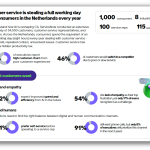
Dutch consumers spend an average of eight hours annually on customer service: waiting, calling back, problems that are not resolved.
-

This summer, facilities contact center ContactCare is expanding with a new branch in Antwerp.
-

BPO service provider ContactCare has opened a new location on Dr. JF Nassylaan in Paramaribo.