
Remember this? During the coronavirus pandemic, the Municipal Health Services (GGDs) offered generous hourly wages to fill the seats on their COVID-19 hotlines. Even after deducting substantial initial investments, this resulted in a spike in annual revenue for a small group of facility contact centers.
After the coronavirus pandemic, regret came: customer service wages weren't going down. It's no coincidence that outsourcing to low-wage countries gained momentum afterward. Not only was it an attractive growth market for Dutch facility contact centers, but it was also a welcome escape for companies that considered 14 euros an hour far too much for their business cards.
Meanwhile, wage increases continue in the 'home market'. A year ago, Ziptone already determined with a quick scan that wages for customer contact employees in July 2024 had risen to 15 to 17 euros; before corona this was around 11 to 12 euros.
FNV is being overtaken on the left

Image: ChatGPT/AI
Although the minimum wage is currently officially €14,40, the FNV is aiming for €16 for next year. The union is being overtaken by the merger party. GroenLinks-PvdA who wants to raise the minimum wage to 18 euros per hour. The SP and NSC also support a minimum wage of 18 euros.
However, raising wages will yield little if there are too few people available. According to Statistics Netherlands (CBS), our working population will remain relatively stable in the coming decades: around 11 million people. Only after 2040 will modest growth resume, with a projected size of around 11,1 million in 2045. That sounds reassuring, but it should cause sleepless nights. The labor market shortage will continue to worsen in the coming years due to a sharply growing demand for labor.
In healthcare alone, the shortage will reach 300.000 professionals by 2034; by 2040, the Social and Economic Council (SER) expects a shortage of half a million people in healthcare. If other sectors with serious shortages are included – such as education, technology, and construction – the shortage will reach approximately 2030 million people by 1,4 (approximately one to three cabinets later).
Gravel pit
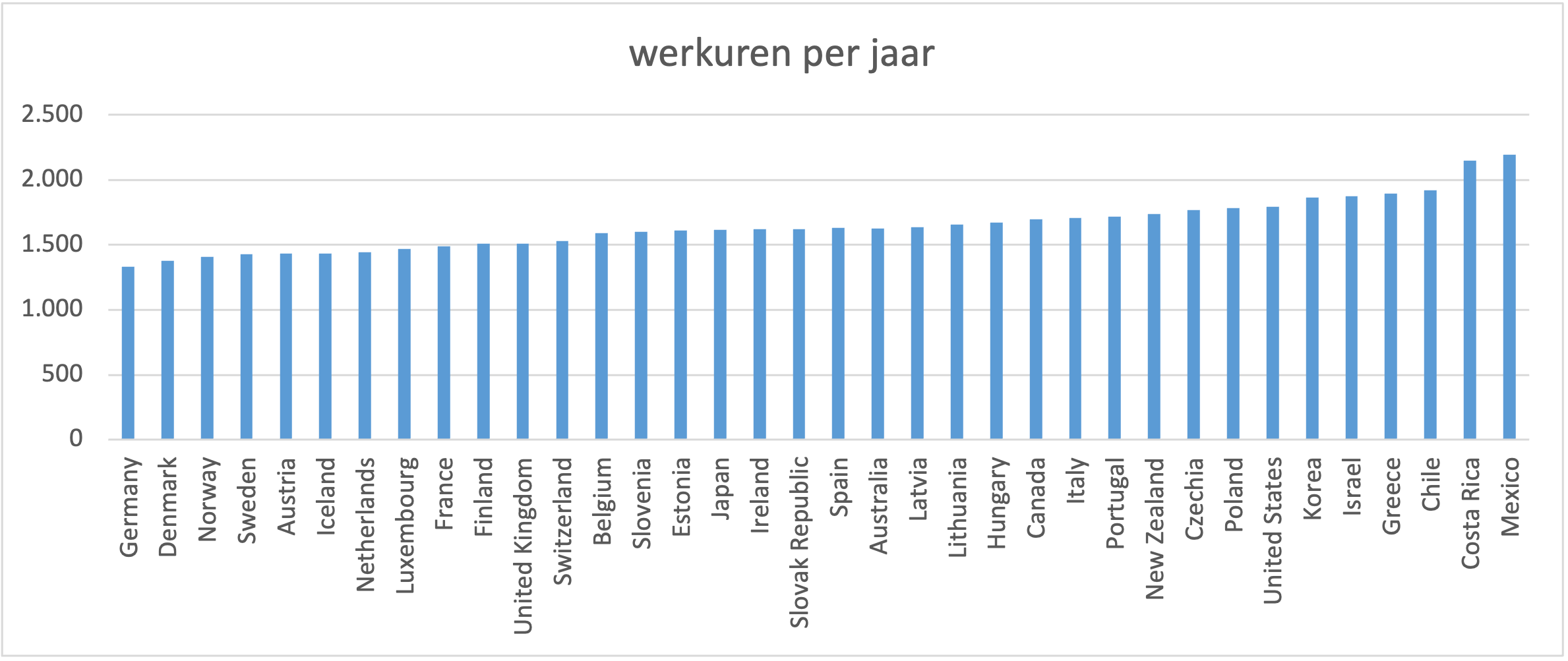
Click to enlarge – Source: OECD
Fortunately, we still have a few escape routes to keep our economy from ending up in the gravel trap. The average number of working hours per employee in the Netherlands is among the lowest in the worldEven though our labor participation rate is relatively high, we can and should really work more hours. So stop with AFAS tendencies like a four-day workweek, unless you answer the phone on that fifth day or deliver coffee in elderly care. Or is AFAS's product simply 20% too expensive?
According to the Ministry of Social Affairs, 273 of the 665 collective labor agreements contain provisions on early retirement. These are relevant to a staggering 6,1 million employees, or 92 percent of the workforce – while continuing to work longer would be more appropriate. And we still have 380.000 unemployed people and approximately 246.000 Wajong recipients. These last two groups are calling for a New Deal.
Other solutions? Experts suggest labor migration and increasing productivity (so not just working more hours, but also adding more per hour). For customer contact, this means automation; outsourcing also benefits our labor shortage and means a better offer at lower costs for employers and outsourcers.
Delta Plan Customer Contact

Image: Gemini/AI
In any case, according to the not-yet-established PvBK (Party for Better Customer Contact), it's time for a national Delta Plan for Customer Contact. Some points from that plan:
- Agents' hourly wages will only increase if the tax burden on employees and employers decreases proportionally;
- Marketing should reallocate 50% of its budget to customer service. This is the 50% that marketers know is wasted money;
- rules-based chatbots will be banned;
- AI-based chatbots should only be put into production if they perform as well as an employee with 6 months of work experience;
- Every contact center that replaces an employee with AI and retrains them to become a healthcare worker will receive a substantial subsidy.
Work from your parents' house
While regular businesses have to earn money before they can spend it, the Amsterdam municipality seems to have already taken an advance on the new hourly wages. For a job as a customer service representative at MBO-4 level, the hourly wage is between 17,31 and 19,94 eurosAnd on top of that, there's travel allowance, pension accrual, and a year-end bonus. It's just a shame that with this generous salary, housing is impossible, and the Dutch Railways (NS) is raising the fares again. That means working from your parents' home (WFYPH). Otherwise, everything will be fine.
I wish you a pleasant campaign period!
(Ziptone/Erik Bouwer)


Also interesting
-

In our field, 'operation failed' rarely means 'patient dead': the customer simply calls again.
-

The organization behind the COPC contact center management standard is launching a CX Awards program.
-

René Kloppenburg has been appointed VP Customer Process at KPN, effective January 2025. Until January 2025, he was…