
 How do you embody corporate digital responsibility when it comes to deploying bots and robots? A tip from Professor Gaby Odekerken: put yourself in your own customer's shoes more often.
At the very bottom of her LinkedIn profile, Gaby Odekerken, Professor of Customer-Centric Service in Maastricht, lists "common mistakes about my name," followed by several misspelled variations of her surname. She noted this so that it can be found even if visitors misspell her name, providing a practical reason.
But being addressed incorrectly also happens regularly in real life, Odekerken explains. “For example, with 'sir.' Or when I went to a store in 2010 to be fitted for my robe. I did it with my family: my husband and our daughter. My husband was the one who was addressed: how nice of you to come and fit me for a robe. There's a huge gender imbalance in our field anyway. For a long time, I was the only female department chair and still in the minority as a female professor within our School of Business and Economics. We currently have about 13% female professors. But it's improved: about seven years ago, it was only 6%.”
Gaby Odekerken is a professor of Customer-Centric Service Science at the Department of Marketing & Supply Chain Management, School of Business and Economics, Maastricht University. Her research focuses on customer experience and technology, among other topics. Her research has been published in international journals such as the Journal of Marketing, Journal of Service Research, Journal of Retailing, International Journal of Robotics, Journal of the American Medical Directors Association, Journal of Service Management, Journal of Services Marketing, Journal of Business Research, European Journal of Marketing, The Internet and Higher Education, and several others.
Physical robots vs. a static check-in column
Odekerken has published extensively on service robots. "These are all robots that interact autonomously with the customer," says Odekerken. Production robots in a factory or warehouse are therefore not included. "Such a service robot may or may not be 'embodied.' Embodied is when a robot approaches you at Schiphol and guides you to the gate. A chatbot isn't embodied. In both cases, the robots are fed protocols, standard operating procedures, a tone of voice, and perhaps even a personality.
"Us research shows That with a physical robot—think of a robot that approaches you in a bank—you experience more social presence than when you type something into a check-in kiosk to register at a hospital. We see the same thing in hybrid meetings, for example, when you give a digital participant in a physical meeting a physical seat at the conference table via a telepresence robot. In that case, you experience more social presence and there is a richer interaction with people who are physically present.
Robots in collaborations
At Maastricht University, we use problem-based learning in small groups of up to fifteen people. In several courses, we've had someone who, for whatever reason, cannot be physically present participate with a telepresence robot. If one of those fifteen isn't a physically present participant, but a robot, with the face of the virtual participant projected into the robot's head, we hardly see any difference compared to in-person attendance. There are, however, significant differences compared to online attendance via Teams or Zoom on a screen. If you also share slides on that screen, the image of that online participant becomes even smaller. When someone sits at a table via a telepresence robot, they look at the same screen as the other participants, instead of being part of it. In the collaboration, you see that their voice is heard more. This offers prospects for sustainable meetings and collaboration.
The responsible use of conversational agents
Anyone getting started with "digital"—and who isn't already doing so in customer contact—needs to consider its impact. In other conversations in this series, it's been argued repeatedly that digital can easily go too far. Last year, Odekerken and colleagues wrote an article about the responsible use of conversational agents, in relation to Corporate Digital Responsibility (CDR).
It's important to realize that, especially in a service context – which is relatively intangible – the role of digital technology is increasing. How do you introduce this effectively? What are the risks? Karim Sidaoui (Radboud University), Dominik Mahr (Maastricht University), and I have developed a framework for this and published it in [website text]. Organizational Dynamics. It's primarily an opinion piece. That makes it an outlier in my publications, because I usually bridge the gap with practice through my publications, based on field research.
Accessibility and inclusivity
The topic of CDR is rapidly gaining relevance. I see this in my work as chair of the Supervisory Board of a large long-term care institution with 5.000 employees, where accessibility and inclusivity—both physical and cognitive—are a challenge. A significant number of employees and clients have low literacy. If someone explains, "You need to scan this QR code, click that link, and then use multifactor authentication to approve," that's Chinese for a large portion of the people. Inclusivity in services isn't just about hearing or visual impairment, but also about cognitive impairment: are we still using the language that resonates with our target groups? Are we sufficiently gradually introducing everyone to the digital transformation?
Hostess next to registration column
In Limburg hospitals, a hostess stands next to the check-in kiosk to help people with identification. For people from our own bubble, digitalization isn't an issue, but there's still a large group who write their shopping lists with pen and paper. At the same time, our research has shown that physical robots do indeed offer significant added value in mental healthcare, for example. While the response from healthcare workers, informal caregivers, and funders—the supply side—is often hesitant, the client often reacts positively. Of course, we'd prefer everyone to have 24/7 support from a human staff member. But with the current healthcare gap, that's no longer possible.
Everything and everyone moving towards a chatbot, does that work?
CX specialists and contact center managers prefer to force all customers through the same process, such as "all to the chatbot first." The question arises: shouldn't we be talking to each client or customer more often to determine what works and what doesn't for each individual?
Yes, and then you'll discover that there's no universal solution. In our CDR article, we talk about 'customization' as a key element of CDR culture. We don't mean personalization, but rather customized service delivery. There are all sorts of ways to organize this customization. For example, by asking how someone wants to receive their information and how often. We can still make significant progress in this area in a CX country.
Expectation management
In customer contact, it's not the customer, but the company that knows the "scope" of a chatbot. For the customer, it's often a matter of trial and error to figure out how far the chatbot can help and when it gets stuck. What can we improve here?
From a marketing perspective, I say: start with managing expectations. Make it clear which topics you can ask the chatbot about. You'll also need to guide the customer through the chatbot's use. The chatbot itself is a useful tool, patient and neutral.
“Everyone I talk to about chatbots talks about frustrations.”
Some companies have also set up a system where phone numbers can only be released via the chatbot. How should we view this in relation to corporate social responsibility?
"No, I don't think so. But let's assume companies aren't doing this because they want to annoy their customers. One reason could be staff shortages. Another could be that the company wants to experiment with AI to keep customer service affordable in the long run. Are we allowing companies to create a kind of playground? At the same time, everyone I talk to about chatbots talks about frustrations."
Automate trivial questions
Keeping services affordable is also a factor in the hospitality sector. In a restaurant, you can have two robots replace one waitress or waiter. The host takes the dishes from the robot and serves them. This prevents the host from having to constantly run to the kitchen, creating more time for chatting with the guests. In another pilot project we conducted with our Maastricht Center for Robots at our university library, we found that the librarian is freed from 80% of the recurring trivial questions (such as "Where can I find my reserved study spot?") from new student intakes thanks to the use of a robot. It's about cost savings and freeing up people for tasks they excel at. It's all about balance.
Test your own chatbot
Companies can sometimes tip this balance in the wrong direction, as we've seen with rules-based chatbots. What can customer service managers and contact center managers do to better manage this balance?
I'd like managers to ask themselves: would you want to be in your customer's shoes? Or more specifically: am I happy when, as a customer, I ask a question of my own organization? You could, of course, argue that you should do that with a panel and a focus group, because that's representative. But just do it yourself sometime. Test your own chatbot. If you're not happy with the results, I think you still have some homework to do.
(Ziptone/Erik Bouwer)


Also interesting
-
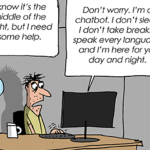
Chatbots can provide great experiences and cause as much frustration as waiting on the phone.
-
The results of the research into municipal chatbots have been shared by the researchers, who previously wrote about their findings.
-

The Netherlands Gambling Authority has provided gambling companies with guidelines on the use of chatbots and artificial intelligence.