
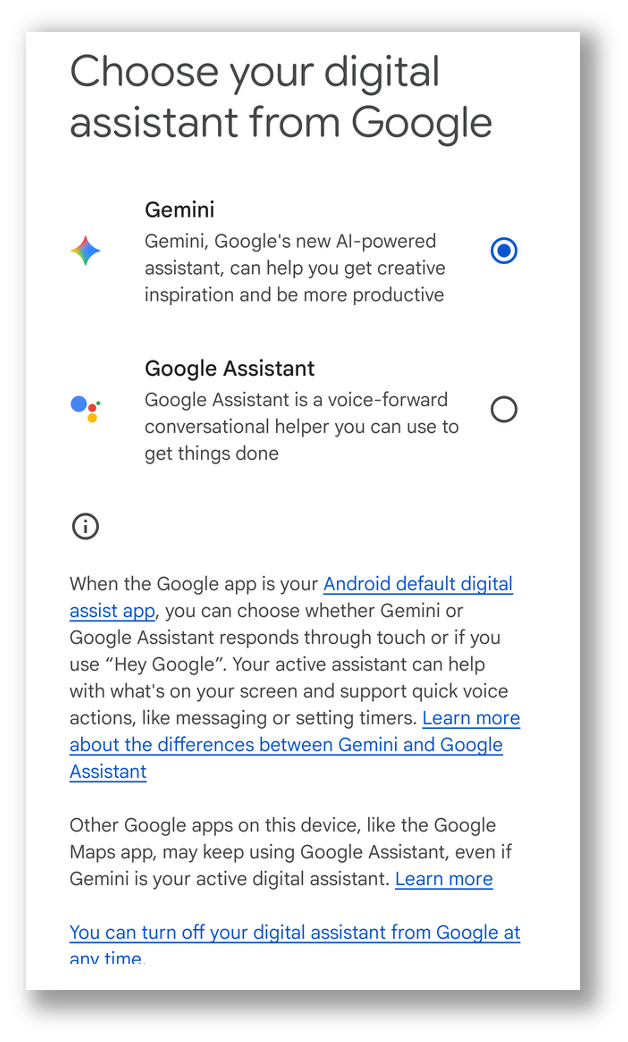
 On September 4, 2026, Google begins removing the Assistant app from Android phones and paired devices. With this, the last remnant of a platform on which companies could once build their own voice services disappears. That capability itself was already eliminated in 2023.
The phase-out concerns Android phones and tablets, Wear OS watches, headphones, earbuds, and cars running Android Auto via the phone. Cars with 'Google built-in' are excluded, as are Google Home speakers, smart displays, and Google TV. However, those devices will not continue to run Assistant; Google is converting them to Gemini for Home via a separate process. Anyone wishing to install Google Assistant in early August 2026 received a message stating that functionality is limited, along with the option to switch to Gemini.
Rule-based chatbot
Google launched the Dutch-language Assistant in July 2018. The idea behind the platform was grand: companies could expand their services by, in particular, having frequently asked questions handled via the assistant. This allowed brands to build their 'own voice' within a rule-based voice assistant.
The Assistants from Google, Microsoft, Amazon, Apple, and Samsung latched onto the idea that voice control was the most logical interface for communicating with companies and systems. These companies each invested in setting up complete platforms and ecosystems.
Call
 There was also a significant practical hurdle: each brand had to provide its own 'invocation', needed to start a conversation with the right assistant, such as 'hey PostNL' or 'talk to Rabobank'. Once correctly connected, you could communicate via voice with the chatbot of the company in question. This was possible via Google's own hardware and from your phone, where Google Assistant could be installed as an app. Adding to this was the fact that it was nowhere to be found which companies you could actually call upon. Another limitation: for general questions, the assistants could only refer to search results on the internet; you could therefore not engage in a substantive dialogue with them. Consequently, “I don't understand you” was a common response.
Short-lived hype
Nevertheless, the introduction was met with enthusiastic reactions from brands wishing to join the platform: Albert Heijn, KLM, Transavia, PostNL, Rabobank, ING, Jumbo, Essent, Eneco, MediaMarkt, Bol.com, Rituals, Centraal Beheer, the NOS, and the NPO. Airline KLM presented itself at the time as one of the first companies in the world with a Dutch-language service on the Google Assistant.
Additionally, the Assistant served as the base for simple commands (such as timers, reminders, navigation, phone calls, and smart home control) and more advanced commands in the form of so-called 'actions'. More complex actions, whether or not including other functionalities, could be programmed using solutions like If This Then That (IFTTT).
Those branded services didn't make it. Google announced the Sunset in June 2022 and set Conversational Actions for June 13, 2023. definitely out. A year later, on July 31, 2024, also closed Google Business Messages, the chat channel through which customers could contact a business directly from Search and Maps. The period in which brands could build their own voice within the Assistant thus lasted five years. What disappears on September 4 is the assistant itself.
Top or flop?
Google only provided selective figures regarding the success of the platforms. In January 2020, the company spoke of more than 500 million monthly Assistant users; for Gemini, it reported 950 million monthly users in the second quarter of 2026. How many people are still using Assistant now has never been disclosed. Doubts had already arisen earlier regarding the range.
There is, however, an exception when it comes to successful call deflectionVarious hotel chains have deployed Google Assistant or similar alternatives to intercept customer inquiries that were normally directed to the reception desk. One of the other practical objections to, for example, Google Assistant as a base for contact with corporate chatbots was the lack of clarity regarding which companies one could call upon.
The same fate for Alexa, Bixby, Siri, and Cortana
With virtually every provider, the first-generation voice assistant has been replaced by a generative model. At Amazon, Alexa+ came onto the market, which on February 4, 2026 rolled out nationwide in the United States and is free for Prime members. Microsoft removed the standalone Cortana app from Windows in 2023 and replaced it with Copilot. Apple signed a multi-year agreement with Google in January 2026, worth approximately one billion dollars per year according to Bloomberg, to to rebuild Siri on a Gemini model running within Apple's own Private Cloud Compute. Samsung chose a third way and placed on the Galaxy S26 Three assistants side by side: Gemini for agentic tasks in external apps, Perplexity for search queries, and a revamped Bixby for device control.
There is also specific criticism regarding the transition from the deterministic Google Assistant to Google Gemini. For exact commands, such as turning lights on or off, deterministic flows work better than generative AI. Furthermore, referrals are not yet always successful; consider podcasts, news and radio stations, third-party music services, and Interpreter Mode.
With the phasing out of Google Assistant, the final layer of an architecture in which a brand could claim its own space within the assistant to steer dialogues disappears. In fact, that space had already ceased to exist since 2023. Now, LLMs decide where the answers to questions come from.
(Ziptone/Erik Bouwer)


Also interesting
-

Premature deployment of GenAI chatbots and virtual agents for customer contact will lead to increased consumer skepticism, according to Forrester.
-

That annual Christmas dinner... it's surprisingly similar to the WFM meeting in a typical customer contact environment.
-

The concept of 'connection' was the 1500th word in the Ziptone dictionary. Ziptone reader Claudia earned a cake for it. But what happened…