
 The deployment of AI in the public sector is slowly gaining momentum, including at the service desks and in the customer contact centers of Dutch municipalities. Experimentation is taking place, but large-scale deployment is not yet common. This is evident from the second edition of the AI Monitor Municipalities by consultancy firm M&I/Partners.
In 20 of the 30 participating municipalities, active experimentation with AI is currently taking place; in the 2024 study, this was lower. Service delivery is one of the work areas where AI is being deployed. 87 percent of the 30 municipalities participating in the research those who participated from consultancy firm M&I/Partners use tools such as ChatGPT, Microsoft Copilot or the Dutch SafeGPT.
A small number of municipalities indicate that they are developing AI applications themselves, or intend to start doing so. These involve applications aimed at providing access to the knowledge base or chatbots for the Customer Contact Center. These are mostly internally focused applications.
AI initiatives at odds with policy and regulations
Only 27 percent of the surveyed municipalities actively choose European AI applications over non-EU AI. Only a few municipalities have a policy in this area, while almost all respondents cite digital sovereignty, privacy, and information security as key areas of focus.
Source: M&I Partners Research
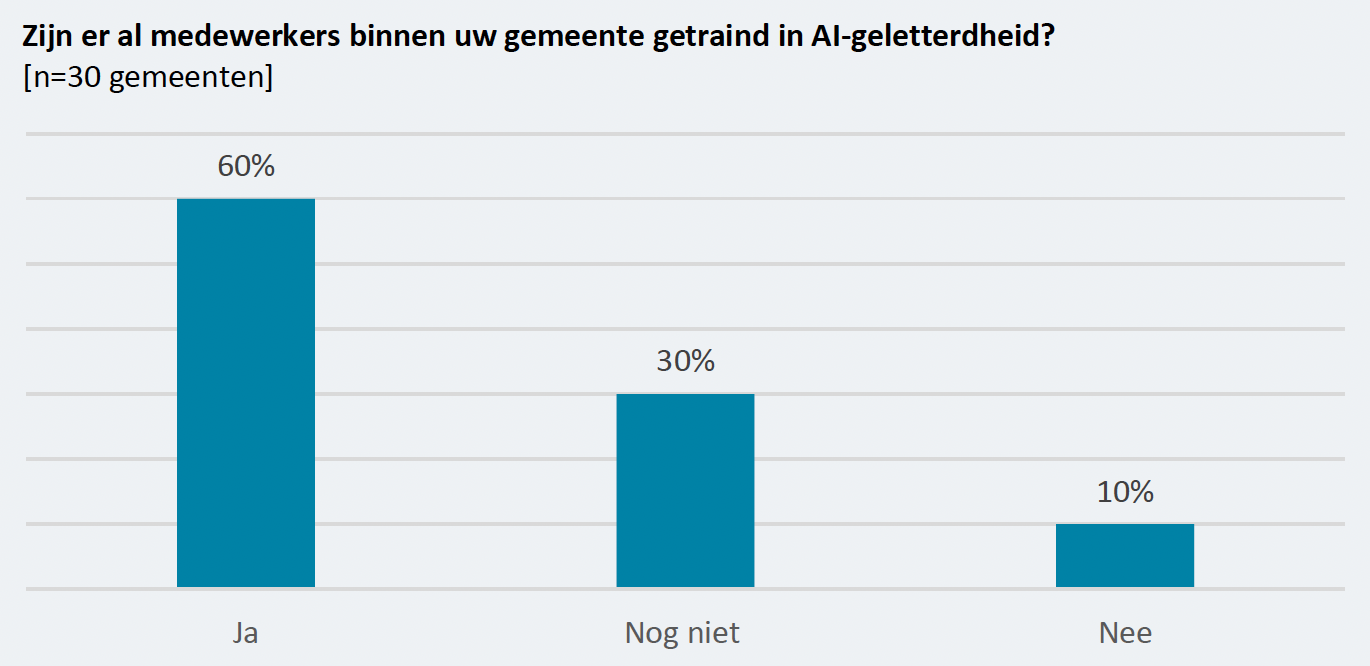
AI literacy is also not keeping pace with policy and regulations. A majority of municipalities (60%, n=18) indicate that employees have already been trained in AI literacy. This is not yet the case for 30% (n=9), while 10% (n=3) indicate that no employees have been trained at this moment.
The AI Monitor Municipalities 2025 is the second annual study by M&I/Partners into the state of AI in Dutch municipalities. The study is not representative, but combines a survey of thirty municipalities with three in-depth interviews. Of the respondents, seventeen municipalities are small (fewer than 60.000 inhabitants), six are medium-sized, and seven are large (more than 100.000 inhabitants). The interviews were conducted in Wierden, Dijk en Waard, and Haarlemmermeer.
(M&I Partners)


Also interesting
-

Premature deployment of GenAI chatbots and virtual agents for customer contact will lead to increased consumer skepticism, according to Forrester.
-

Will the human touch disappear as we further automate customer contact, or will technology actually make it possible to provide real customer service?
-

We started with AI, but have no idea where it will end. Maarten Oosterhoff thinks it is time to…