
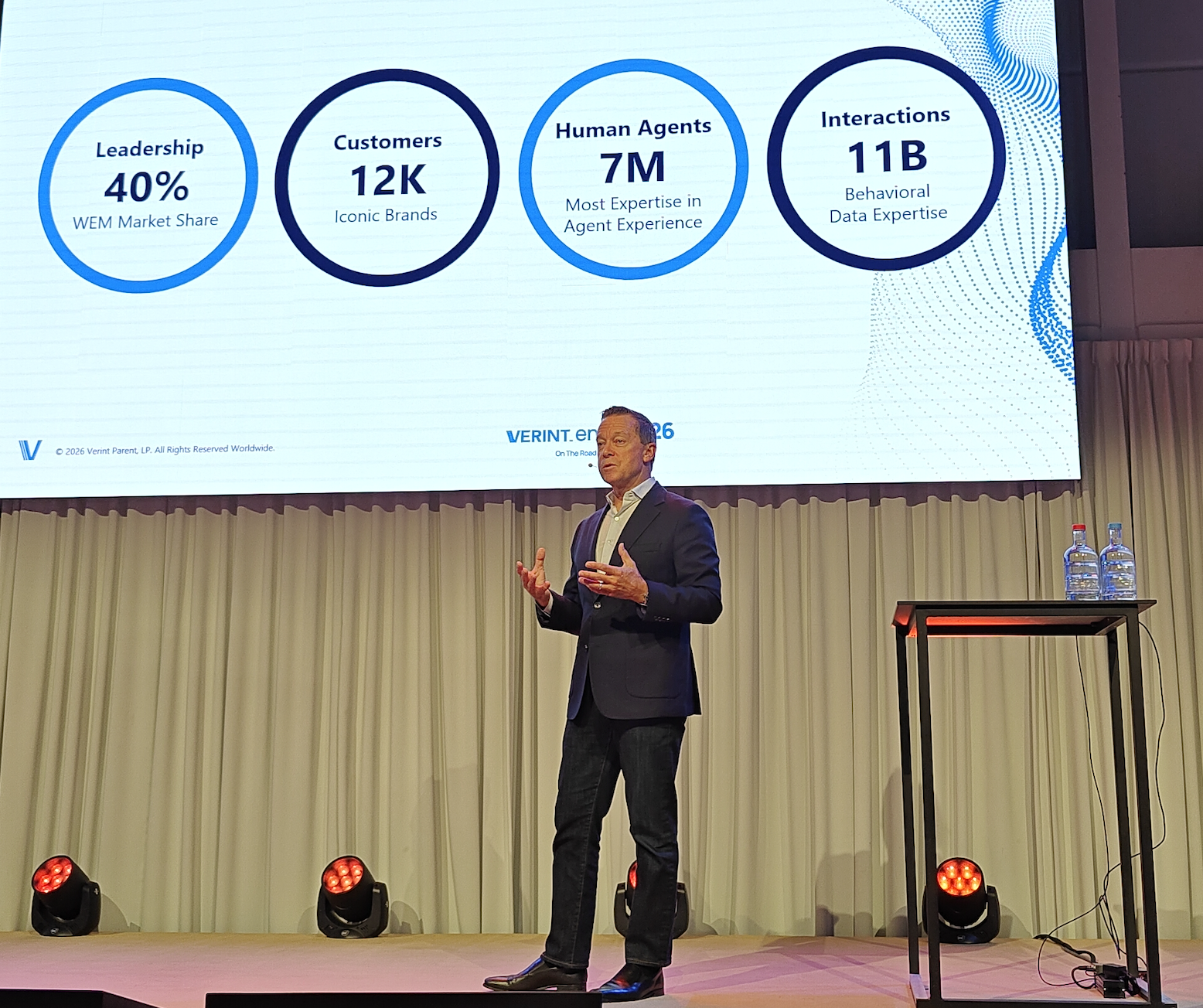
Dave Rhodes, CEO Verint – Image: Eveline Meijer
AI does not replace humans, but supports them. That message is repeated several times during Verint Engage on the Road Benelux 2026. The day is largely dedicated to AI, but 'transition' is also a recurring theme.
Text: Eveline Meijer
“You and your agents are crucial to your business,” kicks off. Verint CEO Dave Rhodes the day ends. “Your interactions make the difference between a customer for life and a customer with a bad experience who never returns.” So there is much to gain, and AI can help with that. But that is far from always yielding what you expect. “There is a large gap between the promises of AI and what companies see in the results. AI investments are increasing enormously. But for many brands, those results are not materializing.”
Rhodes identifies three causes for disappointing results: companies have too many choices, preventing them from starting anything; or they remain stuck in the pilot phase for too long; or the AI applications are not suitable for their task.
Organizations are searching
Customer stories from Verint Engage 2026 reveal that developing effective AI applications is still a work in progress. Take Eurocross Assistance, an emergency call center for various insurers. There, they are looking into, among other things, the automatic summarization of calls: AI makes a suggestion, after which the support worker checks what goes into the file.
But that is easier said than done, he says. Joann Noslin, business analyst at Eurocross. “We talk to a lot of parties: customers, clients, recovery services, garages, et cetera. All those conversations require different summaries.” However, people usually don't say on behalf of which organization they are calling, so the AI must be able to determine who is on the line. “And many employees work in a file. They all need to quickly understand what is going on.”
How does Eurocross tackle such a complex process? With clear agreements. “We have human oversight: the care provider checks the summary and remains responsible. And we are starting in a controlled manner: we started small and are not yet fully automating.” Furthermore, Eurocross maintains close contact with employees and encourages them to use the AI and provide feedback. “We compare the AI summaries with the adjustments employees make. We discuss any patterns we observe with the pilot group and refine the prompts based on that.”
New pension system
Another organization in transition is pension provider APG. It is implementing the new pension law in phases for eight clients: the first switched in 2025, with the last following in 2028. Importantly, the participant must always continue to experience the same service, no matter how complex the transition is.
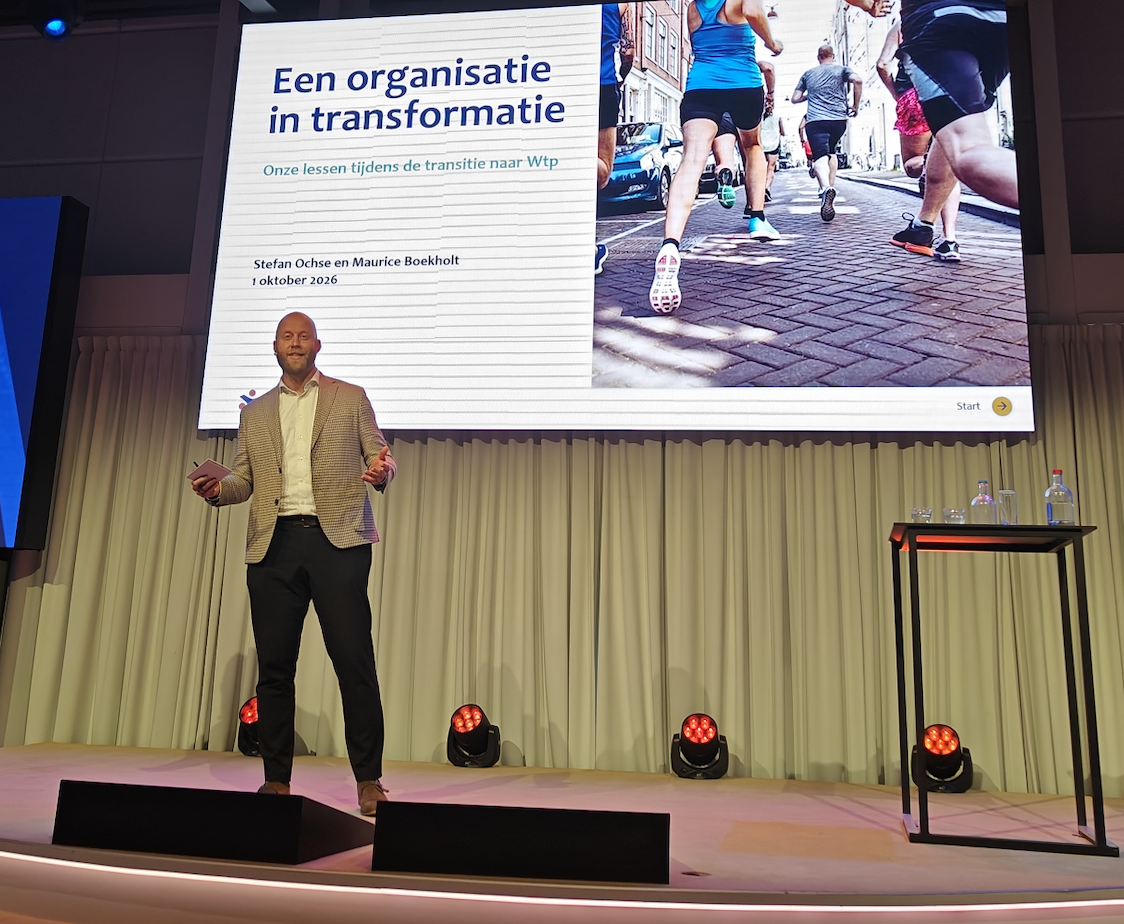
Stefan Ochse, APG – Image: Eveline Meijer
“During the first transition period, it was very tense: what was coming our way? We then set up a control room where all disciplines came together. And we used Verint’s Speech Analytics to make visible the impact our communication has on participants,” says Stefan Ochse, Head of GDC.
Moreover, APG focused on proactive customer communication. After all, certain phases in the process are fixed, so you can communicate about them in advance. And based on previous transition processes, APG can now predict what is needed and when.
What do you learn as a company from such a years-long process? “Predictability creates trust,” says Maurice Boekholt, Product Owner Participant Contact at APG. “Work with consistent messages and recognizable channels. Furthermore, insight makes change manageable. And the future of customer contact is proactive, rather than reactive.”
AI supports humans
The common denominator in the day's presentations is striking: AI and humans work together; one does not replace the other. That Verint itself views the technology in the same way became apparent during the presentation of the Verint CX Automation Platform. Martin Melissa, Director Solutions Consulting, demonstrates with colleagues how new additions support companies. With Agent Factory, organizations build and manage a hybrid workforce of humans and AI agents themselves, among other things.
In this process, AI detects and analyzes, but humans make the decisions. Workforce Intelligence, for example, warns a manager if waiting times or service levels exceed a threshold. The manager then uses a chatbot to identify the cause and possible solutions, such as offering overtime or moving employees to another queue.
QR Intelligence notifies a coach if there is a crucial error in a process, explains what is going wrong, and proposes a better working method that the coach must approve. And analysts can ask CX Intelligence about the main reasons for hotel cancellations. It then turns out, for example, that 41 percent prefer to rebook rather than cancel. The tool immediately makes suggestions to better organize that rescheduling.
Or, as Melis summarizes it: “AI is not going to replace people. People and AI work together.”
(Ziptone/Eveline Meijer)


Also interesting
-

Verint remains true to its own product portfolio: the company has no CCaaS ambitions, according to CEO Dave Rhodes.
-

Verint has appointed Teresa Anania as Chief Customer Officer (CCO). She reports directly to CEO Dave Rhodes.
-
Rhodes, who previously served as CEO of Calabrio prior to its merger with Verint, will lead the newly combined organization.