
Image: Eveline Meijer
Dutch consumers are becoming more hopeful about the possibilities of automated customer contact. This is evident from the results of the sixth National Voice Monitor, a study conducted by Y.digital and Markteffect in collaboration with the Customer Service Federation among more than a thousand Dutch consumers. However, this hope is far from always justified: annoyances about solutions that do not work properly are increasing.
Text: Eveline Meijer
The fact that the use of automation in customer contact is increasing is evident from the number of consumers who come into contact with such solutions. In 2024, a quarter of respondents came into contact with a chatbot every month and 22% with a voice assistant. A significant increase, because in 2022 it was still 16% and 11% respectively.
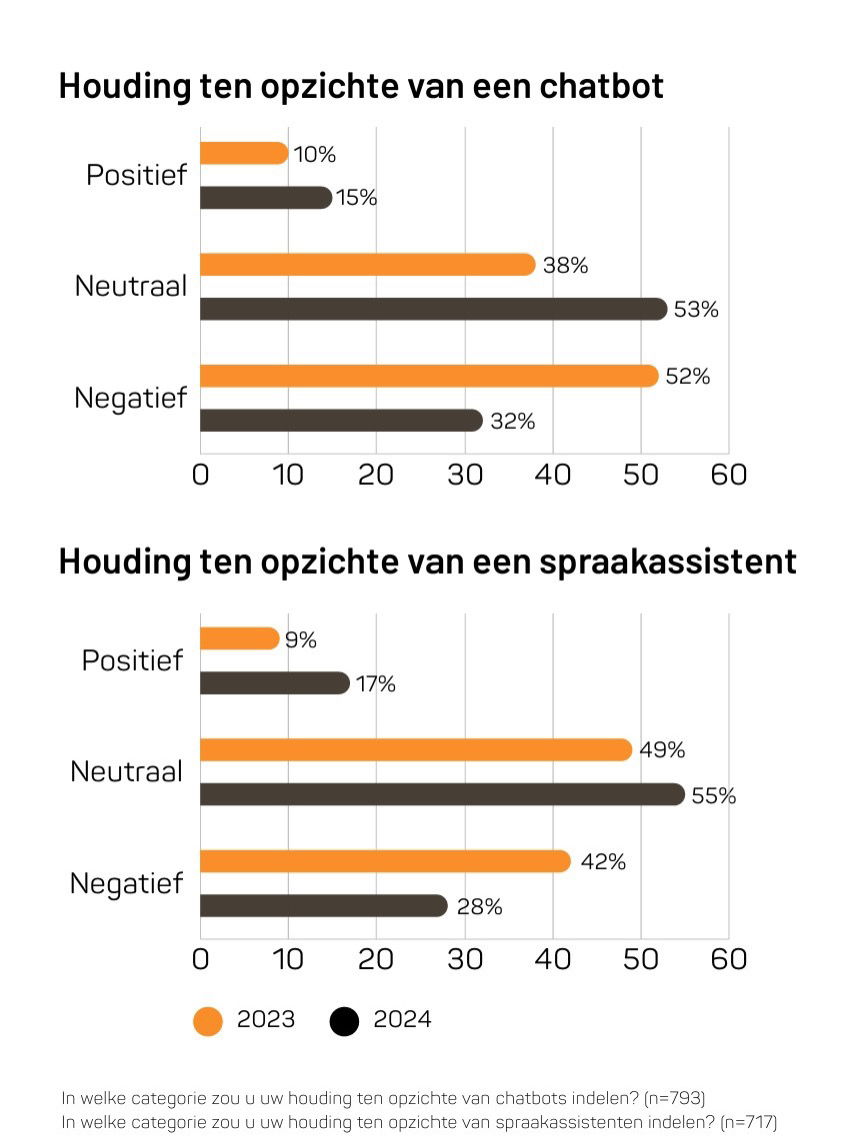
The Dutch are also less negative about such forms of customer contact. In 2023, 42% were negative about voice assistants and 52% about chatbots. These numbers have now dropped to 28% and 32% respectively.
Source: National Voice Monitor 2025
Annoyances are increasing
But Dutch consumers are not really positive yet. More than half have a neutral attitude towards chatbots (53%) and voice assistants (55%). Young people are more often positive: 25% of eighteen to thirty year olds have a positive attitude towards automated customer contact, compared to 7% of respondents between 56 and 65 years old.
The increase in AI in customer contact also goes hand in hand with annoyances about poorly functioning automation. For example, 48% of respondents are annoyed by poorly functioning chatbots and 38% are annoyed by poorly functioning voice assistants. Two years earlier, these were 42% and 34% respectively.
Stuck conversations
“A common problem is that chatbots do not always respond well to the specific question of the customer, causing conversations to get stuck in repetitive or irrelevant answers. This leads to frustration and a feeling of powerlessness, because the consumer does not feel heard or understood,” according to the research. This can have a significant impact: negative emotions often weigh more heavily in memories than positive ones. “Even if a chatbot works well in most cases, one frustrating interaction can make a consumer prefer to seek human help in the future.”
Not convinced yet
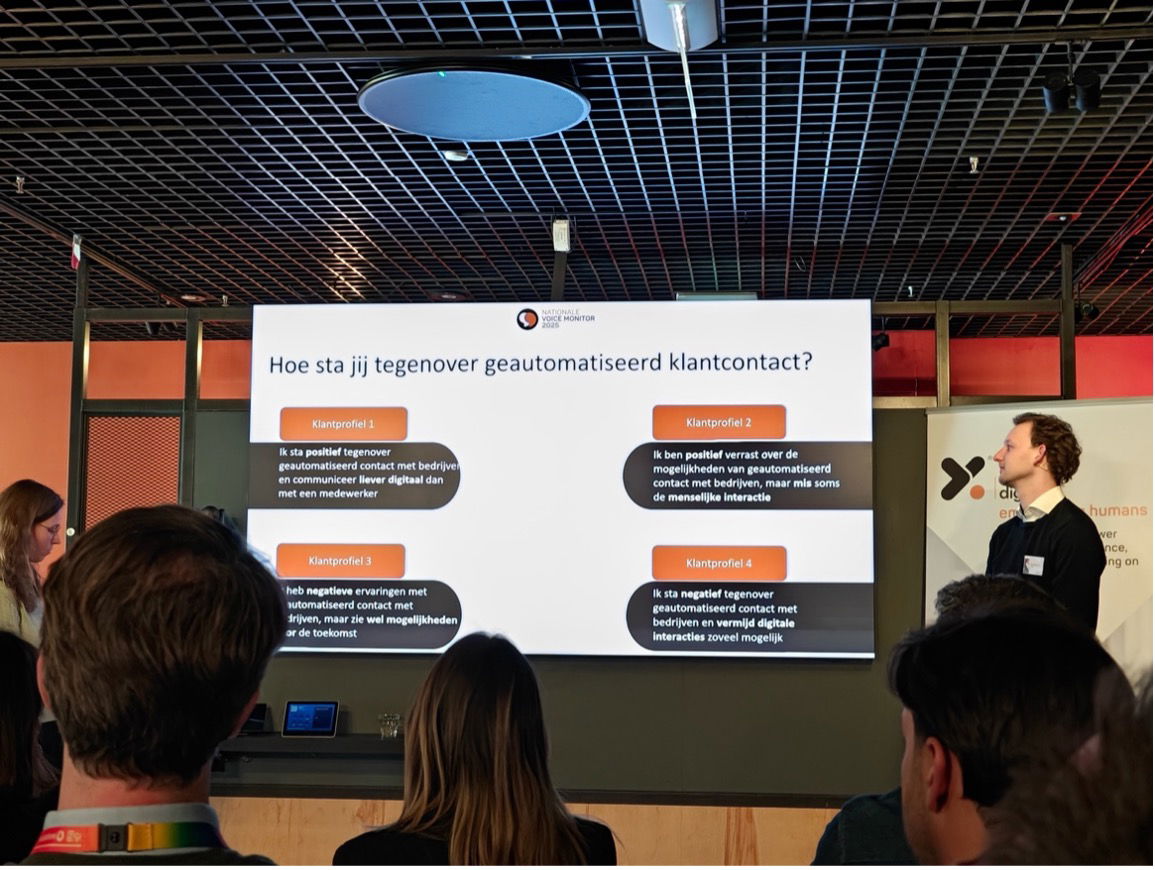
 Many Dutch consumers are not yet convinced about the use of automated customer service. Consumers can be roughly divided into four customer profiles, with the largest group being downright negative about these types of solutions, says Elise van Holsteijn from Markteffect during the presentation of the National Voice Monitor in Utrecht. 37% of consumers fall into the customer profile that is negative about automated contact with companies and avoids digital interactions as much as possible. “Older people are more represented in this group. They grew up less with digital resources. These people prefer to call, because they know that they will get someone on the line who will take them by the hand. They accept the long waiting times.”
Other research points in the same direction
The more negative attitude towards automated customer contact is therefore not an isolated case. Genesys' “The State of Customer Experience 2025” reveals that 53% of consumers still prefer a human agent to resolve questions and issues. However, American, British and Canadian consumers are more open to AI, with 72% of them saying in the Five2025's 9 Customer Experience Report that they are open to AI interactions, provided they can escalate to a human if necessary.
When does the chatbot work?
Source: National Voice Monitor 2025 – click to enlarge
Fortunately, there are also relatively many consumers who can be called hopeful. For example, 27% are positively surprised about the possibilities of automated customer contact, although they sometimes miss the human interaction. Only 10% are really enthusiastic about automated contact and prefer digital channels. According to Van Holsteijn, this mainly concerns younger users, who 'are more used to doing things digitally anyway'.
Automated customer contact is considered particularly useful for functional questions. For practical questions or questions about delivery and returns, 58% and 51% respectively are neutral or positive about automated customer contact. This may be because in these cases there is little need for empathy, in which automated forms of customer contact are even less powerful.
Consumers find it convenient that the automated options are also available outside office hours and that they are helped quickly. But 68% find it annoying that they are not always understood correctly and then have to repeat the question. They also complain that a chatbot or voice assistant can get stuck on a single question (55%) or even give an incorrect answer (52%).
Telephony remains the favorite
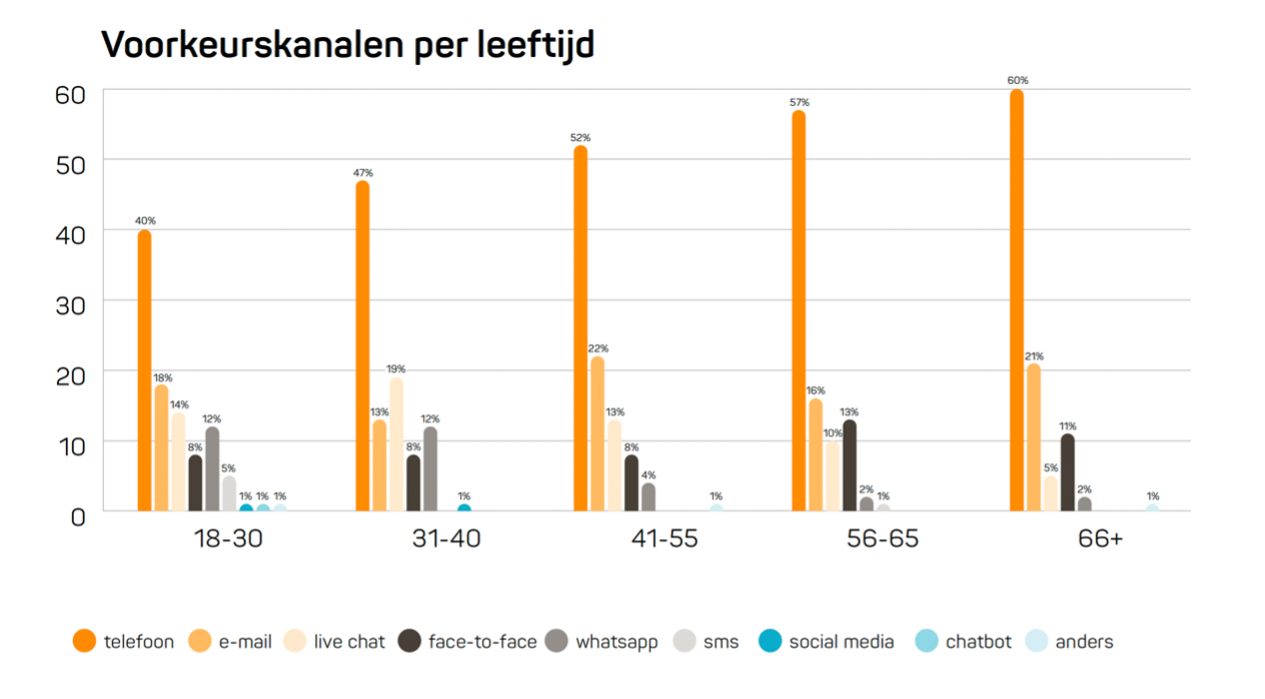
For many respondents – 51% – telephone contact remains the preferred option. In addition, 63% expect to speak to a human employee, not a voice assistant. One respondent states: “I prefer telephone, because I can ask my questions directly and also get a quick answer. The employee must be competent.”
About one in five prefers e-mail, because of its clarity and ease of use. For example, one respondent says that e-mail gives the opportunity to think about the question in peace. It also allows the consumer to respond when it suits them and gives the other party time to figure it out. “And everything is immediately in black and white.”
The preference for live chat is increasing: where in 2023 10% still preferred this, that is now 12%. Just like with telephony, with live chat people appreciate that there is direct contact with an employee. Consumers also like that they respond quickly.
Channel preference by sector
It is striking that the preference for specific channels depends strongly on the sector. Although telephone contact is the most preferred in all sectors, consumers choose e-mail just as often when contacting online retailers and delivery services.
“When the consequences of doing something wrong are greater, consumers still want that human touch. And that also applies when the question is more complex,” says Jan Lyckle Bijlsma from Y.Digital during the presentation of the results. Governments, banks, insurers and healthcare organizations therefore have a greater need for telephone or face-to-face contact.
According to Roel Masselink of the Customer Service Federation, it is extremely important that companies think carefully about who they are creating a solution with automated customer service for. “I truly believe that there is no one size fits all,” he states. “Ultimately, it is all about keeping the customer satisfied and helping them with their question. But no customer is the same, no organization is the same and even within organizations no process is the same. So if you use one chatbot, there is a big chance that a customer will have a negative experience. As an organization, you really have to think: who are we going to come up with a solution for? It starts with the strategy and the vision you have to help your customer.”
Ten golden rules
The National Voice Monitor has drawn up ten golden rules for automated customer contact to support this. For example, transparency is important – where does the information provided come from? – and a good handover. “Consumers feel more comfortable with automated customer contact if they know they can easily switch to an employee,” according to the report. Furthermore, things like understanding, a good handover, a written summary of the conversation for reference, efficiency and a simple way to give feedback are important.
The report can be viewed at nationalevoicemonitor.nl
(Ziptone/Eveline Meijer)


Also interesting
-

73% of consumers miss human contact, but 51% would rather have quick contact with a chatbot than have to wait…
-

Nadella names three challenges for AI to land successfully, including viewing AI not as a replacement, but as an enhancer…
-

Perhaps sustainable engagement does not start with inspiring promises, but with an honest sentence at the beginning.